17 October 2013

Rapid prototyping of a read-only Lims using JSON and Apache Velocity.

In a previous post, I showed how to use the Apache Velocity template engine to format JSON data.


Since that post, I've moved my application to a github repository: https://github.com/lindenb/jsvelocity. The project contains a java-based standalone tool to process the JSON data.
Here is an example: The JSON data:

{
individuals:[
    {
    name: "Riri",
    age: 8,
    duck: true
    },
    {
    name: "Fifi",
    age: 9,
    duck: true
    },
    {
    name: "Loulou",
    age: 10,
    duck: true
    }
    ]
}
.... and the velocity template:
#foreach($indi in ${all.individuals})
<h1>${indi['name']}</h1>
Age:${indi.age}<br/>${indi.duck}
#end
... with the following command line ...
$ java -jar dist/jsvelocity.jar \
    -f all test.json \
    test.vm
... produces the following output ...
<h1>Riri</h1>
Age:8<br/>true
<h1>Fifi</h1>
Age:9<br/>true
<h1>Loulou</h1>
Age:10<br/>true


Today I wrote a web version of the tool using the jetty server. I wanted to quickly write a web interface to display various summaries for our NGS experiments.
My JSON input looks like this:
{
"sequencer":[
 {
 "name":"HiSeq"
 },
 {
 "name":"MiSeq"
 }
 ],
"run":[ {
 "sequencer":"HiSeq",
 "flowcell":"C2AVTACXX",
 "name":"131010_C2AVTACXX_61",
 "date":"2013-10-10",
 "comment":"A comment",
 "samples":[
  {
  "name":"CD0001",
  "meancov": 10
  },
  {
  "name":"CD0002",
  "meancov": 20.0
  }
  ,
  {
  "name":"CD0003",
  "meancov": 30.0
  }
  ]
 },
 {
 "sequencer":"MiSeq",
 "flowcell":"C3VATACYY",
 "name":"131011_C3VATACYY_62",
 "date":"2013-10-11",
 "comment":"Another comment",
 "samples":[
  {
  "name":"CD0001",
  "meancov": 11
  },
  {
  "name":"CD0006",
  "meancov": 21.0
  }
  ,
  {
  "name":"CD0008",
  "meancov": null
  }
  ]
 },
 {
 "sequencer":"MiSeq",
 "flowcell":"C4VATACYZ",
 "name":"131012_C4VATACYZ_63",
 "date":"2013-10-12",
 "comment":"Another comment",
 "samples":[
  {
  "name":"CD0010",
  "meancov":1,
  "comment":"Failed, please, re-sequence"
  }
  ]
 }
 
 
 ],
"samples":[ 
 { "name":"CD0001" },
 { "name":"CD0002" },
 { "name":"CD0003" }, 
 { "name":"CD0004" }, 
 { "name":"CD0005" }, 
 { "name":"CD0006" }, 
 { "name":"CD0007" }, 
 { "name":"CD0008" },
 { "name":"CD0009" },
 { "name":"CD0010" }
 ],
"projects":[
 {
 "name":"Disease1",
 "description": "sequencing Project 1",
 "samples":["CD0001","CD0002","CD0006","CD0009"]
 },
 {
 "name":"Disease2",
 "description": "sequencing Project 2",
 "samples":["CD0002","CD0003","CD0008","CD0009"]
 }
 ]

}
One velocity template is used to browse this 'database': https://github.com/lindenb/jsvelocity/blob/master/src/test/resources/velocity/lims.vm.
The server is started like:
java -jar dist/webjsvelocity.jar  \
    -F lims src/test/resources/json/lims.json \
    src/test/resources/velocity/lims.vm

2013-10-17 12:43:35.566:INFO:oejs.Server:main: jetty-9.1.0.M0
2013-10-17 12:43:35.602:INFO:oejs.ServerConnector:main: Started ServerConnector@72dcb6{HTTP/1.1}{0.0.0.0:8080}
(...)
And here is a screenshot of the result:


That's it,

Pierre

15 October 2013

GNU parallel for #bioinformatics : my notebook

This notebook about GNU parallel follows Ole Tange’s GNU parallel tutorial ( http://www.gnu.org/software/parallel/parallel_tutorial.html ) but I tried to use some bioinformatics-related examples (align with BWA, Samtools, etc.. ).


That's it,
Pierre

07 October 2013

Software Environment Management with Modules: my notebook


The following question was recently asked on Biostar "Bioinformatics: how to version control small scripts located all over the server". I suggested to put the scripts in a central repository (under git or whatever ) and to use symbolic links in the workspaces to manage the files. On the other hand, Alex Reynolds suggested to use a Module to deploy versions of a given package.

http://modules.sourceforge.net/: " The Environment Modules package provides for the dynamic modification of a user's environment via modulefiles. Each modulefile contains the information needed to configure the shell for an application. Once the Modules package is initialized, the environment can be modified on a per-module basis using the module command which interprets modulefiles. Typically modulefiles instruct the module command to alter or set shell environment variables such as PATH, MANPATH, etc. modulefiles may be shared by many users on a system and users may have their own collection to supplement or replace the shared modulefiles."


This tool was also suggested on cited by Lex Nederbragt on twitter:


I've just played with Modules, here is my (short) experience.

I've got two versions of samtools on my server : 0.1.18 and 0.1.19, I want to easily switch from one version to another.

I created a hidden directory in my home:
mkdir ~/.modules
it contains a directory "samtools" that will contain the two 'modules files' for the two versions of samtools:
mkdir ~/.modules/samtools

The directory '~/.modules' is added to the variable ${MODULESPATH} ( The path that the module command searches when looking for modulefiles )
$ export MODULEPATH=${MODULEPATH}:${HOME}/.modules

Create the Module File '${HOME}/.modules/samtools/0.1.18' for samtools 0.1.18: This module file add the PATH to samtools0.1.18 and bcftools0.1.18
#%Module1.0

proc ModulesHelp { } {
global dotversion
puts stderr "\tSamtools"
}

module-whatis "Samtools 0.1.18" 
prepend-path PATH /commun/data/packages/samtools-0.1.18/
prepend-path PATH /commun/data/packages/samtools-0.1.18/bcftools

Create the Module File '${HOME}/.modules/samtools/0.1.19' for samtools 0.1.19: This module file add the PATH to samtools0.1.19 and bcftools0.1.19
#%Module1.0

proc ModulesHelp { } {
global dotversion
puts stderr "\tSamtools"
}

module-whatis "Samtools 0.1.19" 
prepend-path PATH /commun/data/packages/samtools-0.1.19/
prepend-path PATH /commun/data/packages/samtools-0.1.19/bcftools

We also create a file '${HOME}/.modules/samtools/.version' to define the default version of samtools:
#%Module1.0
set ModulesVersion "0.1.19"

On startup the shell doesn't know samtools or bcftools:
$ which samtools
/usr/bin/which: no samtools in (/commun/sge_root/bin/lx24-amd64:/usr/lib64/qt-3.3/bin:/usr/local/bin:/bin:/usr/bin:/usr/local/sbin:/usr/sbin:/sbin:/home/lindenb/bin)

$ which bcftools
/usr/bin/which: no bcftools in (/commun/sge_root/bin/lx24-amd64:/usr/lib64/qt-3.3/bin:/usr/local/bin:/bin:/usr/bin:/usr/local/sbin:/usr/sbin:/sbin:/home/lindenb/bin)
List the available modules :
$ module avail                                                                                                

------------------------------------------------ /usr/share/Modules/modulefiles ------------------------------------------------
dot           module-cvs    module-info   modules       mpich2-x86_64 null          use.own

---------------------------------------------------- /home/lindenb/.modules ----------------------------------------------------
samtools/0.1.18          samtools/0.1.19(default)
Let's load the default configuration for samtools:
$ module load samtools

now, the shell know the PATH to samtools:

$ which samtools
/commun/data/packages/samtools-0.1.19/samtools
$ which bcftools
/commun/data/packages/samtools-0.1.19/bcftools/bcftools

Unload the module for samtools:
$ module unload samtools
$ which samtools
/usr/bin/which: no samtools in (/commun/sge_root/bin/lx24-amd64:/usr/lib64/qt-3.3/bin:/usr/local/bin:/bin:/usr/bin:/usr/local/sbin:/usr/sbin:/sbin:/home/lindenb/bin)

$ which bcftools
/usr/bin/which: no bcftools in (/commun/sge_root/bin/lx24-amd64:/usr/lib64/qt-3.3/bin:/usr/local/bin:/bin:/usr/bin:/usr/local/sbin:/usr/sbin:/sbin:/home/lindenb/bin)

Now load the (old) version 0.1.18 of samtools
$ module load samtools/0.1.18

The old versions of samtools and bcftools are now in the $PATH:
$ which samtools
/commun/data/packages/samtools-0.1.18/samtools

$ which bcftools
/commun/data/packages/samtools-0.1.18/bcftools/bcftools
That's it,

Pierre

26 September 2013

Presentation : File formats for Next Generation Sequencing

Here is my presentation for the course "File formats for Next Generation Sequencing", I gave monday at the University of Nantes.

Presentation: Advanced NCBI

Here is my presentation for the course "Advanced NCBI", I gave yesterday at the University of Nantes.


10 September 2013

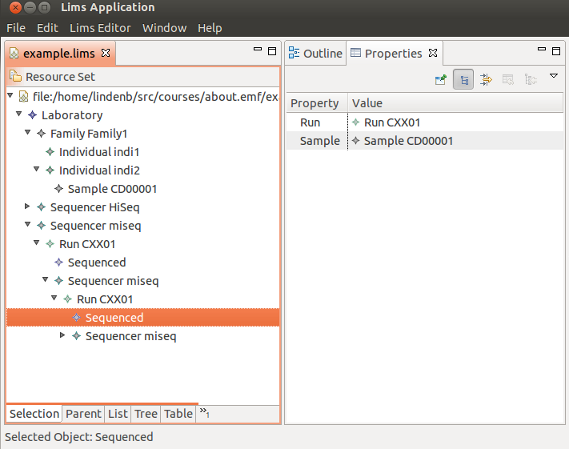
Building a simple & stupid LIMS with the Eclipse Modeling Framework (#EMF), my notebook.

I played with the Eclipse Modeling Framework (EMF) and created a simple interface to manage a list of sequenced samples.


I've uploaded my notes on slideshare:


That's it,

Pierre

26 July 2013

g1kv37 vs hg19

In order to create a class to translate the chromosome names from one naming convention to another. I've compared the MD5 sums of the human genome versions g1k/v37 and ucsc/hg19. Here is the java program to create the MD5s:

The MD5 sums were extracted as follow:


Here are the common chromosomes, joined on the hash-sum:


And here are the unpairable data:


I knew the problem for chrY ( http://www.biostars.org/p/58143/) but not for chr3.. What is the problem for this chromosome ?

Edit: Here are the number of bases for UCSC/chr3:

{T=58760485, G=38670110, A=58713343, C=38653197, N=3225295}
and for g1kv37:
{T=58760485, G=38670110, A=58713343, R=2, C=38653197, M=1, N=3225292}

That's it,


Pierre.

18 July 2013

Running a picard tool in the #KNIME workflow engine

http://www.knime.org/ is "a user-friendly graphical workbench for the entire analysis process: data access, data transformation, initial investigation, powerful predictive analytics, visualisation and reporting". In this post, I'll show how to invoke an external java program, and more precisely a tool from the picard library from with knime. The workflow: load a list of BAM filenames, invoke SortSam and display the names of the sorted files.

Construct the following workflow:


Edit the FileReader node and load a list of paths to the BAMs


Edit the properties of the java node, in the "Additional Libraries" tab, load the jar of SortSam.jar


Edit the java snippet node, create a new column SORTED_BAM for the output.


and copy the following code:

// Your custom imports:
import net.sf.picard.sam.SortSam;
import java.io.File;
----------------------------------------------------------
// Enter your code here:


File input=new File(c_BAM);

//build the output filename 
out_SORTED = input.getName();
if(!(out_SORTED.endsWith(".sam") || out_SORTED.endsWith(".bam")))
{
 throw new Abort("not a SAM/BAM :"+c_BAM);
}
int dot=out_SORTED.lastIndexOf('.');
out_SORTED=new File(input.getParentFile(),out_SORTED.substring(0, dot)+"_sorted.bam").getPath();

//create a new instance of SortSam
SortSam cmd=new SortSam();

//invoke the instance
int ret=cmd.instanceMain(new String[]{
 "I="+input.getPath(),
 "O="+out_SORTED,
 "SO=coordinate",
 "VALIDATION_STRINGENCY=LENIENT",
 "CREATE_INDEX=true",
 "MAX_RECORDS_IN_RAM=500000"
 });

if(ret!=0)
{
 throw new Abort("SortSam failed with: "+c_BAM+" "+out_SORTED);
}
Execute KNIME, picard runs the job, and get the names of the sorted BAMs:


Edit:

The workflow was uplodaded on MyExperiment at http://www.myexperiment.org/workflows/3654.html.


That's it,

Pierre


Inside the Variation toolkit: annotating a VCF with the data of NCBI biosystems mapped to BED.

Let's annotate a VCF file with the data from the NCBI biosystem.

First the 'NCBI biosystem' data are mapped to a BED file using the following script. It joins "ncbi;biosystem2gene", "ncbi:biosystem-label" and "biomart-ensembl:gene"


It produces a tabix-inded BED mapping the data of 'NCBI biosystem':

$ gunzip -c ncbibiosystem.bed.gz | head
1 69091 70008 79501 106356 30 Signaling_by_GPCR
1 69091 70008 79501 106383 50 Olfactory_Signaling_Pathway
1 69091 70008 79501 119548 40 GPCR_downstream_signaling
1 69091 70008 79501 477114 30 Signal_Transduction
1 69091 70008 79501 498 40 Olfactory_transduction
1 69091 70008 79501 83087 60 Olfactory_transduction
1 367640 368634 26683 106356 30 Signaling_by_GPCR
1 367640 368634 26683 106383 50 Olfactory_Signaling_Pathway
1 367640 368634 26683 119548 40 GPCR_downstream_signaling
1 367640 368634 26683 477114 30 Signal_Transduction

I wrote a tool named VCFBed: it takes as input a VCF and annotate it with the data of a tabix-ed BED. This tool is available on github at https://github.com/lindenb/jvarkit#vcfbed. Let's annotate a remote VCF with ncbibiosystem.bed.gz :
java -jar dist/vcfbed.jar \
   TABIXFILE=~/ncbibiosystem.bed.gz \
   TAG=NCBIBIOSYS \
   FMT='($4|$5|$6|$7)'|\
grep -E '(^#CHR|NCBI)'

##INFO=<ID=NCBIBIOSYS,Number=.,Type=String,Description="metadata added from /home/lindenb/ncbibiosystem.bed.gz . Format was ($4|$5|$6|$7)">
#CHROM POS ID REF ALT QUAL FILTER INFO FORMAT 1094PC0005 1094PC0009 1094PC0012 1094PC0013
1 69270 . A G 2694.18 . AC=40;AF=1.000;AN=40;DP=83;Dels=0.00;EFF=SYNONYMOUS_CODING(LOW|SILENT|tcA/tcG|S60|305|OR4F5|protein_coding|CODING|ENST00000335137|exon_1_69091_70008);FS=0.000;HRun=0;HaplotypeScore=0.0000;InbreedingCoeff=-0.0598;MQ=31.06;MQ0=0;NCBIBIOSYS=(79501|119548|40|GPCR_downstream_signaling),(79501|106356|30|Signaling_by_GPCR),(79501|498|40|Olfactory_transduction),(79501|83087|60|Olfactory_transduction),(79501|477114|30|Signal_Transduction),(79501|106383|50|Olfactory_Signaling_Pathway);QD=32.86 GT:AD:DP:GQ:PL ./. ./. 1/1:0,3:3:9.03:106,9,0 1/1:0,6:6:18.05:203,18,0
1 69511 . A G 77777.27 . AC=49;AF=0.875;AN=56;BaseQRankSum=0.150;DP=2816;DS;Dels=0.00;EFF=NON_SYNONYMOUS_CODING(MODERATE|MISSENSE|Aca/Gca|T141A|305|OR4F5|protein_coding|CODING|ENST00000335137|exon_1_69091_70008);FS=21.286;HRun=0;HaplotypeScore=3.8956;InbreedingCoeff=0.0604;MQ=32.32;MQ0=0;MQRankSum=1.653;NCBIBIOSYS=(79501|119548|40|GPCR_downstream_signaling),(79501|106356|30|Signaling_by_GPCR),(79501|498|40|Olfactory_transduction),(79501|83087|60|Olfactory_transduction),(79501|477114|30|Signal_Transduction),(79501|106383|50|Olfactory_Signaling_Pathway);QD=27.68;ReadPosRankSum=2.261 GT:AD:DP:GQ:PL ./. ./. 0/1:2,4:6:15.70:16,0,40 0/1:2,2:4:21.59:22,0,40

That's it,

Pierre

15 July 2013

Playing with the "UCSC Genome Browser Track Hubs". my notebook

The UCSC has recently created the Genome Browser Track Hubs: " Track hubs are web-accessible directories of genomic data that can be viewed on the UCSC Genome Browser. ". I've created a Hub for the Rotavirus Genome hosted on github at:https://github.com/lindenb/genomehub.
My data were primarily described as a XML file. It contains a description of the genome, of the tracks, the path to the fasta sequence etc... The FASTA sequence was provided by Dr Didier Poncet (CNRS/Gig). As far as I understand, it is not currently possible to specify that a track describes a protein.

<?xml version="1.0" encoding="UTF-8"?>
<genomeHub >
  <name>Rotavirus</name>
  <shortLabel>Rotavirus</shortLabel>
  <longLabel>Rotavirus</longLabel>
  (...)
  <accessions id="set1">
   <acn>GU144588</acn>
 <acn source="uniprot">Q0H8C5</acn>
 <acn source="uniprot">Q45UF6</acn>
 (..)
  <genome id="rf11">
    <description>Rotavirus RF11</description>
    <organism>Rotavirus</organism>
    <defaultPos>RF01:1-10</defaultPos>
    <scientificName>Rotavirus</scientificName>
    <organism>Rotavirus</organism>
    <orderKey>10970</orderKey>
    <fasta>rotavirus/rf/rf.fa</fasta>
     (...)
 <group id="active_site"><accessions ref="set1"/><include>active site</include></group>
 <group id="calcium-binding_region"><accessions ref="set1"/><include>calcium-binding region</include></group>
 <group id="chain"><accessions ref="set1"/><include>chain</include></group>
   (...)
This XML file is then processed with the following xsl stylsheet: https://github.com/lindenb/genomehub/blob/master/data/genomehub.xml : it generates a Makefile that will translate the fasta sequence to 2bit, create the bed files by aligning some annotated files to the reference with blast and convert them to bigbed.
At the end, my directory contains the following files:
./data/genomehub.xml
./data/genomehub2make.xsl
./data/sequence2fasta.xsl
./data/hub.txt
./data/genomes.txt
./data/rotavirus
./data/rotavirus/rf
./data/rotavirus/rf/signal_peptide.bed
./data/rotavirus/rf/CDS.bed
./data/rotavirus/rf/turn.bb
./data/rotavirus/rf/chrom.sizes
./data/rotavirus/rf/site.bed
./data/rotavirus/rf/coiled-coil_region.bed
./data/rotavirus/rf/mutagenesis_site.bb
./data/rotavirus/rf/UTR.bed
./data/rotavirus/rf/reference.fa~
./data/rotavirus/rf/misc_feature.bed
./data/rotavirus/rf/CDS.bb
./data/rotavirus/rf/helix.bed
./data/rotavirus/rf/strand.bb
./data/rotavirus/rf/sequence_conflict.bb
./data/rotavirus/rf/modified_residue.bb
./data/rotavirus/rf/coiled-coil_region.bb
./data/rotavirus/rf/topological_domain.bb
./data/rotavirus/rf/active_site.bed
./data/rotavirus/rf/sequence_variant.bb
./data/rotavirus/rf/transmembrane_region.bb
./data/rotavirus/rf/zinc_finger_region.bed
./data/rotavirus/rf/region_of_interest.bb
./data/rotavirus/rf/glycosylation_site.bb
./data/rotavirus/rf/domain.bb
./data/rotavirus/rf/region_of_interest.bed
./data/rotavirus/rf/misc_feature.bb
./data/rotavirus/rf/topological_domain.bed
./data/rotavirus/rf/sequence_conflict.bed
./data/rotavirus/rf/UTR.bb
./data/rotavirus/rf/compositionally_biased_region.bed
./data/rotavirus/rf/chain.bed
./data/rotavirus/rf/glycosylation_site.bed
./data/rotavirus/rf/trackDb.txt
./data/rotavirus/rf/modified_residue.bed
./data/rotavirus/rf/disulfide_bond.bed
./data/rotavirus/rf/strand.bed
./data/rotavirus/rf/helix.bb
./data/rotavirus/rf/compositionally_biased_region.bb
./data/rotavirus/rf/transmembrane_region.bed
./data/rotavirus/rf/rf.fa
./data/rotavirus/rf/rf.2bit
./data/rotavirus/rf/splice_variant.bed
./data/rotavirus/rf/short_sequence_motif.bed
./data/rotavirus/rf/rf.fa.nsq
./data/rotavirus/rf/ALL.bed.blast.xml~
./data/rotavirus/rf/gene.bed
./data/rotavirus/rf/sequence_variant.bed
./data/rotavirus/rf/disulfide_bond.bb
./data/rotavirus/rf/signal_peptide.bb
./data/rotavirus/rf/rf.fa.nin
./data/rotavirus/rf/short_sequence_motif.bb
./data/rotavirus/rf/turn.bed
./data/rotavirus/rf/domain.bed
./data/rotavirus/rf/mutagenesis_site.bed
./data/rotavirus/rf/zinc_finger_region.bb
./data/rotavirus/rf/chain.bb
./data/rotavirus/rf/rf.fa.nhr
./data/rotavirus/rf/splice_variant.bb
./data/rotavirus/rf/active_site.bb
./data/rotavirus/rf/site.bb
./data/rotavirus/rf/description.html
./README.md

The files required by the UCSC are then pushed on github and the URL pointing to hub.txt (https://raw.github.com/lindenb/genomehub/master/data/hub.txt) is registered at http://genome.ucsc.edu/cgi-bin/hgHubConnect. And a few clicks later...


That's it,

Pierre