Showing posts with label genomics. Show all posts

30 October 2014

Visualizing @GenomeBrowser liftOver/chain files using animated #SVG

I wrote a tool to visualize some UCSC "chain/liftOver" files as an animated SVG file. This tool is available on github at:

"A liftOver file is a chain file, where for each region in the genome the alignments of the best/longest syntenic regions are used to translate features from one version of a genome to another.".

SVG Elements and CSS styles can be animated in a SVG file (see http://www.w3.org/TR/SVG/animate.html ) using the <animate/> element.

For example the following SVG snippet

  • defines a rectangle(x=351,y=35,width=6,height=5).
  • at t=60secs the opacity will change from 0 to 0.7 for 2secs
  • the position 'x' will move from x=351 to x=350 starting at t=62secs for 16 seconds
  • the position 'y' will move from y=35 to y=36 starting at t=62secs for 16 seconds
  • the 'width' will grow from width=6 to width=100 starting at t=62secs for 16 seconds
  • at t=78secs the opacity will change from 0.7 to 0 for 2secs
<rect x="351" y="35" width="6" height="15">
        <animate attributeType="CSS" attributeName="opacity" begin="60" dur="2" from="0" to="0.7" repeatCount="1" fill="freeze"/>
        <animate attributeType="XML" attributeName="x" begin="62" dur="16" from="351" to="350" repeatCount="1" fill="freeze"/>
        <animate attributeType="XML" attributeName="y" begin="62" dur="16" from="35" to="36" repeatCount="1" fill="freeze"/>
        <animate attributeType="XML" attributeName="width" begin="62" dur="16" from="6" to="100" repeatCount="1" fill="freeze"/>
        <animate attributeType="CSS" attributeName="opacity" begin="78" dur="2" from="0.7" to="0" repeatCount="1" fill="freeze"/>
</rect>

A demo hg16-hg17-hg18-hg19-hg38 was posted here: http://cardioserve.nantes.inserm.fr/~lindenb/liftover2svg/hg16ToHg38.svg


That's it,

Pierre.

16 October 2014

IGVFox: Integrative Genomics Viewer control through mozilla Firefox

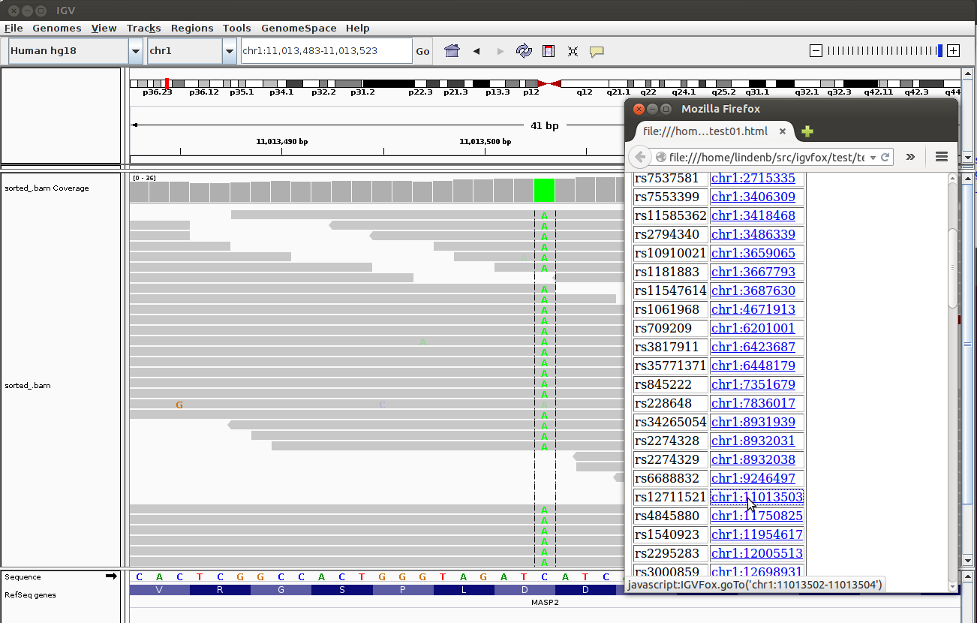
I've just pushed IGVFox 0.1 an add-on for Firefox, controlling IGV, the Integrative Genomics Viewer.
This add-on allows the users to set the genomic position of IGV by just clicking a hyperlink in a HTML page. The source code is available on github at https://github.com/lindenb/igvfox and a first release is available as a *.xpi file at https://github.com/lindenb/igvfox/releases.


That's it,

Pierre

15 July 2013

Playing with the "UCSC Genome Browser Track Hubs". my notebook

The UCSC has recently created the Genome Browser Track Hubs: " Track hubs are web-accessible directories of genomic data that can be viewed on the UCSC Genome Browser. ". I've created a Hub for the Rotavirus Genome hosted on github at:https://github.com/lindenb/genomehub.
My data were primarily described as a XML file. It contains a description of the genome, of the tracks, the path to the fasta sequence etc... The FASTA sequence was provided by Dr Didier Poncet (CNRS/Gig). As far as I understand, it is not currently possible to specify that a track describes a protein.

<?xml version="1.0" encoding="UTF-8"?>
<genomeHub >
  <name>Rotavirus</name>
  <shortLabel>Rotavirus</shortLabel>
  <longLabel>Rotavirus</longLabel>
  (...)
  <accessions id="set1">
   <acn>GU144588</acn>
 <acn source="uniprot">Q0H8C5</acn>
 <acn source="uniprot">Q45UF6</acn>
 (..)
  <genome id="rf11">
    <description>Rotavirus RF11</description>
    <organism>Rotavirus</organism>
    <defaultPos>RF01:1-10</defaultPos>
    <scientificName>Rotavirus</scientificName>
    <organism>Rotavirus</organism>
    <orderKey>10970</orderKey>
    <fasta>rotavirus/rf/rf.fa</fasta>
     (...)
 <group id="active_site"><accessions ref="set1"/><include>active site</include></group>
 <group id="calcium-binding_region"><accessions ref="set1"/><include>calcium-binding region</include></group>
 <group id="chain"><accessions ref="set1"/><include>chain</include></group>
   (...)
This XML file is then processed with the following xsl stylsheet: https://github.com/lindenb/genomehub/blob/master/data/genomehub.xml : it generates a Makefile that will translate the fasta sequence to 2bit, create the bed files by aligning some annotated files to the reference with blast and convert them to bigbed.
At the end, my directory contains the following files:
./data/genomehub.xml
./data/genomehub2make.xsl
./data/sequence2fasta.xsl
./data/hub.txt
./data/genomes.txt
./data/rotavirus
./data/rotavirus/rf
./data/rotavirus/rf/signal_peptide.bed
./data/rotavirus/rf/CDS.bed
./data/rotavirus/rf/turn.bb
./data/rotavirus/rf/chrom.sizes
./data/rotavirus/rf/site.bed
./data/rotavirus/rf/coiled-coil_region.bed
./data/rotavirus/rf/mutagenesis_site.bb
./data/rotavirus/rf/UTR.bed
./data/rotavirus/rf/reference.fa~
./data/rotavirus/rf/misc_feature.bed
./data/rotavirus/rf/CDS.bb
./data/rotavirus/rf/helix.bed
./data/rotavirus/rf/strand.bb
./data/rotavirus/rf/sequence_conflict.bb
./data/rotavirus/rf/modified_residue.bb
./data/rotavirus/rf/coiled-coil_region.bb
./data/rotavirus/rf/topological_domain.bb
./data/rotavirus/rf/active_site.bed
./data/rotavirus/rf/sequence_variant.bb
./data/rotavirus/rf/transmembrane_region.bb
./data/rotavirus/rf/zinc_finger_region.bed
./data/rotavirus/rf/region_of_interest.bb
./data/rotavirus/rf/glycosylation_site.bb
./data/rotavirus/rf/domain.bb
./data/rotavirus/rf/region_of_interest.bed
./data/rotavirus/rf/misc_feature.bb
./data/rotavirus/rf/topological_domain.bed
./data/rotavirus/rf/sequence_conflict.bed
./data/rotavirus/rf/UTR.bb
./data/rotavirus/rf/compositionally_biased_region.bed
./data/rotavirus/rf/chain.bed
./data/rotavirus/rf/glycosylation_site.bed
./data/rotavirus/rf/trackDb.txt
./data/rotavirus/rf/modified_residue.bed
./data/rotavirus/rf/disulfide_bond.bed
./data/rotavirus/rf/strand.bed
./data/rotavirus/rf/helix.bb
./data/rotavirus/rf/compositionally_biased_region.bb
./data/rotavirus/rf/transmembrane_region.bed
./data/rotavirus/rf/rf.fa
./data/rotavirus/rf/rf.2bit
./data/rotavirus/rf/splice_variant.bed
./data/rotavirus/rf/short_sequence_motif.bed
./data/rotavirus/rf/rf.fa.nsq
./data/rotavirus/rf/ALL.bed.blast.xml~
./data/rotavirus/rf/gene.bed
./data/rotavirus/rf/sequence_variant.bed
./data/rotavirus/rf/disulfide_bond.bb
./data/rotavirus/rf/signal_peptide.bb
./data/rotavirus/rf/rf.fa.nin
./data/rotavirus/rf/short_sequence_motif.bb
./data/rotavirus/rf/turn.bed
./data/rotavirus/rf/domain.bed
./data/rotavirus/rf/mutagenesis_site.bed
./data/rotavirus/rf/zinc_finger_region.bb
./data/rotavirus/rf/chain.bb
./data/rotavirus/rf/rf.fa.nhr
./data/rotavirus/rf/splice_variant.bb
./data/rotavirus/rf/active_site.bb
./data/rotavirus/rf/site.bb
./data/rotavirus/rf/description.html
./README.md

The files required by the UCSC are then pushed on github and the URL pointing to hub.txt (https://raw.github.com/lindenb/genomehub/master/data/hub.txt) is registered at http://genome.ucsc.edu/cgi-bin/hgHubConnect. And a few clicks later...


That's it,

Pierre


16 November 2011

"VCF annotation" with the NHLBI GO Exome Sequencing Project (JAX-WS)

The NHLBI Exome Sequencing Project (ESP) has released a web service to query their data. "The goal of the NHLBI GO Exome Sequencing Project (ESP) is to discover novel genes and mechanisms contributing to heart, lung and blood disorders by pioneering the application of next-generation sequencing of the protein coding regions of the human genome across diverse, richly-phenotyped populations and to share these datasets and findings with the scientific community to extend and enrich the diagnosis, management and treatment of heart, lung and blood disorders.".
In the current post, I'll show how I've used this web service to annotate a VCF file with this information.
The web service provided by the ESP is based on the SOAP protocol.
Here is an example of the XML response: We can generate the java classes for a client invoking this Web Service by using ${JAVA_HOME}/bin/wsimport.

$ wsimport -keep "http://evs.gs.washington.edu/wsEVS/EVSDataQueryService?wsdl"

parsing WSDL...
generating code...
compiling code...

Here is the java code running this client. It scans the VCF, calls the webservice for each variation and insert the annotation as JSON in a new column .
... and the makefile:

Result (some columns have been cut)

curl -s "ftp://ftp.1000genomes.ebi.ac.uk/vol1/ftp/release/20100804/supporting/EUR.2of4intersection_allele_freq.20100804.sites.vcf.gz" |\
 gunzip -c |\
 java -jar evsclient.jar 


##fileformat=VCFv4.0
##filedat=20101112
##datarelease=20100804
##samples=629
##description="Where BI calls are present, genotypes and alleles are from BI.  In there absence, UM genotypes are used.  If neither are available, no genotype information is present and the alleles are from the NCBI calls."
(...)
#CHROM POS ID EVS
1 10469 rs117577454 {"start":10469,"chromosome":"1","stop":10470,"strand":"+","snpList":[],"setOfSiteCoverageInfo":[]}
1 10583 rs58108140 {"start":10583,"chromosome":"1","stop":10584,"strand":"+","snpList":[],"setOfSiteCoverageInfo":[]}
1 11508 . {"start":11508,"chromosome":"1","stop":11509,"strand":"
(...)
1 69511 . {"start":69511,"chromosome":"1","stop":69512,"strand":"+","snpList":[{"chromosome":"1","conservationScore":"1.0","conservationScoreGERP":"0.5","refAllele":"A","ancestralAllele":"G","filters":"PASS","clinicalLink":"unknown","positionString":"1:69511","chrPosition":69511,"alleles":"G/A","uaAlleleCounts":"1373/47","aaAlleleCounts":"880/600","totalAlleleCounts":"2253/647","uaAlleleAndCount":"G=1373/A=47","aaAlleleAndCount":"G=880/A=600","totalAlleleAndCount":"G=2253/A=647","uaMAF":3.3099,"aaMAF":40.5405,"totalMAF":22.3103,"avgSampleReadDepth":185,"geneList":"OR4F5","snpFunction":{"chromosome":"1","position":69511,"conservationScore":"1.0","conservationScoreGERP":"0.5","snpFxnList":[{"mrnaAccession":"NM_001005484","fxnClassGVS":"missense","aminoAcids":"THR,ALA","proteinPos":"141/306","cdnaPos":421,"pphPrediction":"benign","granthamScore":"58"}],"refAllele":"A","ancestralAllele":"G","firstRsId":75062661,"secondRsId":0,"filters":"PASS","clinicalLink":"unknown"},"altAlleles":"G","hasAtLeastOneAccession":"true","rsIds":"rs75062661"}],"setOfSiteCoverageInfo":[{"chromosome":"1","position":69511,"avgSampleReadDepth":185.0,"totalSamplesCovered":1452,"eaSamplesCovered":712,"avgEaSampleReadDepth":157.0,"aaSamplesCovered":740,"avgAaSampleReadDepth":211.0},{"chromosome":"1","position":69512,"avgSampleReadDepth":180.0,"totalSamplesCovered":1501,"eaSamplesCovered":739,"avgEaSampleReadDepth":153.0,"aaSamplesCovered":762,"avgAaSampleReadDepth":207.0}]}
(...)
1 901923 . {"start":901923,"chromosome":"1","stop":901924,"strand":"+","snpList":[{"chromosome":"1","conservationScore":"1.0","conservationScoreGERP":"5.0","refAllele":"C","ancestralAllele":"C","filters":"PASS","clinicalLink":"unknown","positionString":"1:901923","chrPosition":901923,"alleles":"A/C","uaAlleleCounts":"2/2542","aaAlleleCounts":"52/1934","totalAlleleCounts":"54/4476","uaAlleleAndCount":"A=2/C=2542","aaAlleleAndCount":"A=52/C=1934","totalAlleleAndCount":"A=54/C=4476","uaMAF":0.0786,"aaMAF":2.6183,"totalMAF":1.1921,"avgSampleReadDepth":35,"geneList":"PLEKHN1","snpFunction":{"chromosome":"1","position":901923,"conservationScore":"1.0","conservationScoreGERP":"5.0","snpFxnList":[{"mrnaAccession":"NM_032129","fxnClassGVS":"missense","aminoAcids":"SER,ARG","proteinPos":"4/612","cdnaPos":12,"pphPrediction":"probably-damaging","granthamScore":"110"}],"refAllele":"C","ancestralAllele":"C","firstRsId":0,"secondRsId":0,"filters":"PASS","clinicalLink":"unknown"},"altAlleles":"A","hasAtLeastOneAccession":"true","rsIds":"none"}],"setOfSiteCoverageInfo":[{"chromosome":"1","position":901923,"avgSampleReadDepth":35.0,"totalSamplesCovered":2280,"eaSamplesCovered":1272,"avgEaSampleReadDepth":32.0,"aaSamplesCovered":1008,"avgAaSampleReadDepth":38.0},{"chromosome":"1","position":901924,"avgSampleReadDepth":35.0,"totalSamplesCovered":2283,"eaSamplesCovered":1273,"avgEaSampleReadDepth":32.0,"aaSamplesCovered":1010,"avgAaSampleReadDepth":38.0}]}
1 902069 rs116147894 {"start":902069,"chromosome":"1","stop":902070,"strand":"+","snpList":[{"chromosome":"1","conservationScore":"0.0","conservationScoreGERP":"1.0","refAllele":"T","ancestralAllele":"T","filters":"PASS","clinicalLink":"unknown","positionString":"1:902069","chrPosition":902069,"alleles":"C/T","uaAlleleCounts":"2/320","aaAlleleCounts":"18/212","totalAlleleCounts":"20/532","uaAlleleAndCount":"C=2/T=320","aaAlleleAndCount":"C=18/T=212","totalAlleleAndCount":"C=20/T=532","uaMAF":0.6211,"aaMAF":7.8261,"totalMAF":3.6232,"avgSampleReadDepth":13,"geneList":"PLEKHN1","snpFunction":{"chromosome":"1","position":902069,"conservationScore":"0.0","conservationScoreGERP":"1.0","snpFxnList":[{"mrnaAccession":"NM_032129","fxnClassGVS":"intron","aminoAcids":"none","proteinPos":"NA","cdnaPos":-1,"pphPrediction":"unknown","granthamScore":"NA"}],"refAllele":"T","ancestralAllele":"T","firstRsId":0,"secondRsId":0,"filters":"PASS","clinicalLink":"unknown"},"altAlleles":"C","hasAtLeastOneAccession":"true","rsIds":"none"}],"setOfSiteCoverageInfo":[{"chromosome":"1","position":902069,"avgSampleReadDepth":13.0,"totalSamplesCovered":304,"eaSamplesCovered":169,"avgEaSampleReadDepth":13.0,"aaSamplesCovered":135,"avgAaSampleReadDepth":12.0},{"chromosome":"1","position":902070,"avgSampleReadDepth":12.0,"totalSamplesCovered":338,"eaSamplesCovered":190,"avgEaSampleReadDepth":13.0,"aaSamplesCovered":148,"avgAaSampleReadDepth":12.0}]}
1 902108 rs62639981 {"start":902108,"chromosome":"1","stop":902109,"strand":"+","snpList":[{"chromosome":"1","conservationScore":"0.0","conservationScoreGERP":"-8.7","refAllele":"C","ancestralAllele":"unknown","filters":"PASS","clinicalLink":"unknown","positionString":"1:902108","chrPosition":902108,"alleles":"T/C","uaAlleleCounts":"5/333","aaAlleleCounts":"0/248","totalAlleleCounts":"5/581","uaAlleleAndCount":"T=5/C=333","aaAlleleAndCount":"T=0/C=248","totalAlleleAndCount":"T=5/C=581","uaMAF":1.4793,"aaMAF":0.0,"totalMAF":0.8532,"avgSampleReadDepth":13,"geneList":"PLEKHN1","snpFunction":{"chromosome":"1","position":902108,"conservationScore":"0.0","conservationScoreGERP":"-8.7","snpFxnList":[{"mrnaAccession":"NM_032129","fxnClassGVS":"coding-synonymous","aminoAcids":"none","proteinPos":"36/612","cdnaPos":108,"pphPrediction":"unknown","granthamScore":"NA"}],"refAllele":"C","ancestralAllele":"unknown","firstRsId":62639981,"secondRsId":0,"filters":"PASS","clinicalLink":"unknown"},"altAlleles":"T","hasAtLeastOneAccession":"true","rsIds":"rs62639981"}],"setOfSiteCoverageInfo":[{"chromosome":"1","position":902108,"avgSampleReadDepth":13.0,"totalSamplesCovered":294,"eaSamplesCovered":170,"avgEaSampleReadDepth":13.0,"aaSamplesCovered":124,"avgAaSampleReadDepth":13.0},{"chromosome":"1","position":902109,"avgSampleReadDepth":13.0,"totalSamplesCovered":309,"eaSamplesCovered":177,"avgEaSampleReadDepth":13.0,"aaSamplesCovered":132,"avgAaSampleReadDepth":13.0}]}
(...)
That's it
Pierre

26 September 2011

PostScript as a Programming Language for Bioinformatics: mynotebook

"PostScript (PS) is an interpreted, stack-based programming language. It is best known for its use as a page description language in the electronic and desktop publishing areas."[wikipedia]. In this post, I'll show how I've used to create a simple and lightweight view of the genome.

Introduction: just a simple postscript program

The following PS program fills a rectangular gray shape; You can display the result using ghostview, a2ps, etc...
%!PS
newpath
50 50 moveto
0 100 rlineto
100 0 rlineto
0 -100 rlineto
closepath
0.5 setgray
fill
showpage

Some global variables

The page width

/screenWidth 1000 def

The page width

/screenHeight 1000 def

The minimum 5' position

/minChromStart 1E9 def

The maximum 3' position

/maxChromEnd -1 def

The size of a genomic feature

/featureHeight 20 def

The distance between two 'ticks' for drawing the orientation

/ticksx 20 def

The font size

/theFontSize 9 def
The variable knownGene is a PS array of genes.

/knownGene [
[(uc002zkr.3) (chr22) (-) 161242...
...]
] def

Each Gene is a PS array holding the structure of the UCSC knownGene table, that is to say: name , chromosome, txStart, txEnd, cdsStart, cdsEnd, exonStarts, exonEnds:

[(uc002zmh.2) (chr22) (-) 17618410 17646177 17618910 17646134
   [17618410 17619439 17621948 17623987 17625913 17629337 17630431 17646098 ]
   [17619247 17619628 17622123 17624021 17626007 17629450 17630635 17646177 ]
]
. a simple command line can be used to fetch those data:
%  curl -s "http://hgdownload.cse.ucsc.edu/goldenPath/hg19/database/knownGene.txt.gz" |\
gunzip -c | grep chr22 | head -n 20 |\
awk '{printf("[(%s) (%s) (%s) %s %s %s %s [%s] [%s] ]\n",$1,$2,$3,$4,$5,$6,$7,$9,$10);}' |\
tr "," " " > result.txt 

Some utilities

converting a PS object to string

/toString
{
20 string cvs 
} bind def

Converting a string to interger (loop over each character an increase the current value)

/toInteger
{
3 dict begin
/s exch def
/i 0 def
/n 0 def
s {
  n 10 mul /n exch def
  s i get 48 sub n add /n exch def %48=ascii('0')
  i 1 add /i exch def
  } forall
n % leave n on the stack
end
} bind def

Convert a genomic position to a index on the page 'x' axis

/convertPos2pixel
{
minChromStart sub maxChromEnd minChromStart sub div screenWidth mul
} bind def

Extract the chromosome (that is to say, extract the 1st element of the current array on the stack)

/getChrom
{
1 get
} bind def

Create a hyperlink to the UCSC genome browser

/getHyperLink
{
3 dict begin
/E exch def %% END
/S exch def %% START
/C exch def %% CHROMOSOME
[ (http://genome.ucsc.edu/cgi-bin/hgTracks?position=) C (:) S toString (-) E toString (&) (&db=hg19) ] concatstringarray
end
} bind def

Paint a rectangle

/box
{
4 dict begin
/height exch def
/width exch def
/y exch def
/x exch def
x y moveto
width 0 rlineto
0 height rlineto
width -1 mul 0 rlineto
0 height -1 mul rlineto
end
} bind def

Paint a gray gradient

/gradient
{
4 dict begin
/height exch def
/width exch def
/y exch def
/x exch def
/i 0 def
height 2 div /i exch def

0 1 height 2 div {
	1 i height 2.0 div div sub setgray
	newpath
	x  
	y height 2 div i sub  add
	width
	i 2 mul
	box
	closepath
	fill
	i 1 sub /i exch def
	}for
newpath
0 setgray
0.4 setlinewidth
x y width height box
closepath
stroke
end
} bind def

Methods extracting a data about the current gene on the PS stack.

Extract the transcription start:

/getTxStart
{
3 get
} bind def

Extract the transcription end:

/getTxEnd
{
4 get
} bind def

Extract the CDS start:

/getCdsStart
{
5 get
} bind def

Extract the transcription end:

/getCdsEnd
{
6 get
} bind def

Extract the strand:

/getStrand
{
2 get (+) eq {1} {-1} ifelse
} bind def
Get the gene name

/getKgName
{
0 get
} bind def

Get the number of exons:

/getExonCount
{
7 get length
} bind def

Get the start position of the i-th exon:

/getExonStart
{
2 dict begin
/i exch def
/gene exch def
gene 7 get i get
end
} bind def

Get the end position of the i-th exon:

/getExonEnd
{
2 dict begin
/i exch def
/gene exch def
gene 8 get i get
end
} bind def

Should we draw this gene on the page ?

/isVisible
{
1 dict begin
/gene exch def
minChromStart gene getTxEnd gt 
	{
	false
	}
	{
	gene getTxStart maxChromEnd gt
		{
		false
		}
		{
		true
		}ifelse
	}ifelse
end
}bind def

Methods for an array of genes

Loop over the genes and extract the lowest 5' index:

/getMinChromStart
{
3 dict begin
/genes exch def
/pos 10E9 def
/i 0 def
genes length {
	genes i get getTxStart pos min /pos  exch def
	i 1 add /i exch def
	}repeat
pos
end
} bind def

Loop over the genes and extract the highest 3' index:

/getMaxChromEnd
{
3 dict begin
/genes exch def
/pos -1E9 def
/i 0 def
genes length {
	genes i get getTxEnd pos max /pos  exch def
	i 1 add /i exch def
	}repeat
pos
end
} bind def

Painting ONE Gene

/paintGene
{
5 dict begin
/gene exch def %% the GENE argument
/midy featureHeight 2.0 div def %the middle of the row
/x0 gene getTxStart convertPos2pixel def % 5' side of the gene in pixel
/x1 gene getTxEnd convertPos2pixel def % 3' side of the gene in pixel
/i 0 def
0.1 setlinewidth

1 0 0 setrgbcolor

newpath
x0 midy moveto
x1 midy lineto
closepath
stroke


% paint ticks
0 1 x1 x0 sub ticksx div{
	newpath
	gene getStrand 1 eq 
		{
		x0 ticksHeight sub i add midy ticksHeight add moveto
		x0 i add midy lineto
		x0 ticksHeight sub i add midy ticksHeight sub lineto
		}
	%else
		{
		x0 ticksHeight add i add midy ticksHeight add moveto
		x0 i add midy lineto
		x0 ticksHeight add i add midy ticksHeight sub lineto
		} ifelse
	stroke
	i ticksx add /i exch def
	} for

%paint Transcript start-end
0 0 1 setrgbcolor
newpath
gene getCdsStart convertPos2pixel
midy cdsHeight 2 div sub
gene getCdsEnd convertPos2pixel gene getCdsStart convertPos2pixel sub 
cdsHeight box
closepath
fill

% loop over exons
0 /i exch def
gene getExonCount
	{
	gene i getExonStart convertPos2pixel
	midy exonHeight 2 div sub
	gene i getExonEnd convertPos2pixel gene i getExonStart convertPos2pixel sub
	exonHeight gradient
	i 1 add /i exch def
	} repeat
0 setgray
gene getTxEnd convertPos2pixel 10 add midy moveto
gene getKgName show

%URL 
[ /Rect [x0 0 x1 1 add featureHeight]
/Border [1 0 0]
/Color [1 0 0]
/Action << /Subtype /URI /URI gene getChrom gene getTxStart gene getTxEnd getHyperLink  >>
/Subtype /Link
/ANN pdfmark

end
} bind def

Paint all Genes

/paintGenes
{
3 dict begin
/genes exch def %the GENE argument (an array)
/i 0 def % loop iterator
/j 0 def % row iterator


% draw 10 vertical lines
i 0 /i exch def
0 setgray
0 1 10 {
	%draw a vertical line
	screenWidth 10 div i mul 0 moveto
	screenWidth 10 div i mul screenHeight lineto
	stroke
	% print the position at the top rotate by 90°
	screenWidth 10 div i mul 10 add screenHeight 5 sub moveto
	-90 rotate
	maxChromEnd minChromStart sub i 10 div mul minChromStart add toString show
	90 rotate
	i 1 add /i exch def
	} for

0 /i exch def
genes length {
	genes i get isVisible
		{
		gsave
		0 j  featureHeight 2 add mul translate
		genes i get paintGene
		j 1 add /j exch def
		grestore
		} if
	i 1 add /i exch def
	}repeat
end
} bind def

All in one: the postscript code


Open the PS file in ghostview, evince, ...

Zooming ? Yes we can.

Ghostview has an option -Sname=string
       -Sname=string
       -sname=string
              Define  a  name  in  "systemdict"  with a given string as value.
              This is different from -d.

In my postscript file, the default values for minChromStart and maxChromEnd are overridden by the user's parameters:

systemdict /userChromStart known {
	userChromStart toInteger /minChromStart  exch def
	} if

systemdict /userChromEnd known {
	userChromEnd toInteger /maxChromEnd  exch def
	} if
That's it,

Pierre

30 March 2011

Parsing a genomic position with javacc

Parsing a genomic position (chrom:start-end) is an easy task but I've always been too lazy to create a library for this. Today I wrote a Java-CC-based parser for analyzing the various syntaxes of a genomic position. Here is the grammar I used:

COMMA: ","
LETTER: (["a"-"z"]|["A"-"Z"]|"_") ;
DIGIT: ["0"-"9"];
INT:<DIGIT> ( (<DIGIT>|<COMMA>)* <DIGIT>)? ;
BP: "b" ("p")? ;
KB: ("k") ("B")? ;
MB: ("m") ("B")? ;
GB: ("g") ("B")? ;
IDENTIFIER: <LETTER> (<DIGIT>|<LETTER>)* ;
COLON: ":" ;
DASH: "-" ;
PLUS: "+" ;
DELIM: ("|"|";") ;


java.util.List<Segment> many(): segment() ((<DELIM>)? segment() )* )? <EOF>);
Segment one(): segment() <EOF>;
Segment segment(): chromName() <COLON> position() (<DASH> position()| <PLUS> position())? );
BigInteger position():integer() (factor())?;
BigInteger factor(): ( <BP> | <KB>| <MB> | <GB> );
BigInteger integer():<INT> ;
String chromName():( integer() | identifier());
String identifier(): <IDENTIFIER> ;

Source code


Compiling

javacc SegmentParser.jj
javac SegmentParser.java

Running

echo " chrM:1-100,000"| java SegmentParser
chrM:1-100000
echo " c1:1000"| java SegmentParser
c1:1000-1001
echo "2:1Gb+1 " | java SegmentParser
chr2:999999999-1000000002
echo "chr2:10+100" | java SegmentParser
ParseException: -90 < 0)
echo "chrX:3147483647" | java SegmentParser
ParseException: 3147483647 > 2147483647 (int-max)
echo "2:1Gb+a azd " | java SegmentParser
ParseException: Encountered "a" at line 1, column 7


That's it,

Pierre

01 January 2011

My tool to annotate VCF files.

The Variant Call Format is a text file format generated by many tools for NGS. It contains meta-information lines, a header line, and then data lines describing how the mutations were called. I don't like this format because it cannot be used to store some hierachical annotations (like json or xml), nevertheless it is a de facto standard.

I wrote a tool called vcfannotator to append a set of annotations from the UCSC database to a VCF file. As I wanted to keep this tool simple and without any dependencies, it only uses the flat files available from the download area at the UCSC.

This tools appends several informations:

  • A prediction of the mutation: is it in the cDNA ? in an intron ? in an exon ? is it a non-synonymous mutation ? was a stop codon lost or gained ? is there any consequence on the splicing process ? Here, the UCSC DAS server and the KnonwGenes table are used to retrieve the genomic DNA and the structure of the gene.
  • dbSNP: was this mutation found before in dbSNP ?
  • Personal genomes: was this mutation found before in Venter's genome ? In Watson's genome ? etc...
  • The mapability (Uniqueness of Reference Genome ): gives an idea about how the context is unique in the genome
  • genomicSuperDups: is this mutation located in a segmental genomic duplication ?
  • tfbsConsSites: is this mutation located in the site of a transcription factor ?
  • phastCons44way: how is the mutation conserved within a multiple alignments of 44 vertebrate genomes to the human genome ?


The tool is available on github at: https://github.com/lindenb/jsandbox in jsandbox/src/sandbox/VCFAnnotator.java.

Compilation

> cd jsandbox
> ant vcfannotator

Execution & Options

> java -jar dist/vcfannotator.jar -h
VCF annotator
Pierre Lindenbaum PhD. 2010. http://plindenbaum.blogspot.com
Options:
-b ucsc.build default:hg18
-m mapability.
-g genomicSuperDups
-p basic prediction
-c phastcons prediction (phastCons44way)
-t transcription factors sites prediction
-pg personal genomes
-snp <id> add ucsc <id> must be present in "http://hgdownload.cse.ucsc.edu/goldenPath/<ucscdb>/database/<id>.txt.gz" e.g. snp129
-log <level> one value from java.util.logging.Level default:OFF
-proxyHost <host>
-proxyPort <port>

Example

Input

##fileformat=VCFv3.2
##fileDate=20091120
##source=gigabayes
##reference=ncbi36
##phasing=none
#CHROM POS ID REF ALT QUAL FILTER INFO
1 1105366 . T C 99 0 NS=471;DP=16179;AC=8;AN=942;HWE=0.0685233
1 1105373 . C T 99 0 NS=469;DP=15318;AC=5;AN=938;HWE=0.0267954
1 1108138 rs61733845 C T 99 0 NS=450;DP=16134;AC=110;AN=900;dbSNP;HWE=0.930276
1 1109206 . G A 99 0 NS=696;DP=54701;AC=2;AN=1392;HWE=0.0028777
1 1109262 . C T 99 0 NS=696;DP=55783;AC=12;AN=1392;HWE=0.104349
1 1110233 . C G 99 0 NS=694;DP=34301;AC=43;AN=1388;HWE=4.91397
1 1110240 . T A 99 0 NS=695;DP=35846;AC=3;AN=1390;HWE=0.00648883
1 1110294 rs1320571 G A 99 0 NS=608;DP=36050;AC=246;AN=1216;dbSNP;HM;HWE=3.05358
1 1110351 . A C 99 0 NS=696;DP=26284;AC=15;AN=1392;HWE=0.163402
1 1110358 . T C 99 0 NS=694;DP=24596;AC=24;AN=1388;HWE=0.422309
1 1110366 . G A 99 0 NS=697;DP=22511;AC=16;AN=1394;HWE=0.185781
1 3537495 . C T 99 0 NS=697;DP=25302;AC=15;AN=1394;HWE=0.163165
1 3537910 . G A 99 0 NS=605;DP=15896;AC=34;AN=1210;HWE=0.46683
1 3537996 rs2760321 T C 99 0 NS=571;DP=15376;AC=1040;AN=1142;dbSNP;HM;HWE=4.28852
(...)

Command:

java -jar dist/vcfannotator.jar -pg -m -g -p -c -t -snp snp130 -log ALL input.vcf
## wait !

Result

##fileformat=VCFv3.2
##fileDate=20091120
##source=gigabayes
##reference=ncbi36
##phasing=none
##SNP130=table snp130 from UCSC
##INFO=NA12878,1,String,"NA12878's Personal genome"
##INFO=NA12891,1,String,"NA12891's Personal genome"
(...)
chr1 1108138 rs61733845 C T 99 0 NS=450;DP=16134;AC=110;AN=900;dbSNP;HWE=0.930276;MAPABILITY_WGENCODEBROADMAPABILITYALIGN36MER=1;MAPABILITY_WGENCODEDUKEUNIQUENESS20=1;MAPABILITY_WGENCODEDUKEUNIQUENESS24=1;MAPABILITY_WGENCODEDUKEUNIQUENESS35=1;phastCons44way=1.000;PREDICTION=geneSymbol:TTLL10|wild.codon:TGC|wild.aa:C|pos.cdna:935|kgId:uc001acy.1|position.protein:312|strand:+|mut.aa:C|mut.codon:TGT|exon.name:Exon 11|type:EXON_CODING_SYNONYMOUS;PREDICTION=geneSymbol:TTLL10|wild.codon:TGC|wild.aa:C|pos.cdna:716|kgId:uc001acz.1|position.protein:239|strand:+|mut.aa:C|mut.codon:TGT|exon.name:Exon 7|type:EXON_CODING_SYNONYMOUS
(...)
chr1 1110351 . A C 99 0 NS=696;DP=26284;AC=15;AN=1392;HWE=0.163402;MAPABILITY_WGENCODEBROADMAPABILITYALIGN36MER=1;MAPABILITY_WGENCODEDUKEUNIQUENESS20=1;MAPABILITY_WGENCODEDUKEUNIQUENESS24=1;MAPABILITY_WGENCODEDUKEUNIQUENESS35=1;phastCons44way=1.000;PREDICTION=geneSymbol:TTLL10|wild.codon:AAG|wild.aa:K|splicing:SPLICING_DONOR|pos.cdna:1399|kgId:uc001acy.1|position.protein:467|strand:+|mut.aa:T|mut.codon:ACG|exon.name:Exon 13|type:EXON_CODING_NON_SYNONYMOUS;PREDICTION=geneSymbol:TTLL10|wild.codon:AAG|wild.aa:K|pos.cdna:1180|kgId:uc001acz.1|position.protein:394|strand:+|mut.aa:T|mut.codon:ACG|exon.name:Exon 9|type:EXON_CODING_NON_SYNONYMOUS
(...)
chr1 113068276 . C G 99 0 NS=697;DP=12774;AC=7;AN=1394;HWE=0.0353282;MAPABILITY_WGENCODEBROADMAPABILITYALIGN36MER=1;MAPABILITY_WGENCODEDUKEUNIQUENESS20=1;MAPABILITY_WGENCODEDUKEUNIQUENESS24=1;MAPABILITY_WGENCODEDUKEUNIQUENESS35=1;phastCons44way=1.000;PREDICTION=geneSymbol:FAM19A3|wild.codon:CCA|wild.aa:P|pos.cdna:451|kgId:uc001ecu.1|position.protein:151|strand:+|mut.aa:R|mut.codon:CGA|exon.name:Exon 4|type:EXON_CODING_NON_SYNONYMOUS;PREDICTION=geneSymbol:FAM19A3|wild.codon:ACC|wild.aa:T|pos.cdna:383|kgId:uc001ecv.1|position.protein:128|strand:+|mut.aa:T|mut.codon:ACG|exon.name:Exon 4|type:EXON_CODING_SYNONYMOUS
(...)
Interestingly, for this last mutation chr1:113068276, there are two transcripts at the same position with two different translation frames, so there are two predictions: one synonymous mutation and one non-synonymous mutation.


That's it,

Pierre

04 August 2010

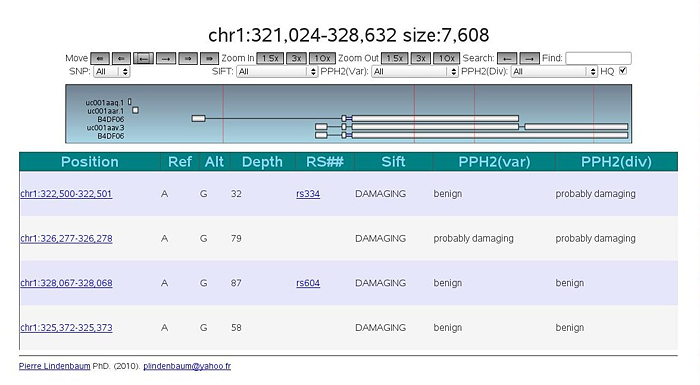
A Tiny Genome Browser (XHTML/Javascript/json/svg)

I'm currently working on a small set of NGS data and all I need is a simple genome browser to display my mutations while being able to select some SNPs according to some criteria (is it a known rs## , what is the prediction with SIFT or/and Polyphen ?, etc... ). As it is a relative small amount of data, it can be embedded in a webpage without needing a web server.

First, I need a description of the genes as JSON: I described yesterday how I generated this file using mysql, XSLT and the data from the UCSC:

var knownGenes=[{"name":"uc001aaa.3","chrom":"chr1","strand":"+","txStart":11873,"txEnd":14409,"cdsStart":11873,"cdsEnd":11873,"exonCount":3,"exonStarts":[11873,12612,13220],"exonEnds":[12227,12721,14409],"proteinID":"","alignID":"uc001aaa.3"}
,{"name":"uc010nxq.1","chrom":"chr1","strand":"+","txStart":11873,"txEnd":14409,"cdsStart":12189,"cdsEnd":13639,"exonCount":3,"exonStarts":[11873,12594,13402],"exonEnds":[12227,12721,14409],"proteinID":"B7ZGX9","alignID":"uc010nxq.1"}
,{"name":"uc010nxr.1","chrom":"chr1","strand":"+","txStart":11873,"txEnd":14409,"cdsStart":11873,"cdsEnd":11873,"exonCount":3,"exonStarts":[11873,12645,13220],"exonEnds":[12227,12697,14409],"proteinID":"","alignID":"uc010nxr.1"},
(...)];


Second, I need a JSON description of my data:
/** these are ==RANDOM== data */
var variations=[
{"chrom":"chr1","start":12874,"end":12875,"ref":"A","alt":"G","struct":false,"depth":8,"sift":"TOLERATED","pph2div":"benign","pph2var":"benign","rs":null,"hq":true,"id":0},
{"chrom":"chr1","start":792398,"end":792399,"ref":"A","alt":"G","struct":false,"depth":89,"sift":"TOLERATED","pph2div":"probably damaging","pph2var":"benign","rs":null,"hq":true,"id":1},
{"chrom":"chr1","start":959761,"end":959762,"ref":"A","alt":"G","struct":false,"depth":76,"sift":"DAMAGING","pph2div":"probably damaging","pph2var":"benign","rs":null,"hq":true,"id":2}
,(...)];

Third, I wrote a small genome browser using javascript , displaying the data as SVG and using the two previous files. Here is a screenshot:


I posted a random sample of the files on http://gist.github.com/508676, feel free to play with it.

That's it
Pierre

04 May 2010

Mapability vs Sequencing Depth

I'm currently trying to see if there is be a correlation between the MAPABILITY and the SEQUENCING DEPTH.

The MAPABILITY, generated for the ENCODE project , is the level of sequence uniqueness of the reference hg18 genome. Scores are normalized to between 0 and 1 with 1 representing a completely unique sequence and 0 representing the sequence occurs >4 times in the genome. A score of 0.5 indicates the sequence occurs exactly twice, likewise 0.33 for three times and 0.25 for four times.

The Sequencing depth represents the (often average) number of nucleotides contributing to a portion of a NGS assembly. On a genome basis, it means that, on average, each base has been sequenced a certain number of times

I've been trying to plot the relation between the mapability*100.0 (X-Axis) and the Sequencing depth( log(Y-Axis),cut-off:100 ) for my data on the human chr1 . The radius of the circles is proportional to the number of times a pair(mapability/depth) was found.
Hum... as far as I can see, nothing really obvious is visible here, but on the other hand, I'm not sure I used the best visualization...


(BTW the image below was created using a base64 endcoding src="data:image/png;base64,iVBORw0KG...". I hope it will be displayed within blogger.com)

mappability.vs.depth


That's it

Pierre

23 April 2010

Short post: Plain text vs Binary data.

This week, I was asked the difference between storing some data using a plain text format and a binary format. I wrote the following code C++ to illustrate how to store some genotypes in a ( possibly huge )table saved as a binary file. The first bytes of this file tells the number of individuals, the number of markers, the name of the individuals. Then for each marker, we get the name of the marker, its position and an array of genotypes for each individual.

The first invocation of this program (-p write ) creates a random table and a second call (-p read ) answers the genotypes for some random individuals/markers.


That's it.

Pierre

05 January 2010

My Python notebook: displaying the state of the Genome Projects

This post if about my first Python program. I'm still a newbie so please, don't flame ! :-)

The NCBI hosts a XML file describing the state of the Genome Projects at ftp://ftp.ncbi.nih.gov/genomes/genomeprj/gp.xml. The very first lines of the file look like this:

<?xml version="1.0" encoding="UTF-8"?>
<!DOCTYPE gp:DocumentSet SYSTEM "gp4v.dtd">
<gp:DocumentSet xmlns:SOAP-ENV="http://schemas.xmlsoap.org/soap/envelope/" xmlns:SOAP-ENC="http://s
chemas.xmlsoap.org/soap/encoding/" xmlns:xsi="http://www.w3.org/2001/XMLSchema-instance" xmlns:xsd="http://www.w3.org/2001/XMLSchema" xmlns:gp="gp">
<gp:Document>
<gp:ProjectID>1</gp:ProjectID>
<gp:IsPrivate>false</gp:IsPrivate>
<gp:eType>eGenome</gp:eType>
<gp:eMethod>eWGS</gp:eMethod>
<gp:eTechnologies>eUnspecified</gp:eTechnologies>
<gp:OriginDB>NCBI</gp:OriginDB>
<gp:CreateDate>03/05/2003 15:03:16</gp:CreateDate>
<gp:ModificationDate>07/18/2006 16:09:02</gp:ModificationDate>
<gp:ProjectName/>
<gp:OrganismName>Acidobacterium capsulatum ATCC 51196</gp:OrganismName>
<gp:StrainName>ATCC 51196</gp:StrainName>
<gp:TaxID>240015</gp:TaxID>
<gp:LocusTagPrefix/>
<gp:DNASource/>
<gp:SequencingDepth/>
<gp:ProjectURL>http://www.tigr.org/tdb/mdb/mdbinprogress.html</gp:ProjectURL>
<gp:DataURL/>
<gp:OrganismDescription/>
<gp:EstimatedGenomeSize>4.15</gp:EstimatedGenomeSize>
(...)
<gp:ChromosomeDefinitions/>
<gp:SubmittedSequences/>
<gp:LegacyPrefixes/>
</gp:Document>
<gp:Document>
<gp:ProjectID>3</gp:ProjectID>
<gp:IsPrivate>false</gp:IsPrivate>
<gp:eType>eGenome</gp:eType>
(...)
The program I wrote reads this XML file and generates the following visualization:
The left part is the tree of the NCBI taxonomy. In front of each taxon, the circles on the right are the Genome Projects. The size of a circle is the log10 of the estimated size of the genome (if available). The position on the x-axis of those circles is the date given by the tag "<p:CreateDate>".
There are two main classes: A Taxon is a node in the NCBI taxonomy, it contains a link to his children and to his parent:
class Taxon:
def __init__(self):
self.id=-1
self.name=None
self.parent=None
self.children=set()
. A Project is an item in the XML file. It contains a link to a Taxon:
class Project:
def __init__(self):
self.id=-1
self.taxon=None
self.genomeSize=None
self.date=None
The XML file is processed with a SAX handler. Each time a new project is found, the corresponding taxon is downloaded :
class GPHandler(handler.ContentHandler):
LIMIT=1E7
SLEEP=0
def __init__(self,owner):
self.owner=owner
self.content=None
self.project=None

(...)

def startElementNS(self,name,qname,attrs):
if name[1]=="Document":
self.project=Project()
elif name[1] in ["ProjectID","TaxID","CreateDate","EstimatedGenomeSize"] :
self.content=""

def endElementNS(self,name,qname):
if name[1]=="Document":
if len(self.owner.id2project)<GPHandler.LIMIT:
self.owner.id2project[self.project.id]= self.project
self.project=None
elif name[1]=="TaxID":
if len(self.owner.id2project)<GPHandler.LIMIT:
self.project.taxon=self.owner.findTaxonById(int(self.content))
time.sleep(GPHandler.SLEEP) #don't be evil with NCBI
elif name[1]=="ProjectID":
self.project.id=int(self.content)
sys.stderr.write("Project id:"+self.content+" n="+str(len(self.owner.id2project))+"\n")
elif name[1]=="EstimatedGenomeSize" and len(self.content)>0:
self.project.genomeSize=float(self.content)
elif name[1]=="CreateDate":
self.project.date=self.sql2date(self.content)
self.content=None
def characters(self,content):
if self.content!=None:
self.content+=content
The XML description of each taxons is downloaded and parsed using the NCBI EFetch service. A XML for a taxon looks like this:
<TaxaSet>
<Taxon>
<TaxId>240015</TaxId>
<ScientificName>Acidobacterium capsulatum ATCC 51196</ScientificName>
<OtherNames>
<EquivalentName>Acidobacterium capsulatum strain ATCC 51196</EquivalentName>
<EquivalentName>Acidobacterium capsulatum str. ATCC 51196</EquivalentName>
</OtherNames>
<ParentTaxId>33075</ParentTaxId>
<Rank>no rank</Rank>
<Division>Bacteria</Division>
<GeneticCode>
<GCId>11</GCId>
<GCName>Bacterial, Archaeal and Plant Plastid</GCName>
</GeneticCode>
<MitoGeneticCode>
<MGCId>0</MGCId>
<MGCName>Unspecified</MGCName>
</MitoGeneticCode>
<Lineage>cellular organisms; Bacteria; Fibrobacteres/Acidobacteria group; Acidobacteria; Acidobacteria (class); Acidobacteriales; Acidobacteriaceae; Acidobacterium; Acidobacterium capsulatum</Lineage>
<LineageEx>
<Taxon>
<TaxId>131567</TaxId>
<ScientificName>cellular organisms</ScientificName>
<Rank>no rank</Rank>
</Taxon>
<Taxon>
<TaxId>2</TaxId>
<ScientificName>Bacteria</ScientificName>
<Rank>superkingdom</Rank>
</Taxon>
<Taxon>
<TaxId>131550</TaxId>
<ScientificName>Fibrobacteres/Acidobacteria group</ScientificName>
<Rank>superphylum</Rank>
</Taxon>
<Taxon>
<TaxId>57723</TaxId>
<ScientificName>Acidobacteria</ScientificName>
<Rank>phylum</Rank>
</Taxon>
<Taxon>
<TaxId>204432</TaxId>
<ScientificName>Acidobacteria (class)</ScientificName>
<Rank>class</Rank>
</Taxon>
<Taxon>
<TaxId>204433</TaxId>
<ScientificName>Acidobacteriales</ScientificName>
<Rank>order</Rank>
</Taxon>
<Taxon>
<TaxId>204434</TaxId>
<ScientificName>Acidobacteriaceae</ScientificName>
<Rank>family</Rank>
</Taxon>
<Taxon>
<TaxId>33973</TaxId>
<ScientificName>Acidobacterium</ScientificName>
<Rank>genus</Rank>
</Taxon>
<Taxon>
<TaxId>33075</TaxId>
<ScientificName>Acidobacterium capsulatum</ScientificName>
<Rank>species</Rank>
</Taxon>
</LineageEx>
<CreateDate>2003/07/25</CreateDate>
<UpdateDate>2005/01/19</UpdateDate>
<PubDate>2005/01/29</PubDate>
</Taxon>
</TaxaSet>
This time I used a DOM implementation for python to analyse the file:
def findTaxonById(self,taxId):
if taxId in self.id2taxon:
return self.id2taxon[taxId]

url="http://eutils.ncbi.nlm.nih.gov/entrez/eutils/efetch.fcgi?db=taxonomy&retmode=xml&id="+str(taxId)
new_taxon=Taxon()
new_taxon.id=taxId
new_taxon.parent

dom = xml.dom.minidom.parse(urllib.urlopen(url))
top= dom.documentElement
e1= self.first(top,"Taxon")
new_taxon.name = self.textContent(self.first(e1,"ScientificName"))

lineage=[]
lineage.append(self.taxonRoot)
for e2 in self.elements(self.first(e1,"LineageEx"),"Taxon"):
t2=Taxon()
t2.id= int(self.textContent(self.first(e2,"TaxId")))
t2.name= self.textContent(self.first(e2,"ScientificName"))
if t2.id in self.id2taxon:
t2= self.id2taxon[t2.id]
else:
self.id2taxon[t2.id]=t2
lineage.append(t2)
lineage.append(new_taxon)

i=1
while i < len(lineage):
lineage[i-1].children.add(lineage[i])
lineage[i].parent=lineage[i-1]
i+=1

self.id2taxon[new_taxon.id]=new_taxon
return new_taxon
At the end, the figure is generated using SVG:

Source code

#Author Pierre Lindenbaum
#Mail: plindenbaum@yahoo.fr
#WWW: http://plindenbaum.blogspot.com
#usage:
# wget -O gp.xml "ftp://ftp.ncbi.nih.gov/genomes/genomeprj/gp.xml"
# python gp.py gp.xml
from xml.sax import make_parser, handler,saxutils
import sys,time,math,pickle,os.path
import xml.dom.minidom
import urllib


class SVG:
NS="http://www.w3.org/2000/svg"
class XLINK:
NS="http://www.w3.org/1999/xlink"


class Main:
DB_FILE="gp.db"
def __init__(self):
self.id2project=dict()
self.id2taxon=dict()
self.min_size=1.0E13
self.max_size=0.0
self.min_date=1.0E13
self.max_date=0.0
self.taxonRoot=Taxon()
self.taxonRoot.id=0
self.taxonRoot.name="Tree of Life"
self.id2taxon[self.taxonRoot.id]=self.taxonRoot

def escape(self,s):
x=""
for c in s:
if c=='<':
x+="&lt;"
elif c=='>':
x+="&gt;"
elif c=='&':
x+="&amp;"
elif c=='\'':
x+="&apos;"
elif c=='\'':
x+="&quot;"
else:
x+=c
return x

def first(self,root,name):
for c1 in root.childNodes:
if c1.nodeType!= xml.dom.minidom.Node.ELEMENT_NODE or \
c1.nodeName!=name:
continue
return c1
return None
def elements(self,root,name):
a=[]
for c1 in root.childNodes:
if c1.nodeType!= xml.dom.minidom.Node.ELEMENT_NODE or \
c1.nodeName!=name:
continue
a.append(c1)
return a

def textContent(self,root):
content=""
for c1 in root.childNodes:
if c1.nodeType== xml.dom.minidom.Node.TEXT_NODE:
content+= c1.nodeValue
else:
content+=self.textContent(c1)
return content

def findTaxonById(self,taxId):
if taxId in self.id2taxon:
return self.id2taxon[taxId]

url="http://eutils.ncbi.nlm.nih.gov/entrez/eutils/efetch.fcgi?db=taxonomy&retmode=xml&id="+str(taxId)
sys.stderr.write(url+"\n")

new_taxon=Taxon()
new_taxon.id=taxId
new_taxon.parent

dom = xml.dom.minidom.parse(urllib.urlopen(url))
top= dom.documentElement
e1= self.first(top,"Taxon")
new_taxon.name = self.textContent(self.first(e1,"ScientificName"))

lineage=[]
lineage.append(self.taxonRoot)
for e2 in self.elements(self.first(e1,"LineageEx"),"Taxon"):
t2=Taxon()
t2.id= int(self.textContent(self.first(e2,"TaxId")))
t2.name= self.textContent(self.first(e2,"ScientificName"))
if t2.id in self.id2taxon:
t2= self.id2taxon[t2.id]
else:
self.id2taxon[t2.id]=t2
lineage.append(t2)
lineage.append(new_taxon)

i=1
while i < len(lineage):
lineage[i-1].children.add(lineage[i])
lineage[i].parent=lineage[i-1]
i+=1

self.id2taxon[new_taxon.id]=new_taxon
return new_taxon

def svg(self):
width= 1000
height=10000
for p in self.id2project.values():
if p.genomeSize!=None:
self.min_size = min(self.min_size, p.genomeSize)
self.max_size = max(self.max_size, p.genomeSize)
self.min_date = min(self.min_date, p.date)
self.max_date = max(self.max_date, p.date)
shift= (self.max_date-self.min_date)*0.05
self.min_date-=shift
self.max_date+=shift
sys.stderr.write(" size:"+str(self.min_size)+"/"+str(self.max_size))
sys.stderr.write(" date:"+str(self.min_date)+"/"+str(self.max_date))
print "<?xml version='1.0' encoding='UTF-8'?>"
print "<svg xmlns='"+SVG.NS+"' xmlns:xlink='"+XLINK.NS+"' "+\
"width='"+str(width+1)+"' "+\
"height='"+str(height+1)+"' "+\
"style='stroke:black;fill:none;stroke-width:0.5px;' "+\
"><title>Genome Projects</title>"
print "<rect x='0' y='0' width='"+str(width/2.0)+"' height='"+str(height)+"' style='stroke:green;'/>"
print "<rect x='"+str(1+width/2.0)+"' y='0' width='"+str(width/2.0)+"' height='"+str(height)+"' style='stroke:blue;'/>"
self.recurs(self.taxonRoot,0,0,width/2,height,(width/2.0)/self.taxonRoot.depth())
print "</svg>"
def recurs(self,taxon,x,y,width,height,h_size):
total=0.0
midy=y+height/2.0
print "<circle cx='"+str(x)+"' cy='"+str(midy)+"' r='"+str(2)+"' title='"+self.escape(taxon.name)+"' style='fill:black;'/>"

for p in self.id2project.values():
if p.taxon!=taxon:
continue
cx= width+ ((p.date - self.min_date)/(self.max_date - self.min_date))*width
cy= midy
print "<a target='ncbi' title='"+self.escape(taxon.name)+" projectId:"+str(p.id)+" size:"+str(p.genomeSize)+"' xlink:href='http://www.ncbi.nlm.nih.gov/sites/entrez?Db=genomeprj&amp;cmd=ShowDetailView&amp;TermToSearch="+str(p.id)+"'>"
print "<g style='stroke:red;' >"
if p.genomeSize!=None:
radius=max(2.0,((math.log10(p.genomeSize) - math.log10(self.min_size))/(math.log10(self.max_size) - math.log10(self.min_size)))*100.0)
print "<circle cx='"+str(cx)+"' cy='"+str(cy)+"' r='"+str(radius)+"' style='fill:orange;fill-opacity:0.1;'/>"
print "<line x1='"+str(cx-5)+"' y1='"+str(cy)+"' x2='"+str(cx+5)+"' y2='"+str(cy)+"'/>"
print "<line x1='"+str(cx)+"' y1='"+str(cy-5)+"' x2='"+str(cx)+"' y2='"+str(cy+5)+"'/>"
print "</g></a>"

for c in taxon.children:
total+= c.weight()
for c in taxon.children:
h2=height* (c.weight()/total)
y2=y+h2/2.0
w2=h_size
if len(c.children)==0:
w2=width-x
print "<polyline points='"+\
str(x)+","+str(midy)+" "+\
str(x+w2/2.0)+","+str(midy)+" "+\
str(x+w2/2.0)+","+str(y2)+" "+\
str(x+w2)+","+str(y2)+" "+\
"' title='"+self.escape(c.name)+"'/>"
self.recurs(c,x+w2,y,width,h2,w2)
y+=h2


class Taxon:
def __init__(self):
self.id=-1
self.name=None
self.parent=None
self.children=set()
def __hash__(self):
return self.id.__hash__()
def __eq__(self,other):
if other==None:
return False
return self.id==other.id
def weight(self):
w=1
for t in self.children:
w+= t.weight()
return w
def depth(self):
##sys.stderr.write(self.name+"\n")
d=0.0
for t in self.children:
d= max(t.depth(),d)
return 1.0+d

class Project:
def __init__(self):
self.id=-1
self.taxon=None
self.genomeSize=None
self.date=None

class GPHandler(handler.ContentHandler):
LIMIT=1E7
SLEEP=0
def __init__(self,owner):
self.owner=owner
self.content=None
self.project=None
def sql2date(self,s):
s=s[:s.index(' ')]
cal =time.mktime( time.strptime(s,"%m/%d/%Y") )
return cal
def startElementNS(self,name,qname,attrs):
if name[1]=="Document":
self.project=Project()
elif name[1] in ["ProjectID","TaxID","CreateDate","EstimatedGenomeSize"] :
self.content=""
def endElementNS(self,name,qname):
if name[1]=="Document":
if len(self.owner.id2project)<GPHandler.LIMIT:
self.owner.id2project[self.project.id]= self.project
self.project=None
elif name[1]=="TaxID":
if len(self.owner.id2project)<GPHandler.LIMIT:
self.project.taxon=self.owner.findTaxonById(int(self.content))
time.sleep(GPHandler.SLEEP) #don't be evil with NCBI
elif name[1]=="ProjectID":
self.project.id=int(self.content)
sys.stderr.write("Project id:"+self.content+" n="+str(len(self.owner.id2project))+"\n")
elif name[1]=="EstimatedGenomeSize" and len(self.content)>0:
self.project.genomeSize=float(self.content)
elif name[1]=="CreateDate":
self.project.date=self.sql2date(self.content)
self.content=None
def characters(self,content):
if self.content!=None:
self.content+=content


main=Main();
sys.stderr.write(main.escape("<>!")+"\n")
parser = make_parser()
# we want XML namespaces
parser.setFeature(handler.feature_namespaces,True)
# tell parser to disable validation
parser.setFeature(handler.feature_validation,False)
parser.setFeature(handler.feature_external_ges, False)
parser.setContentHandler(GPHandler(main))
parser.parse(sys.argv[1])

main.svg()


That's it,

Pierre