27 April 2006

April 2006

I've been away from this blog for a few days. Here are a few thoughts:

I've created a project on sourceforge used to store the sources of MyFOAFExplorer and SciFOAF programs. The project is hosted on http://urbigene.sourceforge.net, the sources can be downloaded via CVS, I need to write the documentation (worst part of programming...), I also plan to include the sources of the tools I wrote for connotea.

Scientific FOAF profiles can now use to Benjamin Nowack's "Semantic Campus" using the URI "http://semanticcampus.org/ns/sc#" to introduce themselves. I also found DOAC to describe a carreer.

Nature Journal instroduced OTMI (Open Text Mining Interface), a XML (draft) format describing a paper and that can be used by computers for text-mining. OTMI is trying to expose the information that publishers already have about already published material. I guess this format could be used to get more (structured) information than an abstract of pubmed, but a text analysis still need to be performed. Last year I wrote a note about semantic abstracts: publishers could ask authors to join a RDF-based version of their abstract, the information would be curated by the author and directly available to the community.

I wonder why Science is not as innovative as Nature ?

There is much effervescence around microformats at this time. May be there is something for the bioinformatics community here...

The latest build (36.1/hg18) of the Human Genome has been released on the UCSC genome browser.

Two new products from google: calendar and Sketchup.

That's all for tonight !


12 April 2006

Windows Live Academic

After NCBI pubmed, Elsevier's scirus and google'sScholar, here is now Microsoft's Academic Live.

(it indexes) content related to computer science, physics, electrical engineering, and related subject areas. Academic search enables you to search for peer reviewed journal articles contained in journal publisher portals and on the web in locations like citeseer.

My first query was "Rotavirus Roxan". It returned no result today on Academic Live whereas I got the correct answers on Scholar. Nevertheless Microsoft's product seems more interactive than google's one.


Systems Biology with iHOP

A few monthes ago, I registered to Siphs, a social network for researchers. I didn't play with it a long time, as it was a little bit buggy, not much populated,.... However, I still receive e-mail from this site and today I received a mail about an impressive text mining tool called Information Hyperlinked over Proteins (iHOP).


A network of concurring genes and proteins extends through the scientific literature touching on phenotypes, pathologies and gene function. iHOP provides this network as a natural way of accessing millions of PubMed abstracts. By using genes and proteins as hyperlinks between sentences and abstracts, the information in PubMed can be converted into one navigable resource, bringing all advantages of the internet to scientific literature research.

iHOP was written by Dr Robert Hoffmann and published in Nature Genetics 36, 664 (2004): Hoffmann, R., Valencia, A. A gene network for navigating the literature.


11 April 2006

Writing a paper for dummies

A few weeks ago I introduced the method I use to draw pedigrees using the dot program. Dr Zhao had recently same idea as his paper using dot and R has just been published in Bioinformatics:

Zhao JH. Pedigree-drawing with R and graphviz.
Bioinformatics. 2006 Apr 15;22(8):1013-4. Epub 2006 Feb 17.
PMID: 16488908


c'est injuste c'est vraiment trop injuste
Sometimes you find a nice piece of code and you don't even think that it could be used to write a paper :-)...


07 April 2006

Nature Network Boston: an online social space for scientists

On Nascent Timo Hannay spoke about Web 2.0 in science. He also announced:

Nature Network Boston, an online social space for scientists will be launching in May

We might expect a new social network such as LinkedIn, OpenBC,etc... for scientists :-) ! This is not a new idea as SIPHS already tried to build such a network. And is it a good idea to create another network only for scientists ? But there might have good idea such as linking it to Nature's connotea. Nature might also have enough influence to link authors in pubmed to its site...

wait and see.

06 April 2006

Social Scientific Community with Connnotea.

Connotea is a free online reference management service. It allows you to save links to all your favourite articles, references, websites and other online resources with one click. Connotea is also a social bookmarking tool, like del.ico.us, so you can view other people's collections to discover new, interesting content. Some features have been requested by the users on the connotea mailing list and, among them Pedro Horna suggested that anonimity was not a good deal with connotea.

Although nicknames are popular in social bookmarking, chatrooms and poetry, anonymity has always been a very rare event in science basically because it does not make any sense. We scientists constantly struggle to let ourselves known and go to great lengths to find out who we might be interacting with in order to strengthen our network of potential collaborators. I bet most researchers are more than willing to put some info about themselves, probably as a "user note" or "user profile"...

Other people suggested to use a WIKI to store such information.

Today, the Connotea team has just released a new version wich uses a wiki to store your scientific profile ([here is mine]) or to describe your team/group...

This also can now be a nice place to define your unique URI and to create your FOAF profile...

Great !


29 March 2006

The Name Of The Rose

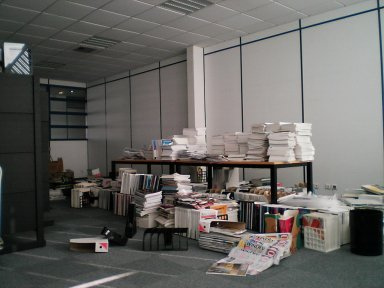
I finally saved a large number of journals from the Genset Libray that were initially intended to end in the bin. Although most of those journals are now in open-access, I stored this collection in my office and I'm now looking for an academic laboratory that would be interested in getting those journals.

The Name Of the Rose


20 March 2006

The ruins of Genset

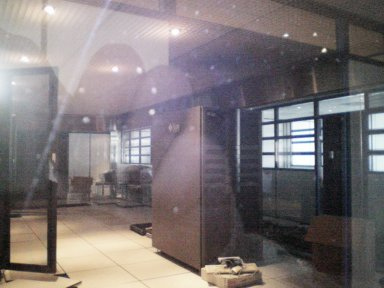
For a few years Genset has been the leader and the pride of the french biotec, it was then acquired by the Swiss pharma Serono in 2002. But this Reseach Center definitively closed this year. With a few colleagues of integragen, we've be visiting the desert building... Nobody in the corridors, the library was a mess, complete collections of scientific journals abandoned on the ground...


15 March 2006

SciFOAF cited at 4th International Semantic Web Conference

SciFOAF was cited at the 4th International Semantic Web Conference. SciFOAF is a tool that helps building FOAF profiles from pubmed.

Using the Semantic Web for e-Science: Inspiration, Incubation, Irritation by Carole Goble [abstract]

(...)Genuine “Semantic WEB” examples, with the emphasis on Web, are also starting to appear. SciFOAF builds a FOAF community mined from the analysis of authors and publications over PubMed (http://www.urbigene.com/foaf/). Scientific publishers like the Institute of Physics (http://syndication.iop.org/), publish RSS feeds in RDF using standard RSS, Dublin Core and PRISM RDF vocabularies. The Uniprot protein sequence database has an experimental publication of results in RDF (http://www.isb-sib.ch/~ejain/rdf/). YeastHub converts the outputs of a variety of databases into RDF and combines them in a warehouse built over a native RDF data store. BioDASH is an experimental Drug Development Dashboard that uses RDF and OWL to associate disease, compounds, drug progression stages, molecular biology, and pathway knowledge for a team of users.
(....)
These examples should be an inspiration to the Semantic Web community.(...)


Thanks for the citation Dr Goble, but can you explain me why my paper was refused by Bioinformatics :-) ?

There was also an interesting note about semantic-web and computer performance:

(...)Performance over medium-large RDF datasets is disappointing – the CombeChem combinatorial chemistry project generated 80 million triples trivially and broke most of the triple stores it tried (www.combechem.org)...


06 March 2006

GBrowse Genome Browser + AJAX

In a previous post I introduced a PHP script to display tracks from the UCSC Genome Browser using SVG. A week later, a mail was sent on the UCSC mailing list to introduce the GBrowse/BioPerl browser based on AJAX and written at the Ian Holmes lab (Berkeley).


Now, let's wait for a genome browser based on both technologies :-)....