29 January 2006

Past projects (IV)

One day I found a book about 'genetic programming' in a colleague's office and I wondered if I could use this (the answer was no) to discover a mathematical way how to describe the signal from BAC clones spotted on a CGH array. Note that 'genetic programming' is different from 'genetic algorithms': in the first one there is a mathematical function which evolve whereas this is a popolulation of data in the second one. See http://www.geneticprogramming.com/Tutorial/ for a tutorial about Genetic Programming.


Two different types of mutations
(from http://www.geneticprogramming.com/Tutorial/).


So I wrote a C++ program that took as input a table of result, a list of expected number and I trained a mathematical function to evolve with those data:
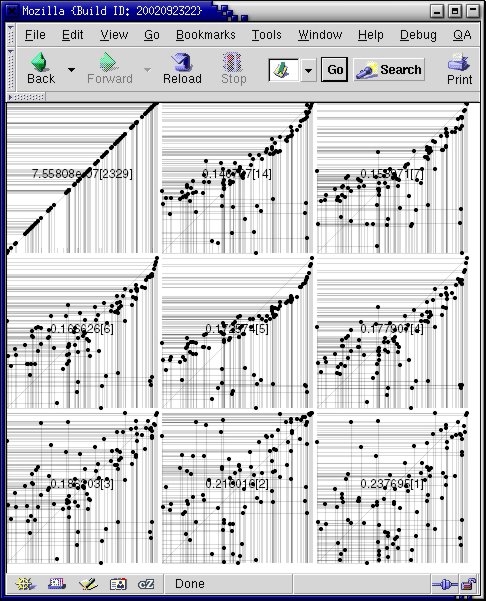


This SVG figure shows nine steps of the evolution process. In each setp, on the X axis are displayed the expected values and the experimental values (calculated from the evolving methematical function) are on the Y axis. The program stopped when a defined fitness was reached. Fun to write.

Past Projects (III)

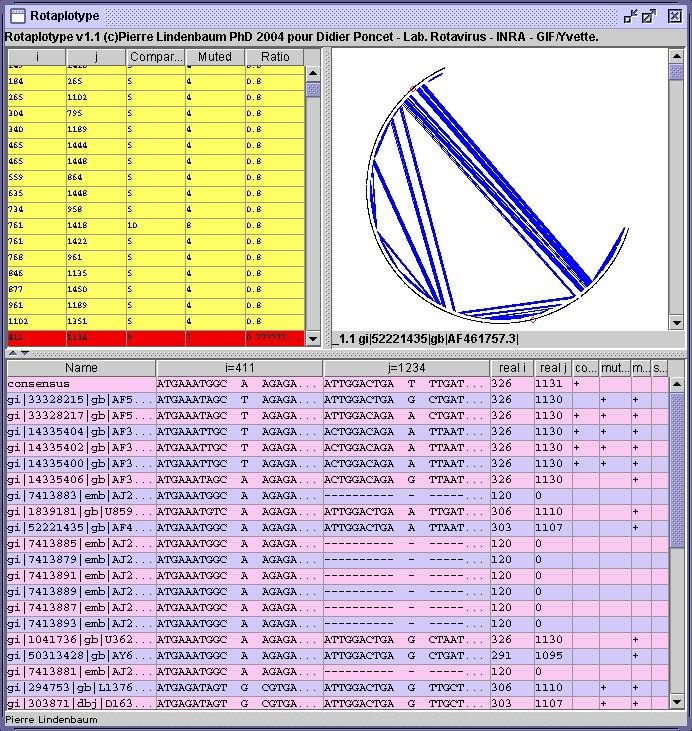
Rotaplotype was a java program asked by my former thesis master Dr D Poncet in order to find and visalize compensatory co-mutations in multiple rotavirus aligned genomes. The program called Rotaplotype took as input a set of rotavirus sequence aligned with clustalw and optionaly a RNAML-based description of the secondary structure of one viral RNA fragment.

Rotaplotype

  • on the top-left pane is displayed each co-mutation found in the alignments.
  • on the top-right pane is displayed the position of the two mutations in the structure (may be of interest if the two mutations are localized in the same hairpin)
  • on bottom are displayed the context of the two mutation for each sequence aligned by clustalw.


... not sure Dr Poncet discovered the deep secrets of the universe with this small tool ;-).

28 January 2006

The Photograph


' want to discover European comics ? Get the third part of "The Photograph" wrote by Guibert & al. that was released this week !


Patent

Today I received a confirmation letter from the European Patent Office about a method called 'CloneTrek' I created at Integragen used to select BAC clones for DNA chips.

<? lang='fr' ?>METHODES DE PREPARATION DE PUCES GENETIQUES ET UTILISATIONS
La présente demande concerne des méthodes et compositions pour la production de biopuces, ainsi que l'utilisation de ces biopuces dans des domaines variés, de la génomique fonctionnelle au diagnostic par exemple, notamment en recherche ou dans le domaine médical. Elle concerne également des outils et procédés de sélection de polynucléotides, permettant la production de Biopuces améliorées. Les biopuces de l'invention comprennent notamment des clones BAC.

Classification CIB1-7 principale :
C12Q-001/68
Classification CIB1-7 secondaire :
G01N-033/53 G06F-019/00
Classification CIB1-7 additionnelle :
G06F-159:00

Literature mining for the biologist in Nature Reviews Genetics

Lars Juhl Jensen & al. wrote a great review about Literature mining in Nature Reviews Genetics. There are many links and many references about algorithms, hypothesis generation and biological discovery.


Dr Jensen said :
"Due to popular request, I have also compiled two zip archives with additional reprints in case you are interested:

http://www.bork.embl-heidelberg.de/Docu/literature_mining/bork_reprints.zip
http://www.bork.embl-heidelberg.de/Docu/literature_mining/selected_reprints.zip

The former contains all literature mining papers published by the Peer Bork's group. The latter archive contains the papers highlighted in the bibliography of the review (with the exception of one for which I unfortunately have not been able to obtain a PDF file)."


23 January 2006

Nemester: antisocial network

Here is a new online community: Nemester The new way to make enemies !


Nemester is an online community that connects paranoids, egotists, villains, and monomaniacs through networks of competing agendas and incompatable ideologies for bitter conflicts, mutual loathing, or to find their one, true nemesis...


Annozilla

Today I tested annozilla, a Firefox extension used to create and share annotations about web sites. Installation of the extension for firefox 1.5 was really fast and simple. Then you need a server that will store your annotations. The w3c provides a free one for testing at http://annotest.w3.org/access.

.

I'm still missing some points: how can I add a new type of annotation (comment, explanation,example, but I'd like to see cellular component, interaction, etc...). Moreover, an annotation is a free-text (with HTML) which may be also hard to analyse...

19 January 2006

MyFOAFExplorer: browse your FOAF network

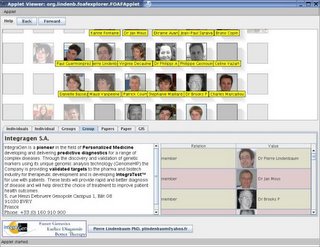
I'm pleased to introduce my new java applet called MyFOAFExplorer available at http://www.urbigene.com/foafexplorer/.


The FOAF project defines a semantic format based on RDF/XML to define persons or groups, their relationships, as well as their basic properties such as name, e-mail address, subjects of interest , publication, and so on... MyFOAFExplorer was created after SciFOAF in order to browse a scientific network, its publications, its laboratories,... The
program is an applet (JAVA 1.5 is required) that takes as an input a FOAF file. The applet can be downloaded and used for your laboratoy/social network to introduce your staff, your publications,...


The code does not contain a compliant RDF parser (such as JENA), but the way it parses the XML worked fine for my test, so it could be used as a framework to write your own FOAF file.

.