Showing posts with label library. Show all posts

18 July 2013

Running a picard tool in the #KNIME workflow engine

http://www.knime.org/ is "a user-friendly graphical workbench for the entire analysis process: data access, data transformation, initial investigation, powerful predictive analytics, visualisation and reporting". In this post, I'll show how to invoke an external java program, and more precisely a tool from the picard library from with knime. The workflow: load a list of BAM filenames, invoke SortSam and display the names of the sorted files.

Construct the following workflow:


Edit the FileReader node and load a list of paths to the BAMs


Edit the properties of the java node, in the "Additional Libraries" tab, load the jar of SortSam.jar


Edit the java snippet node, create a new column SORTED_BAM for the output.


and copy the following code:

// Your custom imports:
import net.sf.picard.sam.SortSam;
import java.io.File;
----------------------------------------------------------
// Enter your code here:


File input=new File(c_BAM);

//build the output filename 
out_SORTED = input.getName();
if(!(out_SORTED.endsWith(".sam") || out_SORTED.endsWith(".bam")))
{
 throw new Abort("not a SAM/BAM :"+c_BAM);
}
int dot=out_SORTED.lastIndexOf('.');
out_SORTED=new File(input.getParentFile(),out_SORTED.substring(0, dot)+"_sorted.bam").getPath();

//create a new instance of SortSam
SortSam cmd=new SortSam();

//invoke the instance
int ret=cmd.instanceMain(new String[]{
 "I="+input.getPath(),
 "O="+out_SORTED,
 "SO=coordinate",
 "VALIDATION_STRINGENCY=LENIENT",
 "CREATE_INDEX=true",
 "MAX_RECORDS_IN_RAM=500000"
 });

if(ret!=0)
{
 throw new Abort("SortSam failed with: "+c_BAM+" "+out_SORTED);
}
Execute KNIME, picard runs the job, and get the names of the sorted BAMs:


Edit:

The workflow was uplodaded on MyExperiment at http://www.myexperiment.org/workflows/3654.html.


That's it,

Pierre


24 May 2013

A Tribble/FeatureCodec handling JSON-based annotations files.

I wrote a java FeatureCodec for JSON with a the tribble library.
Citing the GATK tream: "The Tribble project was started as an effort to overhaul our reference-ordered data system; we had many different formats that were shoehorned into a common framework that didn't really work as intended. What we wanted was a common framework that allowed for searching of reference ordered data, regardless of the underlying type. Jim Robinson had developed indexing schemes for text-based files, which was incorporated into the Tribble library."".

The library is available at:https://github.com/lindenb/jsontribble.


The library contains the tools to sort, index and query the json file.

As a proof of concept, I also created a REST-based service to query those files.

REST/JSON

For example http://localhost:8080/jsontribble/rest/tribble/resources/dbsnp/annotations.json?chrom=chr1&start=881826&end=981826 returns:
{"header":{"description":"UCSC  snp137: select count(*) from snp137 where FIND_IN_SET(func,\"missense\")>0 and avHet>0.1"}
,"features":[
{"chrom":"chr1","start":881826,"end":881827,"name":"rs112341375","score":0,"strand":"+","refNCBI":"G","refUCSC":"G","observed":"C/G","class":"single","valid":["by-frequency"],"avHet":0.5,"func":["missense"],"submitters":["BUSHMAN"]}
{"chrom":"chr1","start":897119,"end":897120,"name":"rs28530579","score":0,"strand":"+","refNCBI":"G","refUCSC":"G","observed":"C/G","class":"single","valid":["unknown"],"avHet":0.375,"func":["missense"],"submitters":["ABI","ENSEMBL","SSAHASNP"]}
{"chrom":"chr1","start":907739,"end":907740,"name":"rs112235940","score":0,"strand":"+","refNCBI":"G","refUCSC":"G","observed":"A/G","class":"single","valid":["unknown"],"avHet":0.5,"func":["missense"],"submitters":["COMPLETE_GENOMICS"]}
{"chrom":"chr1","start":949607,"end":949608,"name":"rs1921","score":0,"strand":"+","refNCBI":"G","refUCSC":"G","observed":"A/C/G","class":"single","valid":["by-cluster","by-frequency","by-1000genomes"],"avHet":0.464348,"func":["missense"],"submitters":["1000GENOMES","AFFY","BGI","BUSHMAN","CGAP-GAI","CLINSEQ_SNP","COMPLETE_GENOMICS","CORNELL","DEBNICK","EXOME_CHIP","GMI","HGSV","ILLUMINA","ILLUMINA-UK","KRIBB_YJKIM","LEE","MGC_GENOME_DIFF","NHLBI-ESP","SC_JCM","SC_SNP","SEATTLESEQ","SEQUENOM","UWGC","WIAF","YUSUKE"],"bitfields":["maf-5-some-pop","maf-5-all-pops"]}
]}

REST/XML

Example http://localhost:8080/jsontribble/rest/tribble/resources/dbsnp/annotations.xml?chrom=chr1&start=897119&end=981826
<?xml version="1.0" encoding="UTF-8"?>
<annotations chrom="chr1" start="897119" end="981826">
  <header>
    <description>UCSC  snp137: select count(*) from snp137 where FIND_IN_SET(func,"missense")&gt;0 and avHet&gt;0.1</description>
  </header>
  <features>
    <feature>
      <chrom>chr1</chrom>
      <start type="integer">897119</start>
      <end type="integer">897120</end>
      <name>rs28530579</name>
      <score type="integer">0</score>
      <strand>+</strand>
      <refNCBI>G</refNCBI>
      <refUCSC>G</refUCSC>
      <observed>C/G</observed>
      <class>single</class>
      <valid>

BED/text

Example: http://localhost:8080/jsontribble/rest/tribble/resources/merge/annotations.bed?chrom=chr1&start=897119&end=981826.
chr1    895966  901099  {"chrom":"chr1","start":895966,"end":901099,"strand":"+","name":"uc001aca.2","cds...
chr1    896828  897858  {"chrom":"chr1","start":896828,"end":897858,"strand":"+","name":"uc001acb.1","cds...
chr1    897008  897858  {"chrom":"chr1","start":897008,"end":897858,"strand":"+","name":"uc010nya.1","cds...
chr1    897119  897120  {"chrom":"chr1","start":897119,"end":897120,"name":"rs28530579","score":0,"strand...
chr1    897734  899229  {"chrom":"chr1","start":897734,"end":899229,"strand":"+","name":"uc010nyb.1","cds...
chr1    901876  910484  {"chrom":"chr1","start":901876,"end":910484,"strand":"+","name":"uc001acd.3","cds...
chr1    901876  910484  {"chrom":"chr1","start":901876,"end":910484,"strand":"+","name":"uc001ace.3","cds...
chr1    901876  910484  {"chrom":"chr1","start":901876,"end":910484,"strand":"+","name":"uc001acf.3","cds...
chr1    907739  907740  {"chrom":"chr1","start":907739,"end":907740,"name":"rs112235940","score":0,"stran...
chr1    910578  917473  {"chrom":"chr1","start":910578,"end":917473,"strand":"-","name":"uc001ach.2","cds...
chr1    934341  935552  {"chrom":"chr1","start":934341,"end":935552,"strand":"-","name":"uc001aci.2","cds...
chr1    934341  935552  {"chrom":"chr1","start":934341,"end":935552,"strand":"-","name":"uc010nyc.1","cds...
chr1    948846  949919  {"chrom":"chr1","start":948846,"end":949919,"strand":"+","name":"uc001acj.4","cds...
chr1    949607  949608  {"chrom":"chr1","start":949607,"end":949608,"name":"rs1921","score":0,"strand":"+...
chr1    955502  991499  {"chrom":"chr1","start":955502,"end":991499,"strand":"+","name":"uc001ack.2","cds...

11 February 2013

Counting the reads in a BAM file using SGE and the Open-MPI library: my notebook.

In the current post, I'll describe my first Open MPI program. Open MPI is "a Message Passing Interface (MPI) library, a standardized and portable message-passing system to function on a wide variety of parallel computers". My C program takes a list of BAMs, distributes some jobs on the SGE (SUN/Oracle Grid Engine) to count the number of reads and returns the results to a master process.

Downloading and installing

The library was downloaded from http://www.open-mpi.org/software/ompi/v1.6/, compiled with the option --with-sge and installed in '/commun/data/packages/openmpi'.
./configure --prefix=/commun/data/packages/openmpi --with-sge
make 
make install

Configuring SGE to run MPI-based program

As described in http://docs.oracle.com/cd/E19080-01/n1.grid.eng6/817-5677/6ml49n2c0/index.html .
$ su
$ source /commun/sge_root/bird/common/settings.csh
$ setenv ARCH lx24-amd64
$ qconf -ap orte
And added:
pe_name            orte
slots              448
user_lists         NONE
xuser_lists        NONE
start_proc_args    /bin/true
stop_proc_args     /bin/true
allocation_rule    $round_robin
control_slaves     TRUE
job_is_first_task  TRUE
urgency_slots      min
accounting_summary FALSE
Add orte to the parallele env list:
qconf -mattr queue pe_list "orte" all.q
Using qconf -mconf I've also set shell_start_mode to 'unix_behavior'.

Algorithm

In the 'main' method, test if this is the master(==0) or a slave process(!=0):
MPI_Comm_rank(MPI_COMM_WORLD, &rank);
if (rank == 0)
 {
 master(argc-1,&argv[1]);
 }
else
 {
 slave(argc-1,&argv[1]);
 }

MASTER

The master gets the number of available proc:
MPI_Comm_size(MPI_COMM_WORLD, &proc_count)
Loop over the number of available processors and the BAMS, for each BAM, create a fixed size structure containing the path to the BAM as well as the count of reads initialized to '0':
typedef struct Params_t
 {
 char filename[FILENAME_MAX];
 int is_error;
 long count_total;
 long count_mapped;
 long count_properly_paired;
 long count_dup;
 }Params;
This structure is sent to the slaves:
 MPI_Send(
 &param, /* message buffer */
 sizeof(Params), /* one data item */
 MPI_CHAR, /* data item is an array of bytes */
 rank, /* destination process rank */
 TAG_COUNT_BAM, /* user chosen message tag */
 MPI_COMM_WORLD /* default communicator */
 ); 
and we wait for the slaves to return those 'Params' with the filled values.:
MPI_Recv(&param, /* message buffer */
 sizeof(Params), /* one data item */
 MPI_CHAR, /* data item is an array of bytes */
 MPI_ANY_SOURCE, /* receive from any sender */
 MPI_ANY_TAG, /* any type of message */
 MPI_COMM_WORLD, /* default communicator */
 &status);
And the result is printed:
printf("%s\t%ld\t%ld\t%ld\t%ld\n",
 param.filename,
 param.count_total,
 param.count_mapped,
 param.count_properly_paired,
 param.count_dup
 );
At the end of the master method, when no more BAM is available, the slaves are released (tag is 'TAG_RELEASE_SLAVE') with :
MPI_Send(
 &empty, /* message buffer */
 sizeof(Params), /* one data item */
 MPI_CHAR, /* data item is an array of bytes */
 rank, /* destination process rank */
 TAG_RELEASE_SLAVE, /* SHutdown */
 MPI_COMM_WORLD
 ); /* default communicator */

SLAVE

The slave method receives some messages from the master:
MPI_Recv(
 &param,
 sizeof(Params),
 MPI_CHAR,
 0,
 MPI_ANY_TAG,
 MPI_COMM_WORLD,
 &status);
If the message was 'TAG_RELEASE_SLAVE' we exit the method. Else the BAM file is scanned using the SAmtools API for C.
count_reads(&param);
and the result is sent back to the master:
MPI_Send(
 &param,
 sizeof(Params),
 MPI_CHAR,
 0,
 0,
 MPI_COMM_WORLD
 );
.

Running the Job on SGE

I still don't understand why I need to write the following line:
# qsh -pe orte 4
Your job 84581 ("INTERACTIVE") has been submitted
waiting for interactive job to be scheduled ...
Your interactive job 84581 has been successfully scheduled.
Run the analysis:
qrsh -cwd -pe orte 100 /commun/data/packages/openmpi/bin/mpirun \
 /path/to/ompibam \
 `find /commun/data/projects/folder1234/align -name "*.bam"`
qstat -f shows the jobs running:
arch          states
   ---------------------------------------------------------------------------------
   all.q@node01                   BIP   0/15/64        2.76 lx24-amd64
      84598 0.55500 mpirun     lindenb      r     02/11/2013 12:03:36    15
   ---------------------------------------------------------------------------------
   all.q@node02                   BIP   0/14/64        3.89 lx24-amd64
      84598 0.55500 mpirun     lindenb      r     02/11/2013 12:03:36    14
   ---------------------------------------------------------------------------------
   all.q@node03                   BIP   0/14/64        3.23 lx24-amd64
      84598 0.55500 mpirun     lindenb      r     02/11/2013 12:03:36    14
   ---------------------------------------------------------------------------------
   all.q@node04                   BIP   0/14/64        3.68 lx24-amd64
      84598 0.55500 mpirun     lindenb      r     02/11/2013 12:03:36    14
   ---------------------------------------------------------------------------------
   all.q@node05                   BIP   0/15/64        2.91 lx24-amd64
      84598 0.55500 mpirun     lindenb      r     02/11/2013 12:03:36    15
   ---------------------------------------------------------------------------------
   all.q@node06                   BIP   0/14/64        3.91 lx24-amd64
      84598 0.55500 mpirun     lindenb      r     02/11/2013 12:03:36    14
   ---------------------------------------------------------------------------------
   all.q@node07                   BIP   0/14/64        3.79 lx24-amd64
      84598 0.55500 mpirun     lindenb      r     02/11/2013 12:03:36    14 
output:
#filename total mapped properly_paired dup
/commun/data/projects/folder1234/11X0589_markdup.bam 1179766 973943 684794 0
/commun/data/projects/folder1234/11X0589_pair1_sorted.bam 1179766 973943 684794 0
/commun/data/projects/folder1234/11X0589_realigned.bam 1179766 973943 684794 0
/commun/data/projects/folder1234/11X0589_recal.bam 1179766 973943 684794 0
/commun/data/projects/folder1234/11X0602_pair1_sorted.bam 982006 815636 566136 0
/commun/data/projects/folder1234/11X0602_realigned.bam 982006 815636 566136 0
/commun/data/projects/folder1234/11X0602_markdup.bam 982006 815636 566136 0
/commun/data/projects/folder1234/11X0602_pair1_unsorted.bam 982006 815636 566136 0
/commun/data/projects/folder1234/11X0375_pair1_sorted.bam 1255772 1031155 735480 0
/commun/data/projects/folder1234/11X0375_realigned.bam 1255772 1031155 735480 0
/commun/data/projects/folder1234/11X0375_markdup.bam 1255772 1031155 735480 0
/commun/data/projects/folder1234/11X0367_pair1_sorted.bam 1422144 1158315 796466 0
/commun/data/projects/folder1234/11X0367_markdup.bam 1422144 1158315 796466 0
/commun/data/projects/folder1234/11X0375_pair1_unsorted.bam 1255772 1031155 735480 0
/commun/data/projects/folder1234/11X0367_realigned.bam 1422144 1158315 796466 0
/commun/data/projects/folder1234/11X0291_pair1_sorted.bam 1296294 1067233 743924 0
/commun/data/projects/folder1234/11X0291_markdup.bam 1296294 1067233 743924 0
/commun/data/projects/folder1234/11X0291_realigned.bam 1296294 1067233 743924 0
/commun/data/projects/folder1234/11X0311_markdup.bam 1353534 1117463 788474 0
/commun/data/projects/folder1234/11X0311_realigned.bam 1353534 1117463 788474 0
/commun/data/projects/folder1234/11X0375_recal.bam 1255772 1031155 735480 0
/commun/data/projects/folder1234/11X0589_pair1_unsorted.bam 1179766 973943 684794 0
/commun/data/projects/folder1234/11X0367_pair1_unsorted.bam 1422144 1158315 796466 0
/commun/data/projects/folder1234/11X0290_pair1_sorted.bam 1436970 1191044 837726 0
/commun/data/projects/folder1234/11X0290_realigned.bam 1436970 1191044 837726 0
/commun/data/projects/folder1234/11X0291_pair1_unsorted.bam 1296294 1067233 743924 0
/commun/data/projects/folder1234/11X0311_pair1_sorted.bam 1353534 1117463 788474 0
/commun/data/projects/folder1234/11X0240_pair1_sorted.bam 1489672 1229654 830042 0
/commun/data/projects/folder1234/11X0240_realigned.bam 1489672 1229654 830042 0
/commun/data/projects/folder1234/11X0240_markdup.bam 1489672 1229654 830042 0
/commun/data/projects/folder1234/XX10272_pair1_sorted.bam 1579608 1296449 876040 0
/commun/data/projects/folder1234/XX10272_markdup.bam 1579608 1296449 876040 0
/commun/data/projects/folder1234/XX10272_realigned.bam 1579608 1296449 876040 0
/commun/data/projects/folder1234/11X0602_recal.bam 982006 815636 566136 0
/commun/data/projects/folder1234/11X0290_markdup.bam 1436970 1191044 837726 0
/commun/data/projects/folder1234/11X0290_pair1_unsorted.bam 1436970 1191044 837726 0
/commun/data/projects/folder1234/11X0247_pair1_sorted.bam 1489832 1233208 862842 0
/commun/data/projects/folder1234/11X0456_pair1_sorted.bam 1486490 1220969 848738 0
/commun/data/projects/folder1234/11X0456_realigned.bam 1486490 1220969 848738 0
/commun/data/projects/folder1234/11X0247_markdup.bam 1489832 1233208 862842 0
/commun/data/projects/folder1234/11X0247_realigned.bam 1489832 1233208 862842 0
/commun/data/projects/folder1234/11X0456_markdup.bam 1486490 1220969 848738 0
/commun/data/projects/folder1234/11X0367_recal.bam 1422144 1158315 796466 0
/commun/data/projects/folder1234/11X0305_pair1_sorted.bam 1818236 1489267 1027458 0
/commun/data/projects/folder1234/11X0305_markdup.bam 1818236 1489267 1027458 0
/commun/data/projects/folder1234/11X0305_realigned.bam 1818236 1489267 1027458 0
/commun/data/projects/folder1234/11X0542_pair1_sorted.bam 1784860 1469183 1016314 0
/commun/data/projects/folder1234/XX07551_recal.bam 1778358 1456518 1018694 0
/commun/data/projects/folder1234/11X0542_realigned.bam 1784860 1469183 1016314 0
/commun/data/projects/folder1234/11X0542_markdup.bam 1784860 1469183 1016314 0
/commun/data/projects/folder1234/11X0311_pair1_unsorted.bam 1353534 1117463 788474 0
/commun/data/projects/folder1234/11X0291_recal.bam 1296294 1067233 743924 0
/commun/data/projects/folder1234/XX07551_pair1_sorted.bam 1778358 1456518 1018694 0
/commun/data/projects/folder1234/11X0240_pair1_unsorted.bam 1489672 1229654 830042 0
/commun/data/projects/folder1234/XX10272_pair1_unsorted.bam 1579608 1296449 876040 0
/commun/data/projects/folder1234/XX07551_markdup.bam 1778358 1456518 1018694 0
/commun/data/projects/folder1234/XX07551_realigned.bam 1778358 1456518 1018694 0
/commun/data/projects/folder1234/11X0305_pair1_unsorted.bam 1818236 1489267 1027458 0
/commun/data/projects/folder1234/11X0311_recal.bam 1353534 1117463 788474 0
/commun/data/projects/folder1234/11X0456_pair1_unsorted.bam 1486490 1220969 848738 0
/commun/data/projects/folder1234/11X0247_pair1_unsorted.bam 1489832 1233208 862842 0
/commun/data/projects/folder1234/11X0542_pair1_unsorted.bam 1784860 1469183 1016314 0
/commun/data/projects/folder1234/XX07551_pair1_unsorted.bam 1778358 1456518 1018694 0
/commun/data/projects/folder1234/11X0433_pair1_sorted.bam 2178798 1800943 1249738 0
/commun/data/projects/folder1234/11X0433_markdup.bam 2178798 1800943 1249738 0
/commun/data/projects/folder1234/XX10272_recal.bam 1579608 1296449 876040 0
/commun/data/projects/folder1234/11X0433_realigned.bam 2178798 1800943 1249738 0
/commun/data/projects/folder1234/11X0240_recal.bam 1489672 1229654 830042 0
/commun/data/projects/folder1234/11X0290_recal.bam 1436970 1191044 837726 0
/commun/data/projects/folder1234/11X0456_recal.bam 1486490 1220969 848738 0
/commun/data/projects/folder1234/11X0247_recal.bam 1489832 1233208 862842 0
/commun/data/projects/folder1234/11X0433_pair1_unsorted.bam 2178798 1800943 1249738 0
/commun/data/projects/folder1234/11X0305_recal.bam 1818236 1489267 1027458 0
/commun/data/projects/folder1234/11X0542_recal.bam 1784860 1469183 1016314 0
/commun/data/projects/folder1234/11X0433_recal.bam 2178798 1800943 1249738 0
However I noticed seems that running this code on the cluster is slower that running it on the master node...

The C code

Note: the C code is compiled with ortecc, not gcc.


I'm still very new to this API and to those concepts. Feel free to suggest anything :-)
That's it,
Pierre

25 January 2013

Samtools tview as a library to display the BAM

I've forked samtools and modified the code of tview to use it as a library to display the alignments. The original code is an inreractive interface using the ncurses library. I've modified the original code and changed the structure of the C 'struct tview' with a few callbacks to make it more object-oriented:

(...)
typedef struct AbstractTview {
 int mrow, mcol;
   (...)
    khash_t(kh_rg) *rg_hash;
    /* callbacks */
    void (*my_destroy)(struct AbstractTview* );
    void (*my_mvprintw)(struct AbstractTview* ,int,int,const char*,...);
    void (*my_mvaddch)(struct AbstractTview*,int,int,int);
    void (*my_attron)(struct AbstractTview*,int);
    void (*my_attroff)(struct AbstractTview*,int);
    void (*my_clear)(struct AbstractTview*);
    int (*my_colorpair)(struct AbstractTview*,int);
    int (*my_drawaln)(struct AbstractTview*,int,int);
    int (*my_loop)(struct AbstractTview*);
    int (*my_underline)(struct AbstractTview*);
} tview_t;
With those callbacks, there is a strong separation between the 'view' and the 'model'. Tview can now be used as a library and it's now easy to create any kind of view you need by extending the 'struct tview_t'. I've created two new interfaces: one for HTML:


samtools tview -d H examples/sorted.bam  -p seq1:20 
seq1:20
 21        31        41        51        61        71        81                 
NNNNNNNNNNNNNNNNNNNNNNNNNNNNNNNNNNNNNNNNNNNNNNNNNNNNNNNNNNNNNNNNNNNNNNNNNNNNNNNN
ATGTGTGGTTTAACTCGTCCATGGCCCAGCATTAGGGAGCTGTGGACCCTGCAGCCTGGCTGTGGGGGCCGCAGTGGSTG
ATGTGTGGTTTAACTCGTACATGGCCCAGCATTAGGGAGCTGTGGACCCCG  GCCTGGCTGTGGGGGCACCAGCCGCTG
ATGTGTGGTTTAACTCGTCCATGGCCCAGCATTAGGGCGCTGTGGACCCTGC       CTGTGGGGGCCGCAGTGGCTG
ATGTGTGGTTTAACTCGT     GCCCAGCATTAGGGAGCTGTGGACCCTGCAGCCTG CTGTGGGGGCCGCAGTGGCTG
ATGTGTGGTTTAACTCGT     GCCCAGCATTAGGGAGCTGTGGACCCTGCAGCCTG CTGTGGGGGCCGCAGTGGGTG
ATGTGTGGTTTAACTCGTCC   GCCCAGCATTAGGGAGCTGTGGACCCTGCAGCCTG CTGTGGGGGCCGCAGTGGCTG
ATGTGTGGTTTAACTCGTCC         CATTAGGGAGCTGTGGACCCTGCAGCCTGGCTGTTG          GGCTG
TTTTTTGTTTTAACTCTTCTCT       CATTAGGGAGCTGTGGACCCTGCAGCCTGGCTGTTG          GGCTG
TTTTTTGTTTTAACTCTTCTCT        ATTAGGGAGCTGTGGACCCTGCAGCCTGGCTGGGG               
ATGTGTGGTTTAACTCGTCCATGG      ATTAGGGAGCTGTGGACCCTGCAGCCTGGCTGGGG               
ATGTGTGGTTTAACTCGTCCATGG       TTAGGGAGCTGTGGACCCTGCAGCCTGGCTGTGGG              
ATGTGTGGTTTAACTCGTCCCTGGCCCA   TTAGGGAGCTGTGGACCCTGCAGCCTGGCTGTGGG              
ATGTGTGGTTTAACTCGTCCATGGCCCAG   TAGGGAGCTGTGGACCCTGCAGCCTGGCTGTGGGGG            
ATGTGTGGTTTAACTCGTCCCTGGCCCA    TAGGGAGCTGTGGACCCTGCAGCCTGGCTGTGGGGG            
ATGTGTGGTTTAACTCGTCCATGGCCCAG   TAGGGAGCTGTGGACCCTGCAGCCTGGCTGTGGGGG            
ATGTGTGGTTTAACTCGTCCCTGGCCCA           CTGTGGACCCTGCAGCCTGGCTGTGGGGGGCGCCG      
ATGTGTGGTTTAACTCGTCCATGGCCCAG          CTGTGGACCCTGCAGCCTGGCTGTGGGGGGCGCCG      
ATGTGTGGTTTAACTCGTCCATTGCCCAGC         CTGTGGACCCTGCAGCCTGGCTGTGGGGGGCGCCG      
ATGTGTGGTTTAACTCGTCCATTGCCCAGC          TGTGGACCCTGCAGCCTGGCTGTGGGGGCCGCAGTG    
ATGTGTGGTTTAACTCGTCCATTGCCCAGC          TGTGGACCCTGCAGCCTGGCTGGGGGGGGCGCAGT     
atgtgtggtttaactcgtccatggcccagcatt       TGTGGACCCTGCAGCCTGGCTGTGGGGGCCGCAGTG    
atgtgtggtttaactcgtccatggcccagcatt       TGTGGACCCTGCAGCCTGGCTGGGGGGGGCGCAGT     
atgtgtggtttaactcgtccatggcccagcatt       TGTGGACCCTGCAGCCTGGCTGTGGGGGCCGCAGTG    
  GTGTGGTTTAACTCGTCCATGGCCCAGCATTTGGG   TGTGGACCCTGCAGCCTGGCTGGGGGGGGCGCAGT     
  GTGTGGTTTAACTCGTCCATGGCCCAGCATTAGGG    GTGGACCCTGCAGCCTGGCTGGGGGGGGCACGGGG    
  GTGTGGTTTAACTCGTCCATGGCCCAGCATTTGGG    GTGGACCCTGCAGCCTGGCTGTGGGGGCCGCAGTG    
  GTGTGGTTTAACTCGTCCATGGCCCAGCATTAGGG    GTGGACCCTGCAGCCTGGCTGGGGGGGGCACGGGG    
  GTGTGGTTTAACTCGTCCATGGCCCAGCATTTGGG    GTGGACCCTGCAGCCTGGCTGTGGGGGCCGCAGTG    
  GTGTGGTTTAACTCGTCCATGGCCCAGCATTAGGG    GTGGACCCTGCAGCCTGGCTGGGGGGGGCACGGGG    
    GTGGTTTAACTCGTCCATGGCCCAGCATTAGGGAGC GTGGACCCTGCAGCCTGGCTGTGGGGGCCGCAGTG    
    GTGGTTTAACTCGTCCATGGCCCAGCATTAGGGAGC   GGACCCTGCAGCCTGGCTGTGGGGGCCGCTGTGGG  
    GTGGTTTAACTCGTCCATGGCCCAGCATTAGGGAGC   GGACCCTGCAGCCTGGCTGTGGGGGCCGCTGTGGG  
        TTTAACTCGTCCATGGCCCAGCATTAGGGATCTGT    CCTGCAGCCTGGCTGTGGGGGCCGCAGCGGGTG
        TTTAACTCGTCCATGGCCCAGCATTAGGGATCTGT    CCTGCAGCCTGGCTGTGGGGGCCGCAGCGGGTG
        TTTAACTCGTCCATGGCCCAGCATTAGGGATCTGT    CCTGCAGCCTGGCTGTGGGGGCCGCAGCGGGTG
         TTAACTCGTCCATGGCCCAGCATTAGGGAGCTGTG      GCAGCCTGGCTGTGGGGGCCGCAGTGGCTG
         TTAACTCGTCCATGGCCCAGCATTAGGGAGCTGTG      GCAGCCTGGCTGTGGGGGCCGCAGTGGCTG
         TTAACTCGTCCATGGCCCAGCATTAGGGAGCTGTG      GCAGCCTGGCTGTGGGGGCCGCAGTGGCTG
           AACTCGTCCATGGCCCAGCATTAGGGAGCTGTGGA             CTGTGGGGGCCGCAGTGGGTG
           AACTCGTCCATGGCCCAGCATTAGGGAGCTGTGGA             CTGTGGGGGCCGCAGTGGCTG
           AACTCGTCCATGGCCCAGCATTAGGGAGCTGTGGA             CTGTGGGGGCCGCAGTGGCTG
                 TCCATGGCCCAGCATTAGGGCGCTGTGGACCCTGC       CTGTGGGGGCCGCAGTGGGTG
                 TCCATGGCCCAGCATTAGGGCGCTGTGGACCCTGC       CTGTGGGGGCCGCAGTGGCTG
                                           GGACCCTGCAGCCTGGCTGTGGGGGCCGCTGTGGG  
                                                            TGTGGGGGCCGCAGTGGCTG
                                                            TGTGGGGGCCGCAGTGGCTG
                                                            TGTGGGGGCCGCAGTGGCTG

And another one for TEXT (with colors on a terminal):

samtools tview -d t examples/sorted.bam  -p seq1:23

        31        41        51        61        71        81        91          
NNNNNNNNNNNNNNNNNNNNNNNNNNNNNNNNNNNNNNNNNNNNNNNNNNNNNNNNNNNNNNNNNNNNNNNNNNNNNNNN
TGTGGTTTAACTCGTCCATGGCCCAGCATTAGGGAGCTGTGGACCCTGCAGCCTGGCTGTGGGGGCCGCAGTGGSTGAGG
TGTGGTTTAACTCGTACATGGCCCAGCATTAGGGAGCTGTGGACCCCG  GCCTGGCTGTGGGGGCACCAGCCGCTGCGG
TGTGGTTTAACTCGTCCATGGCCCAGCATTAGGGCGCTGTGGACCCTGC       CTGTGGGGGCCGCAGTGGCTGAGG
TGTGGTTTAACTCGT     GCCCAGCATTAGGGAGCTGTGGACCCTGCAGCCTG CTGTGGGGGCCGCAGTGGCTGAGG
TGTGGTTTAACTCGT     GCCCAGCATTAGGGAGCTGTGGACCCTGCAGCCTG CTGTGGGGGCCGCAGTGGGTGAGG
TGTGGTTTAACTCGTCC   GCCCAGCATTAGGGAGCTGTGGACCCTGCAGCCTG CTGTGGGGGCCGCAGTGGCTGAGG
TGTGGTTTAACTCGTCC         CATTAGGGAGCTGTGGACCCTGCAGCCTGGCTGTTG          GGCTGAGG
TTTGTTTTAACTCTTCTCT       CATTAGGGAGCTGTGGACCCTGCAGCCTGGCTGTTG          GGCTGAGG
TTTGTTTTAACTCTTCTCT        ATTAGGGAGCTGTGGACCCTGCAGCCTGGCTGGGG               AGG
TGTGGTTTAACTCGTCCATGG      ATTAGGGAGCTGTGGACCCTGCAGCCTGGCTGGGG               AGG

The code is available on github:


That's it,

Pierre


28 June 2011

The java library for BigBed and BigWig: my notebook

Jim Robinson and his team, from the Broad Institute/IGV, have recently released a java library parsing the BigBed and the BigWig formats. Here is my notebook for this API.

Download and compile the library

The sources are hosted at: http://bigwig.googlecode.com/.
$ svn checkout http://bigwig.googlecode.com/svn/trunk/ bigwig-read-only
$ cd bigwig-read-only
$ ant

Buildfile: build.xml

compile:
[mkdir] Created dir: /path/to/bigwig-read-only/build
[javac] Compiling 38 source files to /path/to/bigwig-read-only/build
[javac] Note: /path/to/bigwig-read-only/src/org/broad/igv/bbfile/BPTree.java uses unchecked or unsafe operations.
[javac] Note: Recompile with -Xlint:unchecked for details.

dist:
[mkdir] Created dir: /path/to/bigwig-read-only/dist
[jar] Building jar: /path/to/bigwig-read-only/dist/BigWig.jar

BUILD SUCCESSFUL
Total time: 3 seconds

Code

The following java code prints all the Bed or the Wig data in a given genomics region.

Compile

$javac -cp /path/to/bigwig-read-only/dist/BigWig.jar:. BigCat.java

Test

List the data in a BigBed file:
java -cp /path/to/bigwig-read-only/dist/BigWig.jar:/path/to/bigwig-read-only/lib/log4j-1.2.15.jar:. BigCat /path/to/bigwig-read-only/test/data/chr21.bb  | head
chr21 9434178 9434609
chr21 9508110 9508214
chr21 9516607 9516987
chr21 9903013 9903230
chr21 9905661 9906613
chr21 9907217 9907519
chr21 9907241 9907415
chr21 9907597 9908258

List the data in a BigBed file for the region: 'chr21:9906000-9908000', allow the overlaps.
$ java -cp /path/to/bigwig-read-only/dist/BigWig.jar:/path/to/bigwig-read-only/lib/log4j-1.2.15.jar:. BigCat -p chr21:9906000-9908000 /path/to/bigwig-read-only/test/data/chr21.bb  | head
chr21 9905661 9906613
chr21 9907217 9907519
chr21 9907241 9907415
chr21 9907597 9908258

List the data in a BigBed file for the region: 'chr21:9906000-9908000', do not allow the overlaps.
$ java -cp /path/to/bigwig-read-only/dist/BigWig.jar:/path/to/bigwig-read-only/lib/log4j-1.2.15.jar:. BigCat -p chr21:9906000-9908000 -c /path/to/bigwig-read-only/test/data/chr21.bb  | head
chr21 9907217 9907519
chr21 9907241 9907415

List the data in a BigWig file:
$ java -cp /path/to/bigwig-read-only/dist/BigWig.jar:/path/to/bigwig-read-only/lib/log4j-1.2.15.jar:. BigCat  /path/to/bigwig-read-only/test/data/wigVarStepExample.bw  | head
chr21 9411190 9411195 50.0
chr21 9411195 9411200 40.0
chr21 9411200 9411205 60.0
chr21 9411205 9411210 20.0
chr21 9411210 9411215 20.0
chr21 9411215 9411220 20.0
chr21 9411220 9411225 40.0
chr21 9411225 9411230 60.0
chr21 9411230 9411235 40.0
chr21 9411235 9411240 40.0

List the data in a BigWig file for the region: 'chr21:9906000-9908000'
$ java -cp /path/to/bigwig-read-only/dist/BigWig.jar:/path/to/bigwig-read-only/lib/log4j-1.2.15.jar:. BigCat -p chr21:9906000-9908000 /path/to/bigwig-read-only/test/data/wigVarStepExample.bw  | head
chr21 9906000 9906005 20.0
chr21 9906005 9906010 60.0
chr21 9906010 9906015 60.0
chr21 9906015 9906020 60.0
chr21 9906020 9906025 80.0
chr21 9906025 9906030 60.0
chr21 9906030 9906035 40.0
chr21 9906035 9906040 80.0
chr21 9906040 9906045 80.0
chr21 9906045 9906050 80.0

See also


That's it,

Pierre

03 February 2011

Using the #Gephi toolkit to draw a graph from PSI-MI data, my notebook

GEPHI, interactive visualization and exploration platform for all kinds of networks and complex systems, dynamic and hierarchical graphs. Recently, a java library , the Gephi toolkit has been released and was used by LinkedIn for generating its inMaps.

I've been playing with the Toolkit, to generate a graph from a PSI-MI file downloaded from EMBL-Strings. The source code is available on github:


Shortly: the program reads the PSIMI-XML, uses XPATH to find the nodes and the edges, creates the graph (I could also have used XSLT too, to create an internal GEXF (the native file format for Gephi) file from the PIS-MI file), applies a layout algorithm (YifanHuLayout) and outputs the result (SVG, PDF, GEXF... ). Nevertheless it was not clear how I could change the output to insert a hyperlink, to change the background color, etc... The online javadoc was missing many informations.

Compilation

javac -cp /path/to/gephi-toolkit.jar -sourcepath src -d src src/sandbox/PsimiWithGephi.java

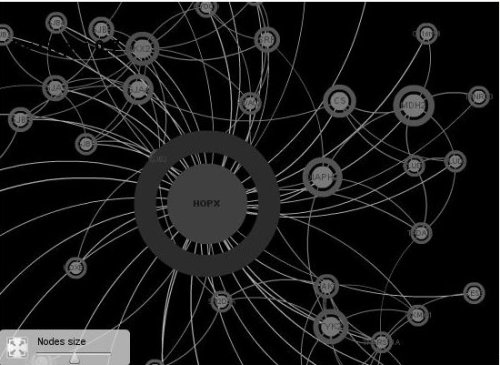
Generating a PDF for HOPX

I've downloaded the psi-mi.xml for HOPX from the embl-strings database and run the program.
java -cp /path/to/gephi-toolkit.jar:src sandbox.PsimiWithGephi -o ~/result.pdf file.xml

Result


Viewing the result with Flash

The API can export a GEXF file too and it can be visualized using a flash application named GEXF Explorer:

Note: "Sigma" is another viewer available for gexf: http://ofnodesandedges.com/sigma-neighborhoods-exploration/

That's it,

Pierre

02 September 2010

Playing with the ming API , a C library for SWF/Flash.My notebook.

Ming is a C library generating some simple Flash/SWF movies. In this post I will describe how I used the Ming API by try to converting to SWF the SVG that was generated in a previous post
Genetic Algorithm with Darwin's Face: Dynamic SVG


The original SVG file

The original SVG file looks like this:
<?xml version="1.0"?>
<svg:svg xmlns:svg="http://www.w3.org/2000/svg" version="1.1" width="160" height="222" style="stroke: none;" viewBox="0 0 160 222">
<svg:g id="face">
<svg:polygon points="110,193 11,320 -67,164" style="fill: rgb(129, 82, 122); opacity: 0.68;"/>
<svg:polygon points="109,30 224,181 -4,-1" style="fill: rgb(213, 113, 17); opacity: 0.52;"/>
<svg:polygon points="128,105 101,0 209,-75" style="fill: rgb(200, 91, 58); opacity: 0.04;"/>
<svg:polygon points="115,183 169,232 193,-29" style="fill: rgb(185, 133, 125); opacity: 0.9;"/>
<svg:polygon points="68,186 47,39 57,30" style="fill: rgb(249, 68, 34); opacity: 0.62;"/>
<svg:polygon points="80,185 108,123 158,131" style="fill: rgb(62, 181, 169); opacity: 0.56;"/>
<svg:polygon points="110,61 211,-86 115,217" style="fill: rgb(10, 46, 216); opacity: 0.86;"/>
<svg:polygon points="115,183 169,232 192,-27" style="fill: rgb(188, 127, 122); opacity: 0.9;"/>
<svg:polygon points="78,197 205,135 85,178" style="fill: rgb(53, 145, 210); opacity: 0.6;"/>
<svg:polygon points="108,64 211,-81 111,220" style="fill: rgb(10, 46, 216); opacity: 0.46;"/>
<svg:polygon points="110,59 210,-88 116,215" style="fill: rgb(10, 46, 216); opacity: 0.86;"/>
<svg:polygon points="53,138 60,45 46,60" style="fill: rgb(13, 98, 29); opacity: 0.8;"/>
(...)


A generic C program using the ming API would look like this:
/* initialize ming */
Ming_init();
/* create a movie */
movie=newSWFMovie();
/* set number of frames */
SWFMovie_setNumberOfFrames(movie, NUM_FRAME);
/* loop over the frames */
for(i=0;i<NUM_FRAME;++i)
{
/* create rectange */
rect = newSWFShape();
SWFShape_movePenTo(rect,x,y);
SWFShape_drawLineTo(rect,x+width,y);
SWFShape_drawLineTo(rect,x+width,y+height);
SWFShape_drawLineTo(rect,x,y+height);
SWFShape_drawLineTo(rect,x,y);
/* add figure in the movie */
SWFMovie_add(swf, rect);
(...)
/* add frame */
SWFMovie_nextFrame(movie);
}
/* save movie to file */
WFMovie_save(movie,"file.swf");
/* dispose movie */
destroySWFMovie(movie);
I created a simple C code transforming my SVG to SWF using the ming API. The file contains 5 frames where I slightly moved some shapes. The code was posted on github at: http://github.com/lindenb/ccsandbox/blob/master/src/svg2swf.c.
Compile & run:
export LD_LIBRARY_PATH=${ming.lib.dir}
gcc -L ${ming.lib.dir} -I ${ming.include.dir} `xml2-config --cflags ` svg2swf.c -lming `xml2-config --libs `
./a.out -o darwin.swf darw.svg


That's it
Pierre

03 October 2008

Java Wrappers for the tables of the UCSC/GoldenPath

Years ago, Jim Kent(UCSC) (the author of the BLAT algorithm) published in the Linux Journal "autoSql and autoXml: Code Generators from the Genome Project" the tools generate database definitions for SQL, write C header files with your data definitions and function prototypes, write C code to get data to and from C structures and generate C code for an XML parser.

For example the following 'as' file (http://hgwdev.cse.ucsc.edu/~kent/src/unzipped/hg/lib/cytoBand.as is the definition of the table called cytoBand:

table cytoBand
"Describes the positions of cytogenetic bands with a chromosome"
(
string chrom; "Reference sequence chromosome or scaffold"
uint chromStart; "Start position in genoSeq"
uint chromEnd; "End position in genoSeq"
string name; "Name of cytogenetic band"
string gieStain; "Giemsa stain results"
)


will be used to generate the following sql definition
# cytoBand.sql was originally generated by the autoSql program, which also 
# generated cytoBand.c and cytoBand.h. This creates the database representation of
# an object which can be loaded and saved from RAM in a fairly
# automatic way.

#Describes the positions of cytogenetic bands with a chromosome
CREATE TABLE cytoBand (
chrom varchar(255) not null, # Human chromosome number
chromStart int unsigned not null, # Start position in genoSeq
chromEnd int unsigned not null, # End position in genoSeq
name varchar(255) not null, # Name of cytogenetic band
gieStain varchar(255) not null, # Giemsa stain results
#Indices
PRIMARY KEY(chrom(12),chromStart),
UNIQUE(chrom(12),chromEnd)
);

the C code, and the C header.

As a java programmer I wanted to create my own wrappers to use the data of the UCSC. I wrote a custom ANT task(the code is available here) using the public mysql server of the UCSC to get the structure of each table (e.g. desc cytoBand) and the description of each table (e.g. select autoSqlDef from tableDescriptions where tableName="cytoBand"). Each structure is parsed and injected into an apache-velocity template (the template is available here).

Here is an example of a source generated by the ant task:

As you can see 'enum' and 'set' are transformed into java Enum, getter, tableModel (for gui/swing) are created. Each class also comes with some useful static methods creating the instances from a sql query. For example here is what I wrote today to grab the information about the genes/cytobands/hapmap about a set of snp.

 for(RsId rsid: rsSet)
{
PreparedStatement pstmt=con.prepareStatement("select * from snp129 where name=?");
pstmt.setString(1, rsid.getName());
Hg18Snp129 snp= Hg18Snp129.selectOneOrZero(pstmt.executeQuery());
if(snp==null)
{
cout().println(rsid.getName()+TAB+"##Not FOUND");
continue;
}

(... print information about this snp ...)

pstmt=con.prepareStatement("select * from cytoBand where chrom=? and chromStart<=? and chromEnd>=?");
pstmt.setString(1, snp.getChrom());
pstmt.setInt(2, snp.getChromStart());
pstmt.setInt(3, snp.getChromEnd());

for(Hg18CytoBand band:Hg18CytoBand.select(pstmt.executeQuery()))
{
(.. print info about this cytoband...)
}
cout().print(TAB);
pstmt=con.prepareStatement("select * from refGene where chrom=? and txStart<=? and txEnd>=?");
pstmt.setString(1, snp.getChrom());
pstmt.setInt(2, snp.getChromStart());
pstmt.setInt(3, snp.getChromEnd());
i=0;
for(Hg18RefGene gene : Hg18RefGene.select(pstmt.executeQuery()))
{
if(i>0) cout().print(",");
cout().print(gene.getName()+"/"+gene.getName2());
++i;
}
cout().print(TAB);

for(String hapmapDb:HAPMAPDB)
{
pstmt=con.prepareStatement("select * from "+hapmapDb+" where name=?");
pstmt.setString(1, snp.getName());
Hg18HapmapSnps hapmap= Hg18HapmapSnps.selectOneOrZero(pstmt.executeQuery());
if(hapmap==null)
{
(...print empty fields...)
}
else
{
(... print result)
}
}
}


Note: Hibernate is also a popular tool to map objects to databases. But here everything is read-only, (we don't need any transaction) and the relationships between the tables are rather complicated to be described using a mapping file (e.g. see the numerous "Connected Tables and Joining Fields" for the table knownGene).

That's it

Pierre

10 January 2008

JAVA Native Interface (JNI): notebook

The JAVA Native Interface (JNI)allows Java code running in the Java virtual machine to call and (be called) some methods from libraries written in C/C++. I've learned this technology by trying to use the CURSES library (an API allowing the programmer to write text user interfaces in a terminal).

We starts by creating a java class: NCurses.java


1 /* A JNI test */
2 public class NCurses
3 {
4 public NCurses() {}
5 /** initializes the ncurses library */
6 public native static int install();
7 /** disposes the ncurses library */
8 public native static int uninstall();
9 /** set character on screen */
10 public native static void setCharAt(int x,int y,int ch);
11 /** update the screen */
12 public native static void refresh();
13 /** get the number of rows */
14 public native int getRowCount();
15 /** get the number of columns */
16 public native int getColumnCount();
17 /** inverse video */
18 public native int standout();
19 /** normal video */
20 public native int standend();
21
22 /** draw a string at the given position */
23 public void drawString(String s,int x, int y)
24 {
25 int maxx= getColumnCount();
26 for(int i=0;i< s.length() && i+x < maxx;++i)
27 {
28 if(i+3< s.length() && s.substring(i,i+3).equals("<b>"))
29 {
30 standout(); i+=2; continue;
31 }
32 else if(i+4< s.length() && s.substring(i,i+4).equals("</b>"))
33 {
34 standend(); i+=3; continue;
35 }
36 setCharAt(i+x,y,s.charAt(i));
37 }
38 }
39
40 public static void main(String[] args)
41 {
42 //load the C library
43 System.loadLibrary("NCurses");
44 //init curses
45 NCurses.install();
46
47 NCurses sample = new NCurses();
48
49 //draw a box
50 for(int i=1;i+1< sample.getRowCount();++i)
51 {
52 sample.setCharAt(1,i,'*');
53 sample.setCharAt(sample.getColumnCount()-2,i,'*');
54 }
55 for(int i=1;i+1< sample.getColumnCount();++i)
56 {
57 sample.setCharAt(i,1,'*');
58 sample.setCharAt(i,sample.getRowCount()-2,'*');
59 }
60 /* draw some strings */
61 int n=0;
62 for(int i=2;i+3< sample.getRowCount();i+=3)
63 {
64 sample.drawString("<b>Menu \t"+(++n)+"</b>: Hello Menu",5,i);
65 }
66 /* update the screen */
67 sample.refresh();
68 /* wait 10 sec */
69 try{ Thread.sleep(10000); } catch(Exception err) {}
70 //dispose ncurses
71 NCurses.uninstall();
72 }
73 }


This class contains some native methods that are not implemented in this class but they will be loading (line 43 by calling System.loadLibrary)

We can compile this class:
javac NCurses.java


We can run JAVAH on this class. javah will generate the C header file that are needed to implement our native methods.

javah NCurses


This generates the following file: NCurses.h


1 /* DO NOT EDIT THIS FILE - it is machine generated */
2 #include <jni.h>
3 /* Header for class NCurses */
4
5 #ifndef _Included_NCurses
6 #define _Included_NCurses
7 #ifdef __cplusplus
8 extern "C" {
9 #endif
10 /*
11 * Class: NCurses
12 * Method: install
13 * Signature: ()I
14 */
15 JNIEXPORT jint JNICALL Java_NCurses_install
16 (JNIEnv *, jclass);
17
18 /*
19 * Class: NCurses
20 * Method: uninstall
21 * Signature: ()I
22 */
23 JNIEXPORT jint JNICALL Java_NCurses_uninstall
24 (JNIEnv *, jclass);
25
26 /*
27 * Class: NCurses
28 * Method: setCharAt
29 * Signature: (III)V
30 */
31 JNIEXPORT void JNICALL Java_NCurses_setCharAt
32 (JNIEnv *, jclass, jint, jint, jint);
33
34 /*
35 * Class: NCurses
36 * Method: refresh
37 * Signature: ()V
38 */
39 JNIEXPORT void JNICALL Java_NCurses_refresh
40 (JNIEnv *, jclass);
41
42 /*
43 * Class: NCurses
44 * Method: getRowCount
45 * Signature: ()I
46 */
47 JNIEXPORT jint JNICALL Java_NCurses_getRowCount
48 (JNIEnv *, jobject);
49
50 /*
51 * Class: NCurses
52 * Method: getColumnCount
53 * Signature: ()I
54 */
55 JNIEXPORT jint JNICALL Java_NCurses_getColumnCount
56 (JNIEnv *, jobject);
57
58 /*
59 * Class: NCurses
60 * Method: standout
61 * Signature: ()I
62 */
63 JNIEXPORT jint JNICALL Java_NCurses_standout
64 (JNIEnv *, jobject);
65
66 /*
67 * Class: NCurses
68 * Method: standend
69 * Signature: ()I
70 */
71 JNIEXPORT jint JNICALL Java_NCurses_standend
72 (JNIEnv *, jobject);
73
74 #ifdef __cplusplus
75 }
76 #endif
77 #endif


I've implemented the C methods in the following file: NCurses.c

1 #include "NCurses.h"
2 #include <string.h>
3 #include <curses.h>
4 #include <signal.h>
5
6 JNIEXPORT jint JNICALL Java_NCurses_install(JNIEnv *env, jclass clazz)
7 {
8 //(void) signal(SIGINT, finish); /* arrange interrupts to terminate */
9
10 (void) initscr(); /* initialize the curses library */
11 keypad(stdscr, TRUE); /* enable keyboard mapping */
12 (void) nonl(); /* tell curses not to do NL->CR/NL on output */
13 (void) cbreak(); /* take input chars one at a time, no wait for \n */
14 (void) noecho(); /* don't echo input */
15 clear();
16 move(0,0);
17 refresh();
18 return 0;
19 }
20
21 JNIEXPORT jint JNICALL Java_NCurses_uninstall(JNIEnv *env, jclass clazz)
22 {
23 endwin();
24 return 0;
25 }
26
27 JNIEXPORT jint JNICALL Java_NCurses_getRowCount(JNIEnv *env, jobject obj)
28 {
29 int h, w;
30 getmaxyx(stdscr, h, w);
31 return h;
32 }
33
34
35 JNIEXPORT jint JNICALL Java_NCurses_getColumnCount(JNIEnv *env, jobject obj)
36 {
37 int h, w;
38 getmaxyx(stdscr, h, w);
39 return w;
40 }
41
42 /*
43 * Class: NCurses
44 * Method: setCharAt
45 * Signature: (III)V
46 */
47 JNIEXPORT void JNICALL Java_NCurses_setCharAt
48 (JNIEnv *env, jclass object, jint x, jint y, jint chr)
49 {
50 mvaddch(y,x,chr);
51 }
52
53 /*
54 * Class: NCurses
55 * Method: refresh
56 * Signature: ()V
57 */
58 JNIEXPORT void JNICALL Java_NCurses_refresh
59 (JNIEnv *env, jclass object)
60 {
61 refresh();
62 }
63
64
65 /*
66 * Class: NCurses
67 * Method: standout
68 * Signature: ()I
69 */
70 JNIEXPORT jint JNICALL Java_NCurses_standout
71 (JNIEnv *env, jobject object)
72 {
73 standout();
74 }
75
76 /*
77 * Class: NCurses
78 * Method: standend
79 * Signature: ()I
80 */
81 JNIEXPORT jint JNICALL Java_NCurses_standend
82 (JNIEnv * env, jobject object)
83 {
84 standend();
85 }


before compiling the C source, I set the variable LD_LIBRARY_PATH. For my machine it was:
export LD_LIBRARY_PATH=${PWD}:/usr/local/lib:/usr/lib


We can now compile NCurses.c and create the C library. You may need to add the path the java C headers which are contained in ${JAVA_HOME}/include/ and ${JAVA_HOME}/include/{your-machine}

gcc -fpic -c NCurses.c -o NCurses.o
gcc -shared -o libNCurses.so NCurses.o -lcurses


Let's run our java program:

java NCurses


The result looks like this:

*********************************************
* Menu 1 : Hello Menu *
* *
* *
* Menu 2 : Hello Menu *
* *
* *
* Menu 3 : Hello Menu *
* *
* *
* Menu 4 : Hello Menu *
* *
* *
* Menu 5 : Hello Menu *
* *
* *
* Menu 6 : Hello Menu *
* *
* *
* *
*********************************************


That's it.
Pierre

18 October 2007

Information R/evolution

A beautiful video about the science of information...

04 May 2007

(Trying to use) The NCBI ASN.1 library

Motivation: I was looking for a way to store and to read my linkage data using a binary format, (then I could get a faster and a smaller size).

I had a glance to the NCBI C toolbox which uses ASN.1 as its main format to encode and to structure the data just like XML.

About ASN1: ASN.1 is a standard that describes data structures for representing, encoding, transmitting, and decoding data. It provides a set of formal rules for describing the structure of objects that are independent of machine-specific encoding techniques and is a precise, formal notation that removes ambiguities. Its usage can be compared to the more recent XML Schema (see also my previous post about JAXB).

The NCBI ASN1 C library is descibed here: http://www.ncbi.nlm.nih.gov/IEB/ToolBox/SDKDOCS/ASNLIB.HTML

Although I still have a problem in the last part, this post can be considered as my first experience with the ASN.1 library.

I started my test by defining a small ASN.1 module to store some PCR primers and their hits on the genome


PCRMod DEFINITIONS ::=
BEGIN
Orientation ::= ENUMERATED
{
forward(0),
reverse(1)
}

Hit ::= SEQUENCE
{
chromosome VisibleString, -- chromosome
start INTEGER, -- starting position in chromosome 5' + strand
orient Orientation -- orientation
}

Primer ::= SEQUENCE {
name VisibleString, -- name
tm REAL OPTIONAL, -- melting temperature
sequence VisibleString, -- sequence
hits SET OF Hit OPTIONAL -- hits
}

PrimerInput ::=SEQUENCE OF Primer

END


This schema 'primer.asn' was digested by the asntool


asntool -Z T -w 128 -m primer.asn -G T -B primer -K primerasn
asntool -Z T -w 128 -m primer.asn-o primerasn.h


here asntool will read the 'primer.asn' and will generate three source files:

primerasn.h: is a C header containing all states that will be used the parse the ASN1 files.
/***********************************************************************
*
**
* Automatic header module from ASNTOOL
*
************************************************************************/

(...)

static char * asnfilename = "primerasn.h";
static AsnValxNode avnx[2] = {
{20,"forward" ,0,0.0,&avnx[1] } ,
{20,"reverse" ,1,0.0,NULL } };

static AsnType atx[20] = {
{401, "Orientation" ,1,0,0,0,0,0,0,0,NULL,&atx[1],&avnx[0],0,&atx[2]} ,
{310, "ENUMERATED" ,0,10,0,0,0,0,0,0,NULL,NULL,NULL,0,NULL} ,
{402, "Hit" ,1,0,0,0,0,0,0,0,NULL,&atx[8],&atx[3],0,&atx[9]} ,
{0, "chromosome" ,128,0,0,0,0,0,0,0,NULL,&atx[4],NULL,0,&atx[5]} ,
{323, "VisibleString" ,0,26,0,0,0,0,0,0,NULL,NULL,NULL,0,NULL} ,
{0, "start" ,128,1,0,0,0,0,0,0,NULL,&atx[6],NULL,0,&atx[7]} ,
{302, "INTEGER" ,0,2,0,0,0,0,0,0,NULL,NULL,NULL,0,NULL} ,
{0, "orient" ,128,2,0,0,0,0,0,0,NULL,&atx[0],NULL,0,NULL} ,
{311, "SEQUENCE" ,0,16,0,0,0,0,0,0,NULL,NULL,NULL,0,NULL} ,
{403, "Primer" ,1,0,0,0,0,0,0,0,NULL,&atx[8],&atx[10],0,&atx[17]} ,
{0, "name" ,128,0,0,0,0,0,0,0,NULL,&atx[4],NULL,0,&atx[11]} ,
{0, "tm" ,128,1,0,1,0,0,0,0,NULL,&atx[12],NULL,0,&atx[13]} ,
{309, "REAL" ,0,9,0,0,0,0,0,0,NULL,NULL,NULL,0,NULL} ,
{0, "sequence" ,128,2,0,0,0,0,0,0,NULL,&atx[4],NULL,0,&atx[14]} ,
{0, "hits" ,128,3,0,1,0,0,0,0,NULL,&atx[16],&atx[15],0,NULL} ,
{0, NULL,1,-1,0,0,0,0,0,0,NULL,&atx[2],NULL,0,NULL} ,
{314, "SET OF" ,0,17,0,0,0,0,0,0,NULL,NULL,NULL,0,NULL} ,
{404, "PrimerInput" ,1,0,0,0,0,0,0,0,NULL,&atx[19],&atx[18],0,NULL} ,
{0, NULL,1,-1,0,0,0,0,0,0,NULL,&atx[9],NULL,0,NULL} ,
{312, "SEQUENCE OF" ,0,16,0,0,0,0,0,0,NULL,NULL,NULL,0,NULL} };

static AsnModule ampx[1] = {
{ "PCRMod" , "primerasn.h",&atx[0],NULL,NULL,0,0} };

static AsnValxNodePtr avn = avnx;
static AsnTypePtr at = atx;
static AsnModulePtr amp = ampx;


/**************************************************
*
* Defines for Module PCRMod
*
**************************************************/

#define ORIENTATION &at[0]

#define HIT &at[2]
#define HIT_chromosome &at[3]
#define HIT_start &at[5]
#define HIT_orient &at[7]

#define PRIMER &at[9]
#define PRIMER_name &at[10]
#define PRIMER_tm &at[11]
#define PRIMER_sequence &at[13]
#define PRIMER_hits &at[14]
#define PRIMER_hits_E &at[15]

#define PRIMERINPUT &at[17]
#define PRIMERINPUT_E &at[18]


primer.h: contains the C headers used to parse the structure declared in the ASN1 schema. There is a method to allocate/free/read and write each structure.
#
(...)
/**************************************************
*
* Generated objects for Module PCRMod
*
**************************************************/

NLM_EXTERN Boolean LIBCALL
primerAsnLoad PROTO((void));
/* following #defines are for enumerated type, not used by object loaders */
#define Orientation_forward 0
#define Orientation_reverse 1


/**************************************************
* Hit
**************************************************/
typedef struct struct_Hit {
struct struct_Hit PNTR next;
Uint4 OBbits__;
CharPtr chromosome;
Int4 start;
Uint2 orient;
} Hit, PNTR HitPtr;


NLM_EXTERN HitPtr LIBCALL HitFree PROTO ((HitPtr ));
NLM_EXTERN HitPtr LIBCALL HitNew PROTO (( void ));
NLM_EXTERN HitPtr LIBCALL HitAsnRead PROTO (( AsnIoPtr, AsnTypePtr));
NLM_EXTERN Boolean LIBCALL HitAsnWrite PROTO (( HitPtr , AsnIoPtr, AsnTypePtr));


/**************************************************
* Primer
**************************************************/
typedef struct struct_Primer {
struct struct_Primer PNTR next;
Uint4 OBbits__;
CharPtr name;
#define OB__Primer_tm 0

FloatHi tm;
CharPtr sequence;
struct struct_Hit PNTR hits;
} Primer, PNTR PrimerPtr;


NLM_EXTERN PrimerPtr LIBCALL PrimerFree PROTO ((PrimerPtr ));
NLM_EXTERN PrimerPtr LIBCALL PrimerNew PROTO (( void ));
NLM_EXTERN PrimerPtr LIBCALL PrimerAsnRead PROTO (( AsnIoPtr, AsnTypePtr));
NLM_EXTERN Boolean LIBCALL PrimerAsnWrite PROTO (( PrimerPtr , AsnIoPtr, AsnTypePtr));


/**************************************************
* PrimerInput
**************************************************/
typedef struct struct_Primer PrimerInput;
typedef struct struct_Primer PNTR PrimerInputPtr;
#define PrimerInputNew() PrimerNew()


NLM_EXTERN PrimerInputPtr LIBCALL PrimerInputFree PROTO ((PrimerInputPtr ));
NLM_EXTERN PrimerInputPtr LIBCALL PrimerInputNew PROTO (( void ));
NLM_EXTERN PrimerInputPtr LIBCALL PrimerInputAsnRead PROTO (( AsnIoPtr, AsnTypePtr));
NLM_EXTERN Boolean LIBCALL PrimerInputAsnWrite PROTO (( PrimerInputPtr , AsnIoPtr, AsnTypePtr));
(...)


and primer.c the C implementation of those methods.

(...)


OK, here comes the problem: I wrote a simple ASN1 input
PrimerInput::={
{
name "Primer0",
sequence "ATAGCTACTGATGCATGCATCG"
}
}


and I wanted to read each primer. Here is my source:
#include <cerrno>
#include <fstream>
#include <iostream>
#include <string>
#include <stdexcept>
#include <asn.h>
#include <cassert>

/** include the files generated by the ASN1 tool */
#include <primer.h>
#include <primerasn.h>

int main(int argc, char** argv)
{
int optind=1;

/* init my specification */
if(!primerAsnLoad())
{
fprintf(stderr,"#%s: cannot load ASN1 specification \"%s\".\n" ,
argv[0],asnfilename );
return (EXIT_FAILURE);
}

if(optind+1!=argc)
{
fprintf(stderr,"bad input : usage %s ASN1 file\n",argv[0]);
return(EXIT_FAILURE);
}

/** open the input file */
AsnIoPtr in = AsnIoOpen(argv[1],"r");
if(in==NULL)
{
fprintf(stderr,"Cannot Read %s\n",argv[1]);
return(EXIT_FAILURE);
}


/** init the state of the parser */
AsnTypePtr asn_type_ptr=PRIMERINPUT;
PrimerPtr primer= NULL;

/** while we can read a primer... */
while ((asn_type_ptr = AsnReadId(in, amp, asn_type_ptr)) != NULL)
{
if(asn_type_ptr==PRIMERINPUT_E)
{
primer= PrimerAsnRead(in,asn_type_ptr);
if(primer!=NULL)
{
fprintf(stderr,"sequence: %s\n",primer->sequence);
PrimerFree(primer);
}
}
else
{
AsnReadVal(in, asn_type_ptr,NULL);
}
}

AsnIoClose(in);
return(0);
}


The problem: my input file is processed silently but the output shows two primers insted of one and the sequence is said to be NULL.

sequence: (null)
sequence: (null)


I'm blocked here :-)


Pierre