Showing posts with label go. Show all posts

09 January 2013

A XML schema (xsd) for GeneOntology

The GeneOntology can be downloaded as a RDF/XML file from http://archive.geneontology.org/latest-termdb/go_daily-termdb.rdf-xml.gz.
Although it is a RDF file, the structure of the file remains the same. As a consequence, it is shipped with a DTD that describes the structure of the document ( http://www.geneontology.org/dtd/go.dtd ).
I've just written a XML schema (XSD) for this RDF file. This schema is available on github at:
https://github.com/lindenb/xsd-sandbox/tree/master/schemas/bio/go.

Validation with xmllint

The RDF file is successfully validated against my xsd schema:
$ curl "http://archive.geneontology.org/latest-termdb/go_daily-termdb.rdf-xml.gz" |\
 gunzip -c | grep -v "<!DOCTYPE " > go.xml

xmllint  --noout --schema go.xsd go.xml
go.xml validates
Note: I've ignored the elements defined in the DTD but absent in the RDF file.

Code Generation with XJC

XJC can be used to generate the java classes for this schema:
xjc go.xsd 
parsing a schema...
compiling a schema...
org/w3/_1999/_02/_22_rdf_syntax_ns_/ObjectFactory.java
org/w3/_1999/_02/_22_rdf_syntax_ns_/RDF.java
org/w3/_1999/_02/_22_rdf_syntax_ns_/package-info.java
org/geneontology/dtds/go/AbstractRelation.java
org/geneontology/dtds/go/Go.java
org/geneontology/dtds/go/IsA.java
org/geneontology/dtds/go/NegativelyRegulates.java
org/geneontology/dtds/go/ObjectFactory.java
org/geneontology/dtds/go/PartOf.java
org/geneontology/dtds/go/PositivelyRegulates.java
org/geneontology/dtds/go/Regulates.java
org/geneontology/dtds/go/package-info.java

Java Parsing

... and we can parse the terms of GO with java without writing a new parser and without any dependencies. For example, the following code parses the whole ontology and prints it to stdout as XML:
import java.io.InputStream;
import java.io.StringWriter;
import org.geneontology.dtds.go.*;
import org.w3._1999._02._22_rdf_syntax_ns_.*;
import javax.xml.namespace.QName;
import javax.xml.bind.JAXBContext;
import javax.xml.bind.JAXBElement;
import javax.xml.bind.Unmarshaller;
import javax.xml.bind.Marshaller;
import javax.xml.transform.stream.StreamSource;

public class TestGo
    {
    public static void main(String[] args) throws Exception
        {
 JAXBContext jaxbCtxt=JAXBContext.newInstance("org.geneontology.dtds.go:org.w3._1999._02._22_rdf_syntax_ns_");
 Marshaller marshaller = jaxbCtxt.createMarshaller();
 Unmarshaller unmarshaller=jaxbCtxt.createUnmarshaller();
        marshaller.setProperty("jaxb.formatted.output",true);
        Object go=unmarshaller.unmarshal(new java.io.File("go.xml"));
        marshaller.marshal(go, System.out);
        }
    }
compile and run:
$javac TestGo.java \
  org/w3/_1999/_02/_22_rdf_syntax_ns_/ObjectFactory.java \
  org/geneontology/dtds/go/ObjectFactory.java

$ java TestGo  | head -n 100
<?xml version="1.0" encoding="UTF-8" standalone="yes"?>
<go xmlns="http://www.geneontology.org/dtds/go.dtd#" xmlns:ns2="http://www.w3.org/1999/02/22-rdf-syntax-ns#">
    <ns2:RDF>
        <term ns2:about="http://www.geneontology.org/go#GO:0000001">
            <accession>GO:0000001</accession>
            <name>mitochondrion inheritance</name>
            <synonym>mitochondrial inheritance</synonym>
            <definition>The distribution of mitochondria, including the mitochondrial genome, into daughter cells after mitosis or meiosis, mediated by interactions between mitochondria and the cytoskeleton.</definition>
            <is_a ns2:resource="http://www.geneontology.org/go#GO:0048308"/>
            <is_a ns2:resource="http://www.geneontology.org/go#GO:0048311"/>
        </term>
        <term ns2:about="http://www.geneontology.org/go#GO:0000002">
            <accession>GO:0000002</accession>
            <name>mitochondrial genome maintenance</name>
            <definition>The maintenance of the structure and integrity of the mitochondrial genome; includes replication and segregation of the mitochondrial chromosome.</definition>
            <is_a ns2:resource="http://www.geneontology.org/go#GO:0007005"/>
            <dbxref ns2:parseType="Resource">
                <database_symbol>InterPro</database_symbol>
                <reference>IPR009446</reference>

That's it,

Pierre

PS: many thanks to @bdoughan for his help on SO.

06 April 2012

Indexing the content of Gene Ontology with apache SOLR

Via Wikipedia:"Solr (http://lucene.apache.org/solr/) is an open source enterprise search platform from the Apache Lucene project. Its major features include powerful full-text search, hit highlighting, faceted search, dynamic clustering, database integration, and rich document (e.g., Word, PDF) handling. Providing distributed search and index replication, Solr is highly scalable." In the this post, I'll show how I've used SOLR to index the content of GeneOntology.

Download and install SOLR

Download from http://mirrors.ircam.fr/pub/apache/lucene/solr/3.5.0/apache-solr-3.5.0.tgz.
tar xvfz apache-solr-3.5.0.tgz
rm apache-solr-3.5.0.tgz

Configure schema.xml

We need to tell SOLR about the which fields of GO will be indexed, what are their type, how they should be tokenized and parsed. This information is defined in the schema.xml. The following components will be indexed: accession, name, synonym and definition. Edit apache-solr-3.5.0/example/solr/conf/schema.xml and add the following <fields>:

<field name="go_name" type="text_general" indexed="true" stored="true" multiValued="false"/>
<field name="go_synonym" type="text_general" indexed="true" stored="true" multiValued="true"/>
<field name="go_definition" type="text_general" indexed="true" stored="true" multiValued="false"/>

Start the SOLR server

In this example, the SOLR server is started using the simple Jetty server provided in the distribution:

$ cd apache-solr-3.5.0/example/example
$ java -jar start.jar

(...)

Indexing Gene Ontology

Go is downloaded as RDF/XML from http://archive.geneontology.org/latest-termdb/go_daily-termdb.rdf-xml.gz
 
<?xml version="1.0" encoding="UTF-8"?>
<!DOCTYPE go:go PUBLIC "-//Gene Ontology//Custom XML/RDF Version 2.0//EN" "http://www.geneontology.org/dtd/go.dtd">

<go:go xmlns:go="http://www.geneontology.org/dtds/go.dtd#" xmlns:rdf="http://www.w3.org/1999/02/22-rdf-syntax-ns#">
    <rdf:RDF>
        <go:term rdf:about="http://www.geneontology.org/go#GO:0000001">
            <go:accession>GO:0000001</go:accession>
            <go:name>mitochondrion inheritance</go:name>
            <go:synonym>mitochondrial inheritance</go:synonym>
            <go:definition>The distribution of mitochondria, including the mitochondrial genome, into daughter cells after mitosis or meiosis, mediated by interactions between mitochondria and the cytoskeleton.</go:definition>
            <go:is_a rdf:resource="http://www.geneontology.org/go#GO:0048308" />
            <go:is_a rdf:resource="http://www.geneontology.org/go#GO:0048311" />
        </go:term>
        <go:term rdf:about="http://www.geneontology.org/go#GO:0000002">
            <go:accession>GO:0000002</go:accession>
            <go:name>mitochondrial genome maintenance</go:name>
            <go:definition>The maintenance of the structure and integrity of the mitochondrial genome; includes replication and segregation of the mitochondrial chromosome.</go:definition>
            <go:is_a rdf:resource="http://www.geneontology.org/go#GO:0007005" />
            <go:dbxref rdf:parseType="Resource">
                <go:database_symbol>InterPro</go:database_symbol>
(...)
 
We now need to transform this XML file to another XML file that can be indexed by the SOLR server.  

"You can modify a Solr index by POSTing XML Documents containing instructions to add (or update) documents, delete documents, commit pending adds and deletes, and optimize your index."

The following XSLT stylesheet is used to transform the RDF/XML for GO:


$ xsltproc --novalid go2solr.xsl go_daily-termdb.rdf-xml.gz > add.xml
$ cat add.xml

Before indexing the current disk usage under apache-solr-3.5.0 is 136Mo. We can now use the java utiliy post.jar to index GeneOntology.

 $ cd  ~/package/apache-solr-3.5.0/example/exampledocs
 $ java -jar post.jar  add.xml

SimplePostTool: version 1.4
SimplePostTool: POSTing files to http://localhost:8983/solr/update..
SimplePostTool: POSTing file jeter.xml
SimplePostTool: COMMITting Solr index changes..

After indexing, the disk usage under apache-solr-3.5.0 is 153Mo.

Querying

Search for the GO terms having go:definition containing "cancer" a go:name containing "genome" but discard those having go:definition containing "metabolism".
 curl "http://localhost:8983/solr/select/?q=go_definition%3Acancer+go_name%3Agenome+-go_definition%3Ametabolism&version=2.2&start=0&rows=10&indent=on"
Same query, but return the result as a JSON structure:
 curl "http://localhost:8983/solr/select/?q=go_definition%3Acancer+go_name%3Agenome+-go_definition%3Ametabolism&version=2.2&start=0&rows=10&indent=on&wt=json"
That's it, Pierre

31 January 2012

Inside the Variation Toolkit: Tools for Gene Ontology

GeneOntologyDbManager is a C++ tool that is part of my experimental Variation Toolkit.
This program is a set of tools for GeneOntology, it is based on the sqlite3 library.

Download

Download the sources from Google-Code using subversion:....
svn checkout http://variationtoolkit.googlecode.com/svn/trunk/ variationtoolkit-read-only
... or update the sources of an existing installation...
cd variationtoolkit
svn update
... and edit the variationtoolkit/congig.mk file.

Dependencies

Compilation

Define "SQLITE_LIB" and "SQLITE_CFLAGS" in config.mk (see HowToInstall )
$ cd variationtoolkit/src/
$ make ../bin/godbmgr 

if ! [ -z "-lsqlite3" ] ;then g++ -o ../bin/godbmgr godatabasemgr.cpp xsqlite.cpp application.o xstream.o xxml.o -g `xml2-config --cflags `  /usr/include/sqlite3.h   -lz -lsqlite3 `xml2-config  --libs` ; else g++ -o ../bin/godbmgr godatabasemgr.cpp  -DNOSQLITE -O3 -Wall  ; fi

Usage

godbmgr (program-name) -f database.sqlite [options] (file1.vcf file2... | stdin )

Sub-Program: loadrdf

Loads the RDF/XML GO database (http://archive.geneontology.org/latest-termdb/go_daily-termdb.rdf-xml.gz) into the sqlite3 database.

Usage

godbmgr loadrdf -f database.sqlite (stdin|file)

Options

  • -f (filename) the sqlite3 database

Example

$ curl -s "http://archive.geneontology.org/latest-termdb/go_daily-termdb.rdf-xml.gz" |\
  gunzip -c |\
  godbmgr loadrdf -f database.sqlite
list the content of the database:
$ sqlite3 -separator '  ' -header  database.sqlite 'select * from TERM where acn="GO:0000007"'
acn xml
GO:0000007 <go:term xmlns:go="http://www.geneontology.org/dtds/go.dtd#" xmlns:rdf="http://www.w3.org/1999/02/22-rdf-syntax-ns#" rdf:about="http://www.geneontology.org/go#GO:0000007">
            <go:accession xmlns:go="http://www.geneontology.org/dtds/go.dtd#">GO:0000007</go:accession>
            <go:name xmlns:go="http://www.geneontology.org/dtds/go.dtd#">low-affinity zinc ion transmembrane transporter activity</go:name>
            <go:definition xmlns:go="http://www.geneontology.org/dtds/go.dtd#">Catalysis of the transfer of a solute or solutes from one side of a membrane to the other according to the reaction: Zn2+ = Zn2+, probably powered by proton motive force. In low affinity transport the transporter is able to bind the solute only if it is present at very high concentrations.</go:definition>
            <go:is_a xmlns:go="http://www.geneontology.org/dtds/go.dtd#" xmlns:rdf="http://www.w3.org/1999/02/22-rdf-syntax-ns#" rdf:resource="http://www.geneontology.org/go#GO:0005385"/>
        </go:term>


$ sqlite3 -separator '  ' -header  database.sqlite 'select * from TERM2REL where acn="GO:0000007"'
acn rel target
GO:0000007 is_a GO:0005385

Sub-Program: loadgoa

inserts the database for GOA into a sqlite3 database (e.g: ftp://ftp.ebi.ac.uk/pub/databases/GO/goa/HUMAN/gene_association.goa_human.gz)

Usage

godbmgr loadgoa -f database.sqlite (stdin|file)

Options

  • -f (filename) the sqlite3 database

Examples

$  curl -s "ftp://ftp.ebi.ac.uk/pub/databases/GO/goa/HUMAN/gene_association.goa_human.gz" |\
     gunzip -c |\
     godbmgr loadgoa -f database.sqlite
list the content of the database:
$ sqlite3 -line   database.sqlite 'select * from GOA where term="GO:0005385" limit 2' 
              DB = UniProtKB
    DB_Object_ID = B3KU87
DB_Object_Symbol = SLC30A6
            term = GO:0005385
  DB_Object_Name = cDNA FLJ45816 fis, clone NT2RP7019682, highly similar to Homo sapiens solute carrier family 30 (zinc transporter), member 6 (SLC30A6), mRNA
         Synonym = B3KU87_HUMAN|SLC30A6|hCG_23082|IPI01009565|B7WP49
  DB_Object_Type = protein

              DB = UniProtKB
    DB_Object_ID = B5MCR8
DB_Object_Symbol = SLC30A6
            term = GO:0005385
  DB_Object_Name = Solute carrier family 30 (Zinc transporter), member 6, isoform CRA_b
         Synonym = B5MCR8_HUMAN|SLC30A6|hCG_23082|IPI00894292
  DB_Object_Type = protein

Sub-Program: desc

print the descendants (children) of a given GO node.

Usage

godbmgr desc -f db.sqlite [options] term1 term2 ... termn

Options

Examples

Default output

$ godbmgr desc -f database.sqlite "GO:0005385"
GO:0000006
GO:0000007
GO:0005385
GO:0015341
GO:0015633
GO:0016463
GO:0022883

xml/rdf output

$ godbmgr desc -f database.sqlite  -t xml "GO:0005385" | head

<go:go xmlns:go='http://www.geneontology.org/dtds/go.dtd#' xmlns:rdf='http://www.w3.org/1999/02/22-rdf-syntax-ns#'>
 <rdf:RDF>
<go:term xmlns:go="http://www.geneontology.org/dtds/go.dtd#" xmlns:rdf="http://www.w3.org/1999/02/22-rdf-syntax-ns#" rdf:about="http://www.geneontology.org/go#GO:0000006">
            <go:accession xmlns:go="http://www.geneontology.org/dtds/go.dtd#">GO:0000006</go:accession>
            <go:name xmlns:go="http://www.geneontology.org/dtds/go.dtd#">high affinity zinc uptake transmembrane transporter activity</go:name>
            <go:definition xmlns:go="http://www.geneontology.org/dtds/go.dtd#">Catalysis of the transfer of a solute or solutes from one side of a membrane to the other according to the reaction: Zn2+(out) = Zn2+(in), probably powered by proton motive force. In high affinity transport the transporter is able to bind the solute even if it is only present at very low concentrations.</go:definition>
            <go:is_a xmlns:go="http://www.geneontology.org/dtds/go.dtd#" xmlns:rdf="http://www.w3.org/1999/02/22-rdf-syntax-ns#" rdf:resource="http://www.geneontology.org/go#GO:0005385"/>
        </go:term>
<go:term xmlns:go="http://www.geneontology.org/dtds/go.dtd#" xmlns:rdf="http://www.w3.org/1999/02/22-rdf-syntax-ns#" rdf:about="http://www.geneontology.org/go#GO:0000007">
            <go:accession xmlns:go="http://www.geneontology.org/dtds/go.dtd#">GO:0000007</go:accession>

GOA output

$godbmgr desc -f database.sqlite -t goa  "GO:0005385"

UniProtKB B3KU87 SLC30A6 GO:0005385 cDNA FLJ45816 fis, clone NT2RP7019682, highly similar to Homo sapiens solute carrier family 30 (zinc transporter), member 6 (SLC30A6), mRNA B3KU87_HUMAN|SLC30A6|hCG_23082|IPI01009565|B7WP49 protein
UniProtKB B5MCR8 SLC30A6 GO:0005385 Solute carrier family 30 (Zinc transporter), member 6, isoform CRA_b B5MCR8_HUMAN|SLC30A6|hCG_23082|IPI00894292 protein
(..)
UniProtKB Q99726 SLC30A3 GO:0015633 Zinc transporter 3 ZNT3_HUMAN|ZNT3|SLC30A3|IPI00293793|Q8TC03protein

TSV output

$ godbmgr desc -f database.sqlite  -t tsv "GO:0022857" |\
    cut -c 1-100 |\
    head
#go:accession go.name go.def
GO:0000006 high affinity zinc uptake transmembrane transporter activity Catalysis of the transfer of
GO:0000007 low-affinity zinc ion transmembrane transporter activity Catalysis of the transfer of a s
GO:0000064 L-ornithine transmembrane transporter activity Catalysis of the transfer of L-ornithine f
GO:0000095 S-adenosylmethionine transmembrane transporter activity Catalysis of the transfer of S-ad
GO:0000099 sulfur amino acid transmembrane transporter activity Catalysis of the transfer of sulfur 
GO:0000100 S-methylmethionine transmembrane transporter activity Catalysis of the transfer of S-meth
GO:0000102 L-methionine secondary active transmembrane transporter activity Catalysis of the transfe
GO:0000227 oxaloacetate secondary active transmembrane transporter activity Catalysis of the transfe
GO:0000269 toxin export channel activity Enables the energy independent passage of toxins, sized les
(...)

Sub-Program: asc

prints the ascendants (parents) of a given node.

Usage

godbmgr asc -f db.sqlite [options] term1 term2 ... termn

Options

Examples

Default output

$ godbmgr asc -f database.sqlite "GO:0022857"
GO:0003674
GO:0005215
GO:0022857
all

xml/rdf output

$ godbmgr asc -f database.sqlite  -t xml "GO:0022857" | head

<go:go xmlns:go='http://www.geneontology.org/dtds/go.dtd#' xmlns:rdf='http://www.w3.org/1999/02/22-rdf-syntax-ns#'>
 <rdf:RDF>
<go:term xmlns:go="http://www.geneontology.org/dtds/go.dtd#" xmlns:rdf="http://www.w3.org/1999/02/22-rdf-syntax-ns#" rdf:about="http://www.geneontology.org/go#GO:0003674">
            <go:accession xmlns:go="http://www.geneontology.org/dtds/go.dtd#">GO:0003674</go:accession>
            <go:name xmlns:go="http://www.geneontology.org/dtds/go.dtd#">molecular_function</go:name>
            <go:synonym xmlns:go="http://www.geneontology.org/dtds/go.dtd#">GO:0005554</go:synonym>
            <go:synonym xmlns:go="http://www.geneontology.org/dtds/go.dtd#">molecular function</go:synonym>
            <go:synonym xmlns:go="http://www.geneontology.org/dtds/go.dtd#">molecular function unknown</go:synonym>
            <go:definition xmlns:go="http://www.geneontology.org/dtds/go.dtd#">Elemental activities, such as catalysis or binding, describing the actions of a gene product at the molecular level. A given gene product may exhibit one or more molecular functions.</go:definition>
            <go:comment xmlns:go="http://www.geneontology.org/dtds/go.dtd#">Note that, in addition to forming the root of the molecular function ontology, this term is recommended for use for the annotation of gene products whose molecular function is unknown. Note that when this term is used for annotation, it indicates that no information was available about the molecular function of the gene product annotated as of the date the annotation was made; the evidence code ND, no data, is used to indicate this.</go:comment>

GOA output

$godbmgr desc -f database.sqlite -t goa  "GO:0005385"

UniProtKB B3KU87 SLC30A6 GO:0005385 cDNA FLJ45816 fis, clone NT2RP7019682, highly similar to Homo sapiens solute carrier family 30 (zinc transporter), member 6 (SLC30A6), mRNA B3KU87_HUMAN|SLC30A6|hCG_23082|IPI01009565|B7WP49 protein
UniProtKB B5MCR8 SLC30A6 GO:0005385 Solute carrier family 30 (Zinc transporter), member 6, isoform CRA_b B5MCR8_HUMAN|SLC30A6|hCG_23082|IPI00894292 protein
(..)
UniProtKB Q99726 SLC30A3 GO:0015633 Zinc transporter 3 ZNT3_HUMAN|ZNT3|SLC30A3|IPI00293793|Q8TC03protein

TSV output

$ godbmgr asc -f database.sqlite  -t tsv "GO:0022857"   
#go:accession go.name go.def
GO:0003674 molecular_function Elemental activities, such as catalysis or binding, describing the actions of a gene product at the molecular level. A given gene product may exhibit one or more molecular functions.
GO:0005215 transporter activity Enables the directed movement of substances (such as macromolecules, small molecules, ions) into, out of or within a cell, or between cells.
GO:0022857 transmembrane transporter activity Enables the transfer of a substance from one side of a membrane to the other.
all all .

Sub-program: goa

Annotate a TSV file with the GOA annotation.

Usage

godbmgr goa -f db.sqlite [options] (stdin|files)

Options

  • -f (filename) the sqlite3 database
  • -c (column index) REQUIRED. The observed column.

Example

$ echo -e "#MyGene\nHello\nNOTCH2" |\
   godbmgr goa -c 1 -f database.sqlite  |\
   head -n 4 |\
   verticalize

>>> 2
$1 #MyGene                Hello
$2 DB                     .
$3 DB_Object_ID           .
$4 DB_Object_Symbol       .
$5 term                   .
$6 DB_Object_Name,Synonym .
$7 DB_Object_Type         .
$8   ???                    .
<<< 2

>>> 3
$1 #MyGene                NOTCH2
$2 DB                     UniProtKB
$3 DB_Object_ID           Q04721
$4 DB_Object_Symbol       NOTCH2
$5 term                   GO:0001709
$6 DB_Object_Name,Synonym Neurogenic locus notch homolog protein 2
$7 DB_Object_Type         NOTC2_HUMAN|NOTCH2|IPI00297655|Q5T3X7|Q99734|Q9H240
$8   ???                    protein
<<< 3

>>> 4
$1 #MyGene                NOTCH2
$2 DB                     UniProtKB
$3 DB_Object_ID           Q04721
$4 DB_Object_Symbol       NOTCH2
$5 term                   GO:0004872
$6 DB_Object_Name,Synonym Neurogenic locus notch homolog protein 2
$7 DB_Object_Type         NOTC2_HUMAN|NOTCH2|IPI00297655|Q5T3X7|Q99734|Q9H240
$8   ???                    protein

Sub-Program: grep

filters the line having an identifier (gene...) that is a children of a given GO term.

Usage

godbmgr grep -f db.sqlite [options] (stdin|files)

Options

  • -f (filename) the sqlite3 database
  • -c (column index) REQUIRED. The column containing a GO:acn
  • -v inverse selection
  • -t (GO:acn) add a GO term in the filter (One is REQUIRED).
  • -r (rel) add a go relationship (http://www.obofoundry.org/ro/) (OPTIONAL, default: it adds "is_a").

Example

$ 
$ echo -e "#MyACN\nGO:0003674\nGO:0001618\n" |\
  godbmgr grep -f database.sqlite -c 1 -t GO:0004872 -t GO:0004879 

#MyACN
GO:0001618
$ echo -e "#MyACN\nGO:0003674\nGO:0001618\n" |\
  godbmgr grep -f database.sqlite -c 1 -t GO:0004872 -t GO:0004879 -v

#MyACN
GO:0003674


That's it,

Pierre

21 September 2010

Trees in Mongodb, my notebook with Gene Ontology

In the current post I've loaded the Gene Ontology into MongoDB and played with the tree structure of the database:

Loading GeneOntology into MongoDB

First, download GO as RDF at http://archive.geneontology.org/latest-termdb/go_daily-termdb.rdf-xml.gz and transform it with my XSLT stylesheet go2mongo.xsl (available here):
<?xml version='1.0' encoding="UTF-8" ?>
<xsl:stylesheet
xmlns:xsl='http://www.w3.org/1999/XSL/Transform'
xmlns:go="http://www.geneontology.org/dtds/go.dtd#"
xmlns:rdf="http://www.w3.org/1999/02/22-rdf-syntax-ns#"
version='1.0'
>
<xsl:output method="text"/>

<xsl:param name="colName">go</xsl:param>

<xsl:template match="/">
<xsl:apply-templates/>
</xsl:template>

<xsl:template match="go:go">
<xsl:apply-templates select="rdf:RDF"/>
</xsl:template>

<xsl:template match="rdf:RDF">

db.<xsl:value-of select="$colName"/>.drop();

<xsl:apply-templates select="go:term"/>


</xsl:template>

<xsl:template match="go:term">
<xsl:text>term={_id:</xsl:text><xsl:apply-templates select="go:accession" mode="text"/>
<xsl:text>,name:</xsl:text><xsl:apply-templates select="go:name" mode="text"/>
<xsl:if test="go:synonym">
<xsl:text>,synonyms:[</xsl:text>
<xsl:for-each select="go:synonym">
<xsl:if test="position()!=1"><xsl:text>,</xsl:text></xsl:if>
<xsl:apply-templates select="." mode="text"/>
</xsl:for-each>
<xsl:text>]</xsl:text>
</xsl:if>

<xsl:if test="go:definition">
<xsl:text>,definition:</xsl:text>
<xsl:apply-templates select="go:definition" mode="text"/>
</xsl:if>

<xsl:if test="go:comment">
<xsl:text>,comments:[</xsl:text>
<xsl:for-each select="go:comment">
<xsl:if test="position()!=1"><xsl:text>,</xsl:text></xsl:if>
<xsl:apply-templates select="." mode="text"/>
</xsl:for-each>
<xsl:text>]</xsl:text>
</xsl:if>

<xsl:if test="go:part_of">
<xsl:text>,part_of:[</xsl:text>
<xsl:for-each select="go:part_of">
<xsl:if test="position()!=1"><xsl:text>,</xsl:text></xsl:if>
<xsl:apply-templates select="@rdf:resource"/>
</xsl:for-each>
<xsl:text>]</xsl:text>
</xsl:if>

<xsl:if test="go:is_a">
<xsl:text>,is_a:[</xsl:text>
<xsl:for-each select="go:is_a">
<xsl:if test="position()!=1"><xsl:text>,</xsl:text></xsl:if>
<xsl:apply-templates select="@rdf:resource"/>
</xsl:for-each>
<xsl:text>]</xsl:text>
</xsl:if>

<xsl:if test="go:negatively_regulates">
<xsl:text>,negatively_regulates:[</xsl:text>
<xsl:for-each select="go:negatively_regulates">
<xsl:if test="position()!=1"><xsl:text>,</xsl:text></xsl:if>
<xsl:apply-templates select="@rdf:resource"/>
</xsl:for-each>
<xsl:text>]</xsl:text>
</xsl:if>

<xsl:if test="go:positively_regulates">
<xsl:text>,positively_regulates:[</xsl:text>
<xsl:for-each select="go:positively_regulates">
<xsl:if test="position()!=1"><xsl:text>,</xsl:text></xsl:if>
<xsl:apply-templates select="@rdf:resource"/>
</xsl:for-each>
<xsl:text>]</xsl:text>
</xsl:if>

<xsl:if test="go:regulates">
<xsl:text>,regulates:[</xsl:text>
<xsl:for-each select="go:regulates">
<xsl:if test="position()!=1"><xsl:text>,</xsl:text></xsl:if>
<xsl:apply-templates select="@rdf:resource"/>
</xsl:for-each>
<xsl:text>]</xsl:text>
</xsl:if>

<xsl:if test="go:dbxref">
<xsl:text>,dbxrefs:[</xsl:text>
<xsl:for-each select="go:dbxref">
<xsl:if test="position()!=1"><xsl:text>,</xsl:text></xsl:if>
<xsl:apply-templates select="."/>
</xsl:for-each>
<xsl:text>]</xsl:text>
</xsl:if>

<xsl:if test="go:association">
<xsl:text>,associations:[</xsl:text>
<xsl:for-each select="go:association">
<xsl:if test="position()!=1"><xsl:text>,</xsl:text></xsl:if>
<xsl:text>{evidences:[</xsl:text>
<xsl:for-each select="go:evidence">
<xsl:if test="position()!=1"><xsl:text>,</xsl:text></xsl:if>
<xsl:apply-templates select="." mode="text"/>
</xsl:for-each>
<xsl:text>],gene_product:{name:</xsl:text>
<xsl:apply-templates select="go:gene_product/go:name" mode="text"/>
<xsl:text>,dbxref:</xsl:text>
<xsl:apply-templates select="go:gene_product/go:dbxref" />
<xsl:text>}}</xsl:text>
</xsl:for-each>
<xsl:text>]</xsl:text>
</xsl:if>

<xsl:if test="go:is_obsolete">
<xsl:text>,is_obsolete:[</xsl:text>
<xsl:for-each select="go:is_obsolete">
<xsl:if test="position()!=1"><xsl:text>,</xsl:text></xsl:if>
<xsl:apply-templates select="@rdf:resource"/>
</xsl:for-each>
<xsl:text>]</xsl:text>
</xsl:if>
<xsl:text>};
db.</xsl:text>
<xsl:value-of select="$colName"/>
<xsl:text>.save(term);
</xsl:text>
</xsl:template>

<xsl:template match="go:dbxref">
<xsl:text>{database_symbol:</xsl:text>
<xsl:apply-templates select="go:database_symbol" mode="text"/>
<xsl:text>,reference:</xsl:text>
<xsl:apply-templates select="go:reference" mode="text"/>
<xsl:text>}</xsl:text>
</xsl:template>

<xsl:template match="*" mode="text">
<xsl:text>&quot;</xsl:text>
<xsl:call-template name="escape">
<xsl:with-param name="s" select="."/>
</xsl:call-template>
<xsl:text>&quot;</xsl:text>
</xsl:template>

<xsl:template match="@rdf:resource">
<xsl:text>{&apos;$ref&apos;:&apos;</xsl:text>
<xsl:value-of select="$colName"/>
<xsl:text>&apos;,&apos;$id&apos;:&apos;</xsl:text>
<xsl:value-of select="substring-after(.,'#')"/>
<xsl:text>&apos;}</xsl:text>
</xsl:template>


<xsl:template name="escape">
<xsl:param name="s"/>
<xsl:choose>
<xsl:when test="contains($s,'&quot;')">
<xsl:value-of select="substring-before($s,'&quot;')"/>
<xsl:text>\&quot;</xsl:text>
<xsl:call-template name="escape">
<xsl:with-param name="s" select="substring-after($s,'&quot;')"/>
</xsl:call-template>
</xsl:when>
<xsl:otherwise>
<xsl:value-of select="$s"/>
</xsl:otherwise>
</xsl:choose>
</xsl:template>


</xsl:stylesheet>


unzip and transform 'go_daily-termdb.rdf-xml' with the stylesheet to generate the javascript:
xsltproc go2mongo.xsl go_daily-termdb.rdf-xml > input.js
The file input.js looks like this:
term={
_id:"GO:0000001",
name:"mitochondrion inheritance",
synonyms:["mitochondrial inheritance"],
definition:"The distribution of mitochondria, including the mitochondrial genome, into daughter cells after mitosis or meiosis, mediated by interactions between mitochondria and the cytoskeleton.",
is_a:[
{'$ref':'go','$id':'GO:0048308'},
{'$ref':'go','$id':'GO:0048311'}
]
};
db.go.save(term);
term={_id:"GO:0000002",name:"mitochondrial genome maintenance",definition:"The maintenance of the structure and integrity of the mitochondrial genome; includes replication and segregation of the mitochondrial chromosome.",is_a:[{'$ref':'go','$id':'GO:0007005'}],dbxrefs:[{database_symbol:"InterPro",reference:"IPR009446"},{database_symbol:"Pfam",reference:"PF06420"}]};
db.go.save(term);
term={_id:"GO:0000003",name:"reproduction",synonyms:["GO:0019952","GO:0050876","reproductive physiological process"],definition:"The production by an organism of new individuals that contain some portion of their genetic material inherited from that organism.",is_a:[{'$ref':'go','$id':'GO:0008150'}],dbxrefs:[{database_symbol:"Wikipedia",reference:"Reproduction"}]};
db.go.save(term);
term={_id:"GO:0000005",name:"ribosomal chaperone activity",definition:"OBSOLETE. Assists in the correct assembly of ribosomes or ribosomal subunits in vivo, but is not a component of the assembled ribosome when performing its normal biological function.",comments:["This term was made obsolete because it refers to a class of gene products and a biological process rather than a molecular function."],is_a:[{'$ref':'go','$id':'obsolete_molecular_function'}]};
db.go.save(term);
term={_id:"GO:0042254",name:"ribosome biogenesis",synonyms:["GO:0007046","ribosomal chaperone activity","ribosome biogenesis and assembly"],definition:"The process of the formation of the constituents of the ribosome subunits, their assembly, and their transport to the sites of protein synthesis.",is_a:[{'$ref':'go','$id':'GO:0022613'}],dbxrefs:[{database_symbol:"InterPro",reference:"IPR001790"},{database_symbol:"InterPro",reference:"IPR004037"},{database_symbol:"InterPro",reference:"IPR007023"},{database_symbol:"InterPro",reference:"IPR012948"},{database_symbol:"SP_KW",reference:"KW-0690"},{database_symbol:"HAMAP",reference:"MF_00554"},{database_symbol:"HAMAP",reference:"MF_00699"},{database_symbol:"HAMAP",reference:"MF_00803"},{database_symbol:"HAMAP",reference:"MF_01852"},{database_symbol:"Pfam",reference:"PF00466"},{database_symbol:"Pfam",reference:"PF04939"},{database_symbol:"Pfam",reference:"PF08142"},{database_symbol:"PROSITE",reference:"PS01082"},{database_symbol:"Wikipedia",reference:"Ribosome_biogenesis"},{database_symbol:"SMART",reference:"SM00785"},{database_symbol:"JCVI_TIGRFAMS",reference:"TIGR00436"},{database_symbol:"JCVI_TIGRFAMS",reference:"TIGR01575"},{database_symbol:"JCVI_TIGRFAMS",reference:"TIGR02729"},{database_symbol:"JCVI_TIGRFAMS",reference:"TIGR03594"},{database_symbol:"JCVI_TIGRFAMS",reference:"TIGR03596"},{database_symbol:"JCVI_TIGRFAMS",reference:"TIGR03597"},{database_symbol:"JCVI_TIGRFAMS",reference:"TIGR03598"}]};
db.go.save(term);
term={_id:"GO:0044183",name:"protein binding involved in protein folding",synonyms:["chaperone activity"],definition:"Interacting selectively and non-covalently with any protein or protein complex (a complex of two or more proteins that may include other nonprotein molecules) that contributes to the process of protein folding.",is_a:[{'$ref':'go','$id':'GO:0005515'}]};
db.go.save(term);
term={_id:"GO:0051082",name:"unfolded protein binding",synonyms:["binding unfolded ER proteins","chaperone activity","fimbrium-specific chaperone activity","glycoprotein-specific chaperone activity","histone-specific chaperone activity","ribosomal chaperone activity","tubulin-specific chaperone activity"],definition:"Interacting selectively and non-covalently with an unfolded protein.",is_a:[{'$ref':'go','$id':'GO:0005515'}],dbxrefs:[{database_symbol:"InterPro",reference:"IPR000397"},{database_symbol:"InterPro",reference:"IPR001305"},{database_symbol:"InterPro",reference:"IPR001404"},{database_symbol:"InterPro",reference:"IPR002194"},{database_symbol:"InterPro",reference:"IPR002777"},{database_symbol:"InterPro",reference:"IPR002939"},{database_symbol:"InterPro",reference:"IPR003095"},{database_symbol:"InterPro",reference:"IPR003708"},{database_symbol:"InterPro",reference:"IPR004127"},{database_symbol:"InterPro",reference:"IPR004226"},{database_symbol:"InterPro",reference:"IPR004487"},{database_symbol:"InterPro",reference:"IPR004961"},{database_symbol:"InterPro",reference:"IPR008971"},{database_symbol:"InterPro",reference:"IPR009033"},{database_symbol:"InterPro",reference:"IPR009169"},{database_symbol:"InterPro",reference:"IPR010236"},{database_symbol:"InterPro",reference:"IPR011599"},{database_symbol:"InterPro",reference:"IPR012713"},{database_symbol:"InterPro",reference:"IPR012714"},{database_symbol:"InterPro",reference:"IPR012715"},{database_symbol:"InterPro",reference:"IPR012716"},{database_symbol:"InterPro",reference:"IPR012717"},{database_symbol:"InterPro",reference:"IPR012718"},{database_symbol:"InterPro",reference:"IPR012719"},{database_symbol:"InterPro",reference:"IPR012720"},{database_symbol:"InterPro",reference:"IPR012721"},{database_symbol:"InterPro",reference:"IPR012722"},{database_symbol:"InterPro",reference:"IPR012724"},{database_symbol:"InterPro",reference:"IPR012725"},{database_symbol:"InterPro",reference:"IPR016153"},{database_symbol:"InterPro",reference:"IPR016154"},{database_symbol:"InterPro",reference:"IPR019805"},{database_symbol:"HAMAP",reference:"MF_00117"},{database_symbol:"PROSITE",reference:"MF_00117"},{database_symbol:"HAMAP",reference:"MF_00175"},{database_symbol:"PROSITE",reference:"MF_00175"},{database_symbol:"HAMAP",reference:"MF_00307"},{database_symbol:"PROSITE",reference:"MF_00307"},{database_symbol:"HAMAP",reference:"MF_00308"},{database_symbol:"PROSITE",reference:"MF_00308"},{database_symbol:"PROSITE",reference:"MF_00332"},{database_symbol:"HAMAP",reference:"MF_00505"},{database_symbol:"PROSITE",reference:"MF_00505"},{database_symbol:"HAMAP",reference:"MF_00600"},{database_symbol:"PROSITE",reference:"MF_00679"},{database_symbol:"HAMAP",reference:"MF_00790"},{database_symbol:"PROSITE",reference:"MF_00821"},{database_symbol:"HAMAP",reference:"MF_00822"},{database_symbol:"HAMAP",reference:"MF_01046"},{database_symbol:"HAMAP",reference:"MF_01152"},{database_symbol:"PROSITE",reference:"MF_01152"},{database_symbol:"HAMAP",reference:"MF_01183"},{database_symbol:"ProDom",reference:"PD010430"},{database_symbol:"Pfam",reference:"PF00684"},{database_symbol:"Pfam",reference:"PF01430"},{database_symbol:"Pfam",reference:"PF01556"},{database_symbol:"Pfam",reference:"PF01920"},{database_symbol:"Pfam",reference:"PF02556"},{database_symbol:"Pfam",reference:"PF02970"},{database_symbol:"Pfam",reference:"PF02996"},{database_symbol:"Pfam",reference:"PF03280"},{database_symbol:"PIRSF",reference:"PIRSF002356"},{database_symbol:"PIRSF",reference:"PIRSF002583"},{database_symbol:"PIRSF",reference:"PIRSF005261"},{database_symbol:"PRINTS",reference:"PR00625"},{database_symbol:"PRINTS",reference:"PR01594"},{database_symbol:"PROSITE",reference:"PS00298"},{database_symbol:"PROSITE",reference:"PS00750"},{database_symbol:"PROSITE",reference:"PS00751"},{database_symbol:"PROSITE",reference:"PS00995"},{database_symbol:"PROSITE",reference:"PS51188"},{database_symbol:"JCVI_TIGRFAMS",reference:"TIGR00074"},{database_symbol:"JCVI_TIGRFAMS",reference:"TIGR00115"},{database_symbol:"JCVI_TIGRFAMS",reference:"TIGR00382"},{database_symbol:"JCVI_TIGRFAMS",reference:"TIGR00809"},{database_symbol:"JCVI_TIGRFAMS",reference:"TIGR02350"},{database_symbol:"JCVI_TIGRFAMS",reference:"TIGR03142"}]};
db.go.save(term);
term={_id:"GO:0000006",name:"high affinity zinc uptake transmembrane transporter activity",definition:"Catalysis of the transfer of a solute or solutes from one side of a membrane to the other according to the reaction: Zn2+(out) = Zn2+(in), probably powered by proton motive force. In high affinity transport the transporter is able to bind the solute even if it is only present at very low concentrations.",is_a:[{'$ref':'go','$id':'GO:0005385'}]};
db.go.save(term);
(...)
Here the notation {'$ref':'go','$id':'GO:0048308'} is a special object interpreted by mongo as a "Database Reference", a kind of forein-key/link/pointer to another document with a special method named 'fetch' retrieving the linked document.

Load 'input.js' into mongo
mongo mygodatabase input.js

Playing with the GeneOntology Tree

I'm going to look if a go-term is a descendant of one another. First, let's define two useful javascript recursive functions looking for the parent(s) of a given node threw the property is_a.
var goNodeIsA= function (childNode, parentId) {
if (childNode == null) {
return false;
}
if (childNode._id == parentId) {
return true;
}
if (!childNode.is_a) {
return false;
}
for (var i = 0; i < childNode.is_a.length; ++i) {
if (goNodeIsA(childNode.is_a[i].fetch(), parentId))
{
return true;
}
}
return false;
}

var goIsA=function (childId, parentId)
{
return goNodeIsA(db.go.findOne({_id:childId}), parentId);
}

Now, let's find if GO:0003723 (RNA binding) is a descendant of GO:0005488 (binding) ?
> goIsA("GO:0003723","GO:0005488");
true

And is GO:0003723 (RNA binding) is a descendant of GO:0050355 (triphosphatase activity) ?
> goIsA("GO:0003723","GO:0050355");
false

Loop over all the GO terms and find the descendants of GO:0050355 (triphosphatase activity):
> db.go.find({},{name:1,is_a:1}).forEach(function(term) { if(goIsA(term._id,'GO:0005488')) printjson(term); })

(...)
{
"_id" : "GO:0080084",
"name" : "5S rDNA binding",
"is_a" : [
{
"$ref" : "go",
"$id" : "GO:0000182"
}
]
}
{
"_id" : "GO:0080087",
"name" : "callose binding",
"is_a" : [
{
"$ref" : "go",
"$id" : "GO:0030247"
}
]
}
{
"_id" : "GO:0080115",
"name" : "myosin XI tail binding",
"is_a" : [
{
"$ref" : "go",
"$id" : "GO:0032029"
}
]
}
{
"_id" : "GO:0090079",
"name" : "translation regulator activity, nucleic acid binding",
"is_a" : [
{
"$ref" : "go",
"$id" : "GO:0003676"
},
{
"$ref" : "go",
"$id" : "GO:0045182"
}
]
}
(...)


That's it

Pierre

29 May 2010

From mRNA to GO

In this post , I've just copied the solutions I gave on http://biostar.stackexchange.com/ for the following problem:"How do I do simple GO term lookup given a gene (or mRNA) identifier?".
The best answer was given by Neil who suggested to use the BiomartR package.

On my side, I submitted two solutions:

1st solution: use a recursive XSLT stylesheet

The following XSLT stylesheet gets the GeneID from the mRNA, download the XML document describing this gene and extracts the identifiers for Gene Ontology :
<?xml version="1.0" encoding="ISO-8859-1" ?>
<xsl:stylesheet version="1.0" xmlns:xsl='http://www.w3.org/1999/XSL/Transform'>

<xsl:output method="text" encoding="ISO-8859-1"/>

<xsl:template match="/">
<xsl:apply-templates/>
</xsl:template>

<xsl:template match="Dbtag[Dbtag_db='GeneID']">
<xsl:for-each select="Dbtag_tag/Object-id/Object-id_id">
<xsl:variable name="genid" select="."/>
<xsl:variable name="url" select="concat('http://eutils.ncbi.nlm.nih.gov/entrez/eutils/efetch.fcgi?db=gene&retmode=xml&id=',$genid)"/>
<xsl:apply-templates select="document($url,//Other-source)" mode="go"/>
</xsl:for-each>
</xsl:template>

<xsl:template match="Other-source" mode="go">
<xsl:if test="Other-source_src/Dbtag/Dbtag_db='GO'">
<xsl:value-of select="concat('GO:',Other-source_src/Dbtag/Dbtag_tag/Object-id/Object-id_id)"/>
<xsl:text> </xsl:text>
<xsl:value-of select="Other-source_anchor"/>
<xsl:text>
</xsl:text>
</xsl:if>
</xsl:template>

<xsl:template match="text()">
<xsl:apply-templates/>
</xsl:template>

<xsl:template match="text()" mode="go">
</xsl:template>

</xsl:stylesheet>

Running the stylesheet with xsltproc

Result:

GO:5524 ATP binding
GO:8026 ATP-dependent helicase activity
GO:3725 double-stranded RNA binding
GO:4519 endonuclease activity
GO:4386 helicase activity
GO:16787 hydrolase activity
GO:46872 metal ion binding
GO:166 nucleotide binding
GO:5515 protein binding
GO:4525 ribonuclease III activity
GO:6396 RNA processing
GO:1525 angiogenesis
GO:48754 branching morphogenesis of a tube
GO:35116 embryonic hindlimb morphogenesis
GO:31047 gene silencing by RNA
GO:30324 lung development
GO:31054 pre-microRNA processing
GO:30422 production of siRNA involved in RNA interference
GO:19827 stem cell maintenance
GO:30423 targeting of mRNA for destruction involved in RNA interference
GO:16442 RNA-induced silencing complex
GO:5737 cytoplasm
GO:5622 intracellular

2nd solution: using the ensembl.org mysql server

After doing some little reverse engineering with the SQL schema of ensembl.org, I wrote the following SQL query:
use homo_sapiens_core_48_36j;

select distinct
GENE_ID.stable_id as "ensembl.gene",
RNA_ID.stable_id as "ensembl.transcript",
PROT_ID.stable_id as "ensembl.translation",
GO.acc as "go.acc",
GO.name as "go.name",
GOXREF.linkage_type as "evidence"
from

ensembl_go_54.term as GO,
external_db as EXTDB0,
external_db as EXTDB1,
object_xref as OX0,
object_xref as OX1,
xref as XREF0,
xref as XREF1,
transcript as RNA,
transcript_stable_id as RNA_ID,
gene as GENE,
gene_stable_id as GENE_ID,
translation as PROT,
translation_stable_id as PROT_ID,
go_xref as GOXREF
where
XREF0.dbprimary_acc="NM_030621" and
XREF0.external_db_id=EXTDB0.external_db_id and
EXTDB0.db_name="RefSeq_dna" and
OX0.xref_id=XREF0.xref_id and
RNA.gene_id=GENE.gene_id and
GENE.gene_id= GENE_ID.gene_id and
RNA.transcript_id=OX0.ensembl_id and
RNA_ID.transcript_id=RNA.transcript_id and
PROT.transcript_id = RNA.transcript_id and
OX1.ensembl_id=PROT.translation_id and
PROT.translation_id=PROT_ID.translation_id and
OX1.ensembl_object_type='Translation' and
OX1.xref_id=XREF1.xref_id and
GOXREF.object_xref_id=OX1.object_xref_id and
XREF1.external_db_id=EXTDB1.external_db_id and
EXTDB1.db_name="GO" and
GO.acc=XREF1.dbprimary_acc

order by GO.acc;

Execute

mysql -A -h ensembldb.ensembl.org -u anonymous -P 5306 < query.sql

Result

ensembl.geneensembl.transcriptensembl.translationgo.accgo.name
ENSG00000100697ENST00000393063ENSP00000376783GO:0000166nucleotide binding
ENSG00000100697ENST00000393063ENSP00000376783GO:0001525angiogenesis
ENSG00000100697ENST00000393063ENSP00000376783GO:0003676nucleic acid binding
ENSG00000100697ENST00000393063ENSP00000376783GO:0003677DNA binding
ENSG00000100697ENST00000393063ENSP00000376783GO:0003723RNA binding
ENSG00000100697ENST00000393063ENSP00000376783GO:0003725double-stranded RNA binding
ENSG00000100697ENST00000393063ENSP00000376783GO:0004386helicase activity
ENSG00000100697ENST00000393063ENSP00000376783GO:0004519endonuclease activity
ENSG00000100697ENST00000393063ENSP00000376783GO:0004525ribonuclease III activity
ENSG00000100697ENST00000393063ENSP00000376783GO:0005515protein binding
ENSG00000100697ENST00000393063ENSP00000376783GO:0005524ATP binding
ENSG00000100697ENST00000393063ENSP00000376783GO:0005622intracellular
ENSG00000100697ENST00000393063ENSP00000376783GO:0006396RNA processing
ENSG00000100697ENST00000393063ENSP00000376783GO:0008026ATP-dependent helicase activity
ENSG00000100697ENST00000393063ENSP00000376783GO:0016787hydrolase activity
ENSG00000100697ENST00000393063ENSP00000376783GO:0019827stem cell maintenance
ENSG00000100697ENST00000393063ENSP00000376783GO:0030324lung development
ENSG00000100697ENST00000393063ENSP00000376783GO:0030422RNA interference, production of siRNA
ENSG00000100697ENST00000393063ENSP00000376783GO:0030423RNA interference, targeting of mRNA for destruction
ENSG00000100697ENST00000393063ENSP00000376783GO:0031047gene silencing by RNA
ENSG00000100697ENST00000393063ENSP00000376783GO:0035116embryonic hindlimb morphogenesis
ENSG00000100697ENST00000393063ENSP00000376783GO:0035196gene silencing by miRNA, production of miRNAs
ENSG00000100697ENST00000393063ENSP00000376783GO:0048754branching morphogenesis of a tube


Note: my solutions don't list all the GO terms visible in http://www.ensembl.org/Homo_sapiens/Transcript/(...)/ENSG00000100697. E.g.: I can see GO:0016442 on the web page, but not in my result ). The ensembl schema is complex, and I might have missed some links ("left join" ?) between the tables (anybody knows ?).UPDATE:The results should be the same as ensembl when using "homo_sapiens_core_58_37c" (Thank you @joachimbaran. )

That's it

Pierre

23 February 2010

A Mysql user defined function (UDF) for Gene Ontology (GO)

In this post I'll create a Mysql Defined function (UDF) answering if a defined GO term is a descendant of another term. This post is not much different from two previous posts I wrote here:

Here I built a binary file containing an array of pairs(term,parent_term) of GO identifiers from the XML/RDF file o_daily-termdb.rdf-xml.gz. This file is then used by the mysql UDF to find all the ancestors of a given term. The source code is available here:

Building the database

The libxml API is used to load go_daily-termdb.rdf-xml.gz. For each go:term, the parent terms are searched and each pair(term,parent-term) is saved into the array.
static void scanterm(xmlNode *term)
{
xmlAttrPtr rsrc;
xmlNode *n=NULL;
xmlChar * acn=NULL;
for(n=term->children; n!=NULL; n=n->next)
{
if (n->type != XML_ELEMENT_NODE) continue;
if(strcmp(n->name,"accession")==0 &&
n->ns!=NULL && n->ns->href!=NULL &&
strcmp(n->ns->href,GO_NS)==0)
{
acn= xmlNodeGetContent(n);
break;
}
}
if(acn==NULL) return;

for(n=term->children; n!=NULL; n=n->next)
{
if (n->type != XML_ELEMENT_NODE) continue;
if(strcmp(n->name,"is_a")==0 &&
n->ns!=NULL && n->ns->href!=NULL &&
strcmp(n->ns->href,GO_NS)==0
)
{
xmlChar* is_a=xmlGetNsProp(n,"resource",RDF_NS);
if(is_a!=NULL)
{
char* p=strstr(is_a,"#GO:");
if(p!=NULL)
{
++p;
termdb.terms=(TermPtr)realloc(termdb.terms,sizeof(Term)*(termdb.n_terms+1));
if(termdb.terms==NULL)
{
fprintf(stderr,"out of memory\n");
exit(EXIT_FAILURE);
}
strncpy(termdb.terms[termdb.n_terms].parent,p,MAX_TERM_LENGTH);
strncpy(termdb.terms[termdb.n_terms].child,acn,MAX_TERM_LENGTH);
++termdb.n_terms;
}
xmlFree(is_a);
}
}
}
xmlFree(acn);
}
When the RDF file has been read, the content of the array is sorted by term and saved to a file
qsort(termdb.terms,termdb.n_terms,sizeof(Term),cmp_term);
out= fopen(argv[1],"w");
if(out==NULL)
{
fprintf(stderr,"Cannot open %s\n",argv[1]);
return -1;
}
fwrite(&(termdb.n_terms),sizeof(int),1,out);
fwrite(termdb.terms,sizeof(Term),termdb.n_terms,out);
fflush(out);
fclose(out);

Initializing the mysql UDF

When the mysql UDF is inited the binary file is loaded into memory (error handling ignored)
my_bool go_isa_init(
UDF_INIT *initid,
UDF_ARGS *args,
char *message
)
{
TermDBPtr termdb;
FILE* in=NULL;

initid->maybe_null=1;
initid->ptr= NULL;

termdb=(TermDBPtr)malloc(sizeof(TermDB));


in=fopen(GO_PATH,"r");
fread(&(termdb->n_terms),sizeof(int),1,in);
termdb->terms=malloc(sizeof(Term)*(termdb->n_terms));
fread(termdb->terms,sizeof(Term),termdb->n_terms,in);
fclose(in);
initid->ptr=(void*)termdb;
return 0;
}

Disposing the mysql UDF

When the UDF is disposed, we just free the memory
/* The deinitialization function */
void go_isa_deinit(UDF_INIT *initid)
{
/* free the memory **/
if(initid->ptr!=NULL)
{
TermDBPtr termdb=(TermDBPtr)initid->ptr;
if(termdb->terms!=NULL) free(termdb->terms);
free(termdb);
initid->ptr=NULL;
}
}

invoking the UDF

The UDF itself will scan the GO directed tree and will get all the ancestors of a given term:
long long go_isa(UDF_INIT *initid, UDF_ARGS *args,
char *is_null, char *error)
{
(...)
index=termdb_findIndexByName(termdb,term);
if(index==-1)
{
return 0;
}
return recursive_search(termdb,index,parent);
}

static int recursive_search(const TermDBPtr db,int index, const char* parent)
{
int rez=0;
int start=index;
int parent_idx=0;

if(start<0 || start>=db->n_terms) return 0;
if(strcmp(db->terms[index].child,parent)==0) return 1;
while(index < db->n_terms)
{
if(strcmp(db->terms[index].child,db->terms[start].child)!=0) break;
if(strcmp(db->terms[index].parent,parent)==0) return 1;
parent_idx= termdb_findIndexByName(db,db->terms[index].parent);
rez= recursive_search(db,parent_idx,parent);
if(rez==1) return 1;
++index;
}
return 0;
}
As the terms have been ordered by their names, a binary_search is used to find the index of a given term:
static int lower_bound(const TermDBPtr termsdb, const char* name)
{
int low = 0;
int len= termsdb->n_terms;

while(len>0)
{
int half=len/2;
int mid=low+half;
if( strncmp(termsdb->terms[mid].child,name,MAX_TERM_LENGTH)<0)
{
low=mid;
++low;
len=len-half-1;
}
else
{
len=half;
}
}
return low;
}


static int termdb_findIndexByName(const TermDBPtr termsdb,const char* name)
{
int i=0;
if(name==NULL || termsdb==NULL || termsdb->terms==NULL || termsdb->n_terms==0) return -1;
i= lower_bound(termsdb,name);
if(i<0 || i >= termsdb->n_terms || strcmp(termsdb->terms[i].child,name)!=0) return -1;
return i;
}

Compiling

On my laptop, the UDF was compiled using
gcc -shared -DGO_PATH='"/tmp/terms.bin"' -I /usr/include -I /usr/local/include -I /usr/include/mysql -o /usr/lib/go_udf.so src/go_udf.c

Creating the function

mysql> create function go_isa RETURNS INTEGER SONAME 'go_udf.so';

Invoking the UDF function

Finf all the GO terms that are a descendant of GO:0016859 (cis-trans isomerase activity):
mysql> select LEFT(T.name,20) as name,T.acc from go_latest.term as T where go_isa(T.acc,"GO:0016859");
+----------------------+------------+
| name | acc |
+----------------------+------------+
| peptidyl-prolyl cis- | GO:0003755 |
| retinal isomerase ac | GO:0004744 |
| maleylacetoacetate i | GO:0016034 |
| cis-trans isomerase | GO:0016859 |
| cis-4-[2-(3-hydroxy) | GO:0018839 |
| trans-geranyl-CoA is | GO:0034872 |
| carotenoid isomerase | GO:0046608 |
| 2-chloro-4-carboxyme | GO:0047466 |
| 4-hydroxyphenylaceta | GO:0047467 |
| farnesol 2-isomerase | GO:0047885 |
| furylfuramide isomer | GO:0047907 |
| linoleate isomerase | GO:0050058 |
| maleate isomerase ac | GO:0050076 |
| maleylpyruvate isome | GO:0050077 |
| retinol isomerase ac | GO:0050251 |
+----------------------+------------+
15 rows in set (1.27 sec)

Disposing the UDF function

drop function go_isa;


That's it
Pierre

21 February 2009

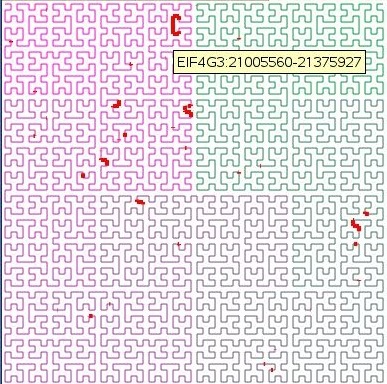
Genes for Translation mapped on a Hilbert Curve

In this post I describe how I mapped a list of genes involved in the Translational process on a Hilbert Curve .
This post was mostly inspired by Gareth Palidwor's recent post titled "Mapping genomes to a Hilbert Curve" see http://www.palidwor.com/blog/?p=123 (and yes, Paulo is right: , a blog can be a source of inspiration)

Wikipedia: A Hilbert curve is a continuous fractal space-filling curve first described by the German mathematician David Hilbert in 1891.


I've played with this idea and written a simple program mapping a list of genes on a Curve.

Finding the genes


First we need to get the name of genes involved in the Translational process. I've used the anonymous mysql GO server at EBI. I'm not a GO guru, so just tell me if the query below was not correct.
The position of those genes was then found using the anonymous mysql server of the UCSC. This mapping information is roughly available in the hg18.refGene table. I've restricted the search to the chromosome chr1.
At the end, my shell looks like this:
mysql -N -hmysql.ebi.ac.uk -ugo_select -pamigo -P4085 go_latest -A -e "SELECT DISTINCT
gene_product.symbol
FROM
term
INNER JOIN graph_path
ON (term.id=graph_path.term1_id)
INNER JOIN association
ON (graph_path.term2_id=association.term_id)
INNER JOIN gene_product
ON (association.gene_product_id=gene_product.id)
INNER JOIN species
ON (gene_product.species_id=species.id)
WHERE
term.name = 'translation' AND
species.ncbi_taxa_id = 9606" |\
gawk 'BEGIN {printf("select distinct name2,txStart,txEnd from refGene where chrom=\"chr1\" and name2 in (\"_\" ");}
{
printf(",\"%s\"",$1);
}
END {
printf(") order by txStart;\n");
}' |\
mysql -h genome-mysql.cse.ucsc.edu -D hg18 -u genome -A

Drawing the map


Then I mapped this list of gene on a Hilbert Curve drawn as SVG. I won't show the code here, it was mostly copied from the code provided on the wikipedia-page. The only major modification was the one used to convert a position on the genome to the curve. For those interested, I put the code here:http://code.google.com/p/lindenb/source/browse/trunk/proj/tinytools/src/org/lindenb/tinytools/HilbertSequence.java

Result


The curve is the human chromosome chr1.
The red lines are the genes.
Moving the mouse over a red line shows a balloon with the name of the gene


That's it.


'

23 January 2008

Introduction of new relationship types in GO

FYI: via the GO-friends mailing list.
We are pleased to announce that The Gene Ontology Consortium will
introduce three new relationship types


  • regulates

  • negatively_regulates

  • positively_regulates

into the BiologicalProcess ontology.

25 May 2007

Public Gene Ontology MySQL Mirror Now Available

Via the Go newsletter.
A public Gene Ontology MySQL mirror at the EBI now offers a remote connection to a regularly updated mirror of the GO schema.
Connection details are:


  • user: go_select

  • password:amigo

  • host: mysql.ebi.ac.uk

  • port: 4085


example:
mysql -hmysql.ebi.ac.uk -ugo_select -pamigo -P4085 latest_go -e 'select concat(left(name,20),"...") as name,term_type,acc from term where acc like "GO:%" limit 20'
+-------------------------+--------------------+------------+
| name | term_type | acc |
+-------------------------+--------------------+------------+
| mitochondrion inheri... | biological_process | GO:0000001 |
| mitochondrial genome... | biological_process | GO:0000002 |
| reproduction... | biological_process | GO:0000003 |
| ribosomal chaperone ... | molecular_function | GO:0000005 |
| high affinity zinc u... | molecular_function | GO:0000006 |
| low-affinity zinc io... | molecular_function | GO:0000007 |
| thioredoxin... | molecular_function | GO:0000008 |
| alpha-1,6-mannosyltr... | molecular_function | GO:0000009 |
| trans-hexaprenyltran... | molecular_function | GO:0000010 |
| vacuole inheritance... | biological_process | GO:0000011 |
| single strand break ... | biological_process | GO:0000012 |
| single-stranded DNA ... | molecular_function | GO:0000014 |
| phosphopyruvate hydr... | cellular_component | GO:0000015 |
| lactase activity... | molecular_function | GO:0000016 |
| alpha-glucoside tran... | biological_process | GO:0000017 |
| regulation of DNA re... | biological_process | GO:0000018 |
| regulation of mitoti... | biological_process | GO:0000019 |
| negative regulation ... | biological_process | GO:0000020 |
| mitotic spindle elon... | biological_process | GO:0000022 |
| maltose metabolic pr... | biological_process | GO:0000023 |
+-------------------------+--------------------+------------+