02 February 2015

Listing the 'Subject' Sequences in a BLAST database using the NCBI C++ toolbox. My notebook.

In my previous post (http://plindenbaum.blogspot.com/2015/01/filtering-fasta-sequences-using-ncbi-c.html) I've built an application filtering FASTA sequences using the
NCBI C++ toolbox (http://www.ncbi.nlm.nih.gov/IEB/ToolBox/CPP_DOC/). Here, I'm gonna write a tool listing the 'subject' sequences in a BLAST database.

This new application ListBlastDatabaseContent takes only one argument '-db', the name of the blast database :

void ListBlastDatabaseContent::Init()
    {
    (...)
    /* argument for name */
    arg_desc->AddDefaultKey(
            "db",/* name */
            "database",/* synopsis */
            "Blast database",/* comment */
            CArgDescriptions::eString, /* argument type */
            "" /* default value*/
            );
    (...)
    }   

in ListBlastDatabaseContent::Run() we get the name of the database

(...)
string database_name(  this->GetArgs()["db"].AsString() );
(...)

and we open a new CSearchDatabase object ("Blast Search Subject")

CSearchDatabase* searchDatabase = new CSearchDatabase(
    database_name, /* db name */
    CSearchDatabase::eBlastDbIsNucleotide /* db type */
    );

We get a handle to the seqdb, "it defines access to the database component by calling methods on objects which represent the various database files, such as the index, header, sequence, and alias files".

CRef<CSeqDB> seqdb= searchDatabase->GetSeqDb();

We get an iterator to the seqdb database http://www.ncbi.nlm.nih.gov/IEB/ToolBox/CPP_DOC/doxyhtml/classCSeqDBIter.html:

CSeqDBIter  iter = seqdb->Begin();

While this iterator is valid, we retrieve and print the DNA sequence and the header associated to the iterator.

while(iter)
    {
    string output;
    TSeqRange range; /* entire sequence */
    seqdb->GetSequenceAsString(iter.GetOID(),output,range); 
    CRef< CBlast_def_line_set > def_line= seqdb->GetHdr(iter.GetOID());
    CBlast_def_line_set:: Tdata::const_iterator r = def_line->Get().begin();
    while(r!= def_line->Get().end())
        {
        cout << ">" << (*r)->GetTitle()  << endl;
        cout << output << endl;
        ++r;
        }
    ++iter;
    }

All in one:

#include <memory>
#include <limits>
#include "corelib/ncbiapp.hpp"
#include <algo/blast/api/blast_types.hpp>
#include <algo/blast/api/sseqloc.hpp>
#include <algo/blast/api/blast_aux.hpp>
#include <algo/blast/api/blast_options_handle.hpp>
#include <algo/blast/api/blast_results.hpp>
#include <algo/blast/api/local_blast.hpp>
#include <ctype.h>


USING_NCBI_SCOPE;
using namespace blast;

/**
 *  Name
 *      ListBlastDatabaseContent
 *  Motivation:
 *      Print content of blast database
 *  Author:
 *      Pierre Lindenbaum PhD 2015
 *
 */
class ListBlastDatabaseContent : public CNcbiApplication /* extends a basic NCBI application defined in c++/include/corelib/ncbiapp.hpp */
    {
    public:

        /* constructor, just set the version to '1.0.0'*/
        ListBlastDatabaseContent()
            {
            CRef<CVersion> version(new CVersion());
            version->SetVersionInfo(1, 0, 0);
            this->SetFullVersion(version);
            }
            
            
        /* called to initialize rge program.
        *  The default behavior of this in 'CNcbiApplication' is "do nothing".
        *  Here, we set the command line arguments.
        */
        virtual void Init()
            {
            CArgDescriptions* arg_desc = new CArgDescriptions ; /* defined in /c++/include/corelib/ncbiargs.hpp */
            arg_desc->SetUsageContext(
                GetArguments().GetProgramBasename(),
                __FILE__
                );
            
         
            /* argument for name */
           arg_desc->AddDefaultKey(
                    "db",/* name */
                    "database",/* synopsis */
                    "Blast database",/* comment */
                    CArgDescriptions::eString, /* argument type */
                    "" /* default value*/
                    );
            
            /* push this command args */
            SetupArgDescriptions( arg_desc );
            }   
        
        /* class destructor */
        virtual ~ListBlastDatabaseContent()
            {
            }
        
        /* workhorse of the program */
        virtual int Run()
            {
            string database_name(  this->GetArgs()["db"].AsString() );
            /* Blast Search Subject.  http://www.ncbi.nlm.nih.gov/IEB/ToolBox/CPP_DOC/doxyhtml/classCSearchDatabase.html#details */
            CSearchDatabase* searchDatabase = 0;
            
        
            /* initialize search database */
            searchDatabase = new CSearchDatabase(
                database_name, /* db name */
                CSearchDatabase::eBlastDbIsNucleotide /* db type */
                );
            
            /* This class provides the top-level interface class for BLAST database users. It 
            defines access to the database component by calling methods on objects which represent
            the various database files, such as the index, header, sequence, and alias files. 
            http://www.ncbi.nlm.nih.gov/IEB/ToolBox/CPP_DOC/doxyhtml/classCSeqDB.html */
            CRef<CSeqDB> seqdb= searchDatabase->GetSeqDb();                 
            
            /* Small class to iterate over a seqdb database. http://www.ncbi.nlm.nih.gov/IEB/ToolBox/CPP_DOC/doxyhtml/classCSeqDBIter.html#details */
            CSeqDBIter  iter = seqdb->Begin();
            
            while(iter)
                {
                /* we put the sequence here */
                 string output;
                 /* retrieve the entire sequence */
                 TSeqRange range;
                /* This method gets the sequence data for an OID, converts it to a human-readable encoding (either Iupacaa for protein, or Iupacna for nucleotide), and returns it in a string. This is equivalent to calling the three-argument versions of this method with those encodings. http://www.ncbi.nlm.nih.gov/IEB/ToolBox/CPP_DOC/doxyhtml/classCSeqDB.html */
                seqdb->GetSequenceAsString(iter.GetOID(),output,range); 
                /* Represents ASN.1 type Blast-def-line-set defined in file blastdb.asn http://www.ncbi.nlm.nih.gov/IEB/ToolBox/CPP_DOC/doxyhtml/classCBlast__def__line__set.html */
                CRef< CBlast_def_line_set > def_line= seqdb->GetHdr(iter.GetOID());
                CBlast_def_line_set:: Tdata::const_iterator r = def_line->Get().begin();
                while(r!= def_line->Get().end())
                    {
                    cout << ">" << (*r)->GetTitle()  << endl;
                    cout << output << endl;
                    ++r;
                    }

                ++iter;
                }
            if( searchDatabase != 0) delete searchDatabase;
            return 0;
            }
    };

int main(int argc,char** argv)
    {
    return ListBlastDatabaseContent().AppMain(
        argc,
        argv,
        0, /* envp Environment pointer */
        eDS_ToStderr,/* log message. In /c++/include/corelib/ncbidiag.hpp  */
        0, /* Specify registry to load, as per LoadConfig() */
        "loadblastdb" /* Specify application name */
        );
    }

Testing

get some fasta sequences, remove the headers and create a blast database.

$ curl  "http://eutils.ncbi.nlm.nih.gov/entrez/eutils/efetch.fcgi?db=nuccore&id=281381068,281381067,281381066,281381065&rettype=fasta" |\
        awk '/^>/ {printf(">%d\n",NR);next;} {print;}' > sequences.fa

$ makeblastdb -in sequences.fa -dbtype nucl

run the program:

$ loadblastdb -db sequences.fa
>1
GATCGCGGGTATCTTCGATGTAGGGCGAGTCGCGTCACCCTGACCAACCCCTCGAGGTGGTCCTCGTGGAAGGAGGAAGCGCAGTCGACGAAGCGGAAGATGTGGCTGAGCCATCTCGTCGTGTCGGCCGCGAGACGACCCGCGAGTTTCTGCGCGTGTGACTTTGGTAGCGCTACTGCGTAAGCCGAGA
>6
CAGAAACTCGCGGGTCGTCTCGCGGCCGACACGACGAGATGGCTCAGCCACATCTTCCGCTTCGTCGACTGCGCTTCCTCCTTCCACGAGGACCACCTCGAGGGGTTGGTCAGGGTGACGCGACTC
>10
ACCGAAACGGCAAAATTGGCCTTAGTCACGCACACTATCTCGGCTTACGCAGTAGCGCTACCAAAGTCACACGCGCAGAAACTCGCGGGTCGTCTCGCGGCCGACACGACGAGATGGCTCAGCCACATCTTCCGCTTCGTCGACTGCGCTTCCTCCTTCCACGAGGACCACCTCGAGGGGTTGGTCAGGGTGACGCGACTCGCCCTACATCGAAGATACCCGCGATC
>16
GATCGAACGATAAACTTCTGCTATCGGTTCCTCAGCAATCAGTATAACGAGCGGCACATGTATTGCGGCATATTGCAAAAAACATACCTATAAAGAAGGCTAAACTGATTGATTCAAATTAACTTGAGAATACACGATGTTGATGTTCAGTCGAAACAAATCGCTCGCGTATTGTGATC

That's it,
Pierre

30 January 2015

Filtering Fasta Sequences using the #NCBI C++ API. My notebook.

In my previous post (http://plindenbaum.blogspot.com/2015/01/compiling-c-hello-world-program-using.html) I've built a simple "Hello World" application using the
NCBI C++ toolbox (http://www.ncbi.nlm.nih.gov/IEB/ToolBox/CPP_DOC/). Here, I'm gonna to extend the code in order to create a program filtering FASTA sequences on their sizes.

This new application FastaFilterSize needs three new arguments:

  • '-m' min size of the fasta sequence
  • '-M' max size of the fasta sequence
  • '-v' inverse selection

the method FastaFilterSize::Init() is used to register those optional arguments

/* optional argument for min size */
arg_desc->AddOptionalKey(
    "m",
    "min_size",
    "min size inclusive",
    CArgDescriptions::eInteger
    );
/* optional argument for max size */
arg_desc->AddOptionalKey(
    "M",
    "max_size",
    "max size inclusive",
    CArgDescriptions::eInteger
    );
/* add simple flag to inverse selection */
arg_desc->AddFlag("v", 
    "inverse selection",
    true
    );

the FastaFilterSize::Run() method is the workhorse of the program. Here, we get the output stream that will be used by a CFastaOstream to print the filtered Fasta sequences:

(...)
/* get output stream */
CNcbiOstream& out =  this->GetArgs()["o"].AsOutputFile();
/* create a FASTA writer */
CFastaOstream* writer = new CFastaOstream(out);
(...)

We get the input stream that will be used by a CFastaReader to read the FASTA sequences to be filtered.

/* get input stream */
CNcbiIstream& input_stream  = this->GetArgs()["i"].AsInputFile();
CFastaReader reader(input_stream ,
        CFastaReader::fNoParseID /* http://www.ncbi.nlm.nih.gov/IEB/ToolBox/CPP_DOC/doxyhtml/fasta_8hpp_source.html */
        );

We get the optional values for min-length and max-length:

if (this->GetArgs()["m"])
    {
    min_inclusive = this->GetArgs()["m"].AsInteger();
    }
if (this->GetArgs()["M"])
    {
    max_inclusive = this->GetArgs()["M"].AsInteger();
    }

We get the 'inverse' flag.

bool invert=this->GetArgs()["v"];

While a Fasta sequence can be read, we check its size and we print it if needed:

while( !reader.AtEOF() )
    {
    /* read next sequence */
    CRef<CSeq_entry> seq(reader.ReadOneSeq());
    /* should we print the sequence ?*/
    if((seq->GetSeq().GetLength()>= min_inclusive && 
        seq->GetSeq().GetLength()<= max_inclusive
        )!= invert)
        {
        /* yes, print */
        writer->Write(*seq);
        }
    }

All in one:

#include <memory>
#include <limits>
#include <objtools/readers/fasta.hpp>
#include "corelib/ncbiapp.hpp"
#include <objects/seq/Bioseq.hpp>
#include <objects/seq/Delta_ext.hpp>
#include <objects/seq/Delta_seq.hpp>
#include <objects/seq/NCBIeaa.hpp>
#include <objects/seq/IUPACaa.hpp>
#include <objects/seq/IUPACna.hpp>
#include <objects/seq/Seg_ext.hpp>
#include <objects/seq/Seq_annot.hpp>
#include <objects/seq/Seq_descr.hpp>
#include <objects/seq/Seq_ext.hpp>
#include <objects/seq/Seq_hist.hpp>
#include <objects/seq/Seq_inst.hpp>
#include <objects/seq/Seq_literal.hpp>
#include <objects/seq/Seqdesc.hpp>
#include <objects/seq/seqport_util.hpp>
#include <objects/seqalign/Dense_seg.hpp>
#include <objects/seqalign/Seq_align.hpp>
#include <objects/seqloc/Seq_id.hpp>
#include <objects/seqloc/Seq_interval.hpp>
#include <objects/seqloc/Seq_loc.hpp>
#include <objects/seqloc/Seq_loc_mix.hpp>
#include <objects/seqloc/Seq_point.hpp>
#include <objects/seqset/Bioseq_set.hpp>
#include <objects/seqset/Seq_entry.hpp>
#include <objtools/readers/message_listener.hpp>
#include <objtools/readers/line_error.hpp>
#include <objtools/seqmasks_io/mask_reader.hpp>
#include <objtools/seqmasks_io/mask_writer.hpp>
#include <objtools/seqmasks_io/mask_fasta_reader.hpp>
#include <objmgr/util/sequence.hpp>
#include <ctype.h>

USING_NCBI_SCOPE;
USING_SCOPE(objects);

/**
 * FastaFilterSize
 *    
 *  Motivation:
 *      filter sequences on size
 *  Author:
 *      Pierre Lindenbaum PhD 2015
 *
 */
class FastaFilterSize : public CNcbiApplication /* extends a basic NCBI application defined in c++/include/corelib/ncbiapp.hpp */
    {
    public:

        /* constructor, just set the version to '1.0.0'*/
        FastaFilterSize()
            {
            CRef<CVersion> version(new CVersion());
            version->SetVersionInfo(1, 0, 0);
            this->SetFullVersion(version);
            }
            
            
        /* called to initialize rge program.
        *  The default behavior of this in 'CNcbiApplication' is "do nothing".
        *  Here, we set the command line arguments.
        */
        virtual void Init()
            {
            CArgDescriptions* arg_desc = new CArgDescriptions ; /* defined in /c++/include/corelib/ncbiargs.hpp */
            arg_desc->SetUsageContext(
                GetArguments().GetProgramBasename(),
                "A program filtering fasta sequences on size"
                );
            /* argument for input file */
            arg_desc->AddDefaultKey(
                    "i",/* name */
                    "input_file_name",/* synopsis */
                    "input file name",/* comment */
                    CArgDescriptions::eInputFile, /* argument type */
                    "-" /* default value*/
                    );
           /* argument for output file */
           arg_desc->AddDefaultKey(
                    "o",/* name */
                    "output_file_name",/* synopsis */
                    "output file name",/* comment */
                    CArgDescriptions::eOutputFile, /* argument type */
                    "-" /* default value*/
                    );
            /* optional argument for min size */
            arg_desc->AddOptionalKey(
                    "m",
                    "min_size",
                    "min size inclusive",
                    CArgDescriptions::eInteger
                    );
            /* optional argument for max size */
            arg_desc->AddOptionalKey(
                    "M",
                    "max_size",
                    "max size inclusive",
                    CArgDescriptions::eInteger
                    );
            
            /* add simple flag to inverse selection */
            arg_desc->AddFlag("v", 
                "inverse selection",
                true
                );
            
            /* push this command args */
            SetupArgDescriptions( arg_desc );
            }   
        
        /* class destructor */
        virtual ~FastaFilterSize()
            {
            }
        
        /* workhorse of the program */
        virtual int Run()
            {
            /* get output stream */
            CNcbiOstream& out =  this->GetArgs()["o"].AsOutputFile();
            /* create a FASTA writer */
            CFastaOstream* writer = new CFastaOstream(out);
            /* shall we inverse the selection ? */
            bool invert=this->GetArgs()["v"];

            /* get input stream */
            CNcbiIstream& input_stream  = this->GetArgs()["i"].AsInputFile();
            /* init min and max inclusive */
            TSeqPos min_inclusive=0;
            TSeqPos max_inclusive= std::numeric_limits<TSeqPos>::max();
            /* if min and max set by user */
            if (this->GetArgs()["m"])
                {
                min_inclusive = this->GetArgs()["m"].AsInteger();
                }
            if (this->GetArgs()["M"])
                {
                max_inclusive = this->GetArgs()["M"].AsInteger();
                }
            /* create a FASTA parser */
            CFastaReader reader(input_stream ,
                    CFastaReader::fNoParseID /* http://www.ncbi.nlm.nih.gov/IEB/ToolBox/CPP_DOC/doxyhtml/fasta_8hpp_source.html */
                    );
            /* while we can read something */
            while( !reader.AtEOF() )
                {
                /* read next sequence */
                CRef<CSeq_entry> seq(reader.ReadOneSeq());
                
                /* should we print the sequence ?*/
                if((seq->GetSeq().GetLength()>= min_inclusive && 
                    seq->GetSeq().GetLength()<= max_inclusive
                    )!= invert)
                    {
                    /* yes, print */
                    writer->Write(*seq);
                    }
                }
            /* cleanup */
            delete writer;
            out.flush();
            return 0;
            }
    };

int main(int argc,char** argv)
    {
    return FastaFilterSize().AppMain(
        argc,
        argv,
        0, /* envp Environment pointer */
        eDS_ToStderr,/* log message. In /c++/include/corelib/ncbidiag.hpp  */
        0, /* Specify registry to load, as per LoadConfig() */
        "filterfasta" /* Specify application name */
        );
    }

Compiling

g++  -std=gnu++11  -finline-functions -fstrict-aliasing -fomit-frame-pointer    
-I/commun/data/users/lindenb/src/blast2.2.30/ncbi-blast-2.2.30+-src/c++/include 
-I/commun/data/users/lindenb/src/blast2.2.30/ncbi-blast-2.2.30+-src/c++/ReleaseM
T/inc  -Wno-deprecated -Wno-deprecated-declarations -o filtersize filtersize.cpp
 -L/commun/data/users/lindenb/src/blast2.2.30/ncbi-blast-2.2.30+-src/c++/Release
MT/lib -lblast_app_util -lblastinput-static -lncbi_xloader_blastdb-static -lncbi
_xloader_blastdb_rmt-static -lxblastformat-static -lalign_format-static -ltaxon1
-static -lblastdb_format-static -lgene_info-static -lxalnmgr-static -lblastxml-s
tatic -lblastxml2-static -lxcgi-static -lxhtml-static -lxblast-static -lxalgobla
stdbindex-static -lcomposition_adjustment-static -lxalgodustmask-static -lxalgow
inmask-static -lseqmasks_io-static -lseqdb-static -lblast_services-static -lxobj
util-static -lxobjread-static -lvariation-static -lcreaders-static -lsubmit-stat
ic -lxnetblastcli-static -lxnetblast-static -lblastdb-static -lscoremat-static -
ltables-static -lxalnmgr-static -lncbi_xloader_genbank-static -lncbi_xreader_id1
-static -lncbi_xreader_id2-static -lncbi_xreader_cache-static -lxconnext-static 
-lxconnect-static -ldbapi_driver-static -lncbi_xreader-static -lxconnext-static 
-lxconnect-static -lid1-static -lid2-static -lseqsplit-static -lxcompress-static
 -lxobjmgr-static -lgenome_collection-static -lseqedit-static -lseqset-static -l
seq-static -lseqcode-static -lsequtil-static -lpub-static -lmedline-static -lbib
lio-static -lgeneral-static -lxser-static -lxutil-static -lxncbi-static -lgomp -
lz -lbz2 -ldl -lnsl -lrt -lm -lpthread -L/commun/data/users/lindenb/src/blast2.2
.30/ncbi-blast-2.2.30+-src/c++/ReleaseMT/lib -lblast_app_util -lblastinput-stati
c -lncbi_xloader_blastdb-static -lncbi_xloader_blastdb_rmt-static -lxblastformat
-static -lalign_format-static -ltaxon1-static -lblastdb_format-static -lgene_inf
o-static -lxalnmgr-static -lblastxml-static -lblastxml2-static -lxcgi-static -lx
html-static -lxblast-static -lxalgoblastdbindex-static -lcomposition_adjustment-
static -lxalgodustmask-static -lxalgowinmask-static -lseqmasks_io-static -lseqdb
-static -lblast_services-static -lxobjutil-static -lxobjread-static -lvariation-
static -lcreaders-static -lsubmit-static -lxnetblastcli-static -lxnetblast-stati
c -lblastdb-static -lscoremat-static -ltables-static -lxalnmgr-static -lncbi_xlo
ader_genbank-static -lncbi_xreader_id1-static -lncbi_xreader_id2-static -lncbi_x
reader_cache-static -lxconnext-static -lxconnect-static -ldbapi_driver-static -l
ncbi_xreader-static -lxconnext-static -lxconnect-static -lid1-static -lid2-stati
c -lseqsplit-static -lxcompress-static -lxobjmgr-static -lgenome_collection-stat
ic -lseqedit-static -lseqset-static -lseq-static -lseqcode-static -lsequtil-stat
ic -lpub-static -lmedline-static -lbiblio-static -lgeneral-static -lxser-static 
-lxutil-static -lxncbi-static -lgomp -lz -lbz2 -ldl -lnsl -lrt -lm -lpthread

Testing

get help

$ ./filtersize  -help
USAGE
  filtersize [-h] [-help] [-xmlhelp] [-i input_file_name]
    [-o output_file_name] [-m min_size] [-M max_size] [-v]
    [-logfile File_Name] [-conffile File_Name] [-version] [-version-full]
    [-dryrun]

DESCRIPTION
   A program filtering fasta sequences on size

OPTIONAL ARGUMENTS
 (...)
 -i <File_In>
   input file name
   Default = `-'
 -o <File_Out>
   output file name
   Default = `-'
 -m <Integer>
   min size inclusive
 -M <Integer>
   max size inclusive
 -v
   inverse selection
(...)

test with some fasta sequences:

echo -e  ">seq1\nAATCGTACGCTAG\n>seq2\nAATCGTACGATGCAAAAAAAAAAAATCTAG\n>seq3\nAATC\n>seq3\nAATC" |\
./filtersize -m 10 -M 20

>lcl|1 seq1
AATCGTACGCTAG
echo -e  ">seq1\nAATCGTACGCTAG\n>seq2\nAATCGTACGATGCAAAAAAAAAAAATCTAG\n>seq3\nAATC\n>seq3\nAATC" |\
./filtersize -m 10 -M 20 -v 

>lcl|2 seq2
AATCGTACGATGCAAAAAAAAAAAATCTAG
>lcl|3 seq3
AATC
>lcl|4 seq3
AATC

That's it,
Pierre

29 January 2015

Compiling a C++ 'Hello world' program using the #NCBI C++ toolbox: my notebook.

This post is my notebook for compiling a simple C++ application using the NCBI C++ toolbox (http://www.ncbi.nlm.nih.gov/IEB/ToolBox/CPP_DOC/).

This application prints 'Hello world' and takes two arguments:

  • '-o' to specificiy the output filename (default is standard output)
  • '-n' to set the name to be printed (default: "Word !")

The code I used is the one containing in the distribution of blast 2.2.30

The program itself is a C++ Class, it extends the class CNcbiApplication

(...)
class HelloApp : public CNcbiApplication
    {
    (...)
    }

In the constructor, we just set the name and the version of the program:

HelloApp::HelloApp()
    {
    CRef<CVersion> version(new CVersion());
    version->SetVersionInfo(1, 0, 0);
    this->SetFullVersion(version);
    }

The destructor is void

HelloApp::~HelloApp()
    {
    }

an HelloApp::Init() method is used to register the command line arguments.

void HelloApp::Init()
    {
    CArgDescriptions* arg_desc = new CArgDescriptions ;
    arg_desc->SetUsageContext(
        GetArguments().GetProgramBasename(),
        "Hello NCBI"
        );
    (...)

in HelloApp::Init() we register the '-o' argument:

arg_desc->AddDefaultKey(
    "o",/* name */
    "output_file_name",/* synopsis */
    "output file name",/* comment */
    CArgDescriptions::eOutputFile, /* argument type */
    "-" /* default value*/
    );

and the '-n' argument:

arg_desc->AddDefaultKey(
    "n",/* name */
    "name",/* synopsis */
    "Name",/* comment */
    CArgDescriptions::eString, /* argument type */
    "World !" /* default value*/
    );

once the two arguments have been registered, the new command line is pushed in the application:

SetupArgDescriptions( arg_desc );

the HelloApp::Run() method is the workhorse of the program. Here, we get the output stream and we print the name.

int HelloApp::Run()
    {
    /* get output stream */
    CNcbiOstream& out =  this->GetArgs()["o"].AsOutputFile();
    out << "Hello " << this->GetArgs()["n"].AsString() << endl;
    return 0;
    }

All in one:

#include <memory>
#include <limits>
#include "corelib/ncbiapp.hpp"
#include <ctype.h>


USING_NCBI_SCOPE;

/**
 * Hello NCBI
 *      testing NCBI C++ toolbox
 *  Motivation:
 *      filter sequences on size
 *  Author:
 *      Pierre Lindenbaum PhD 2015
 *
 */
class HelloApp : public CNcbiApplication /* extends a basic NCBI application defined in c++/include/corelib/ncbiapp.hpp */
    {
    public:

        /* constructor, just set the version to '1.0.0'*/
        HelloApp()
            {
            CRef<CVersion> version(new CVersion());
            version->SetVersionInfo(1, 0, 0);
            this->SetFullVersion(version);
            }
            
            
        /* called to initialize rge program.
        *  The default behavior of this in 'CNcbiApplication' is "do nothing".
        *  Here, we set the command line arguments.
        */
        virtual void Init()
            {
            CArgDescriptions* arg_desc = new CArgDescriptions ; /* defined in /c++/include/corelib/ncbiargs.hpp */
            arg_desc->SetUsageContext(
                GetArguments().GetProgramBasename(),
                "Hello NCBI"
                );
            
           /* argument for output file */
           arg_desc->AddDefaultKey(
                    "o",/* name */
                    "output_file_name",/* synopsis */
                    "output file name",/* comment */
                    CArgDescriptions::eOutputFile, /* argument type */
                    "-" /* default value*/
                    );
            /* argument for name */
           arg_desc->AddDefaultKey(
                    "n",/* name */
                    "name",/* synopsis */
                    "Name",/* comment */
                    CArgDescriptions::eString, /* argument type */
                    "World !" /* default value*/
                    );
            
            /* push this command args */
            SetupArgDescriptions( arg_desc );
            }   
        
        /* class destructor */
        virtual ~HelloApp()
            {
            }
        
        /* workhorse of the program */
        virtual int Run()
            {
            /* get output stream */
            CNcbiOstream& out =  this->GetArgs()["o"].AsOutputFile();
            out << "Hello " << this->GetArgs()["n"].AsString() << endl;
            return 0;
            }
    };

int main(int argc,char** argv)
    {
    return HelloApp().AppMain(
        argc,
        argv,
        0, /* envp Environment pointer */
        eDS_ToStderr,/* log message. In /c++/include/corelib/ncbidiag.hpp  */
        0, /* Specify registry to load, as per LoadConfig() */
        "hello" /* Specify application name */
        );
    }

Compiling

there is a bunch of libaries available under ncbi-blast-2.2.30+-src/c++/ReleaseMT/lib and it's hard to know which are the one required for linking. I put everything in my command line. All in one it looks like:

g++  -std=gnu++11  -finline-functions -fstrict-aliasing -fomit-frame-pointer    
-Iblast2.2.30/ncbi-blast-2.2.30+-src/c++/include -Iblast2.2.30/ncbi-blast-2.2.30
+-src/c++/ReleaseMT/inc  -Wno-deprecated -Wno-deprecated-declarations -o hello h
ello.cpp -Lblast2.2.30/ncbi-blast-2.2.30+-src/c++/ReleaseMT/lib -lblast_app_util
 -lblastinput-static -lncbi_xloader_blastdb-static -lncbi_xloader_blastdb_rmt-st
atic -lxblastformat-static -lalign_format-static -ltaxon1-static -lblastdb_forma
t-static -lgene_info-static -lxalnmgr-static -lblastxml-static -lblastxml2-stati
c -lxcgi-static -lxhtml-static -lxblast-static -lxalgoblastdbindex-static -lcomp
osition_adjustment-static -lxalgodustmask-static -lxalgowinmask-static -lseqmask
s_io-static -lseqdb-static -lblast_services-static -lxobjutil-static -lxobjread-
static -lvariation-static -lcreaders-static -lsubmit-static -lxnetblastcli-stati
c -lxnetblast-static -lblastdb-static -lscoremat-static -ltables-static -lxalnmg
r-static -lncbi_xloader_genbank-static -lncbi_xreader_id1-static -lncbi_xreader_
id2-static -lncbi_xreader_cache-static -lxconnext-static -lxconnect-static -ldba
pi_driver-static -lncbi_xreader-static -lxconnext-static -lxconnect-static -lid1
-static -lid2-static -lseqsplit-static -lxcompress-static -lxobjmgr-static -lgen
ome_collection-static -lseqedit-static -lseqset-static -lseq-static -lseqcode-st
atic -lsequtil-static -lpub-static -lmedline-static -lbiblio-static -lgeneral-st
atic -lxser-static -lxutil-static -lxncbi-static -lgomp -lz -lbz2 -ldl -lnsl -lr
t -lm -lpthread -Lblast2.2.30/ncbi-blast-2.2.30+-src/c++/ReleaseMT/lib -lblast_a
pp_util -lblastinput-static -lncbi_xloader_blastdb-static -lncbi_xloader_blastdb
_rmt-static -lxblastformat-static -lalign_format-static -ltaxon1-static -lblastd
b_format-static -lgene_info-static -lxalnmgr-static -lblastxml-static -lblastxml
2-static -lxcgi-static -lxhtml-static -lxblast-static -lxalgoblastdbindex-static
 -lcomposition_adjustment-static -lxalgodustmask-static -lxalgowinmask-static -l
seqmasks_io-static -lseqdb-static -lblast_services-static -lxobjutil-static -lxo
bjread-static -lvariation-static -lcreaders-static -lsubmit-static -lxnetblastcl
i-static -lxnetblast-static -lblastdb-static -lscoremat-static -ltables-static -
lxalnmgr-static -lncbi_xloader_genbank-static -lncbi_xreader_id1-static -lncbi_x
reader_id2-static -lncbi_xreader_cache-static -lxconnext-static -lxconnect-stati
c -ldbapi_driver-static -lncbi_xreader-static -lxconnext-static -lxconnect-stati
c -lid1-static -lid2-static -lseqsplit-static -lxcompress-static -lxobjmgr-stati
c -lgenome_collection-static -lseqedit-static -lseqset-static -lseq-static -lseq
code-static -lsequtil-static -lpub-static -lmedline-static -lbiblio-static -lgen
eral-static -lxser-static -lxutil-static -lxncbi-static -lgomp -lz -lbz2 -ldl -l
nsl -lrt -lm -lpthread

Testing

run without arguments:

$ ./hello 
Hello World !

run with arguments:

$ ./hello -n Pierre
Hello Pierre
$ ./hello -n Pierre -o test.txt && cat test.txt 
Hello Pierre

errors:

$ ./hello -x Pierre
USAGE
  hello [-h] [-help] [-xmlhelp] [-o output_file_name] [-n name]
    [-logfile File_Name] [-conffile File_Name] [-version] [-version-full]
    [-dryrun]

DESCRIPTION
   Hello NCBI

Use '-help' to print detailed descriptions of command line arguments
========================================================================

Error: Unknown argument: "x"

get help:

$ ./hello -help
USAGE
  hello [-h] [-help] [-xmlhelp] [-o output_file_name] [-n name]
    [-logfile File_Name] [-conffile File_Name] [-version] [-version-full]
    [-dryrun]

DESCRIPTION
   Hello NCBI

OPTIONAL ARGUMENTS
 -h
   Print USAGE and DESCRIPTION;  ignore all other parameters
 -help
   Print USAGE, DESCRIPTION and ARGUMENTS; ignore all other parameters
 -xmlhelp
   Print USAGE, DESCRIPTION and ARGUMENTS in XML format; ignore all other
   parameters
 -o <File_Out>
   output file name
   Default = `-'
 -n <String>
   Name
   Default = `World !'
 -logfile <File_Out>
   File to which the program log should be redirected
 -conffile <File_In>
   Program's configuration (registry) data file
 -version
   Print version number;  ignore other arguments
 -version-full
   Print extended version data;  ignore other arguments
 -dryrun
   Dry run the application: do nothing, only test all preconditions

get xml help:

$ ./hello -xmlhelp | xmllint --format -
<?xml version="1.0"?>
<ncbi_application xmlns="ncbi:application" xmlns:xs="http://www.w3.org/2001/XMLSchema-instance" xs:schemaLocation="ncbi:application ncbi_application.xsd">
  <program type="regular">
    <name>hello</name>
    <version>1.0.0</version>
    <description>Hello NCBI</description>
  </program>
  <arguments>
    <key name="conffile" type="File_In" optional="true">
      <description>Program's configuration (registry) data file</description>
      <synopsis>File_Name</synopsis>
    </key>
    <key name="logfile" type="File_Out" optional="true">
      <description>File to which the program log should be redirected</description>
      <synopsis>File_Name</synopsis>
    </key>
    <key name="n" type="String" optional="true">
      <description>Name</description>
      <synopsis>name</synopsis>
      <default>World !</default>
    </key>
    <key name="o" type="File_Out" optional="true">
      <description>output file name</description>
      <synopsis>output_file_name</synopsis>
      <default>-</default>
    </key>
    <flag name="dryrun" optional="true">
      <description>Dry run the application: do nothing, only test all preconditions</description>
    </flag>
    <flag name="h" optional="true">
      <description>Print USAGE and DESCRIPTION;  ignore all other parameters</description>
    </flag>
    <flag name="help" optional="true">
      <description>Print USAGE, DESCRIPTION and ARGUMENTS; ignore all other parameters</description>
    </flag>
    <flag name="version" optional="true">
      <description>Print version number;  ignore other arguments</description>
    </flag>
    <flag name="version-full" optional="true">
      <description>Print extended version data;  ignore other arguments</description>
    </flag>
    <flag name="xmlhelp" optional="true">
      <description>Print USAGE, DESCRIPTION and ARGUMENTS in XML format; ignore all other parameters</description>
    </flag>
  </arguments>
</ncbi_application>

That's it,
Pierre

05 December 2014

Divide-and-conquer in a #Makefile : recursivity and #parallelism.

This post is my notebook about implementing a divide-and-conquer strategy in GNU make.
Say you have a list of 'N' VCFs files. You want to create a list of:

  • common SNPs in vcf1 and vcf2
  • common SNPs in vcf3 and the previous list
  • common SNPs in vcf4 and the previous list
  • (...)
  • common SNPs in vcfN and the previous list
Yes, I know I can do this using:grep -v '^#' f.vcf|cut -f 1,2,4,5 | sort | uniq

Using a linear Makefile it could look like:

list2: vcf1 vcf2
    grep -v '^#' $^ |cut -f 1,2,4,5 | sort | uniq > $@
list3: vcf3 list2
    grep -v '^#' $^ |cut -f 1,2,4,5 | sort | uniq > $@
list4: vcf4 list3
    grep -v '^#' $^ |cut -f 1,2,4,5 | sort | uniq > $@
list5: vcf5 list4
    grep -v '^#' $^ |cut -f 1,2,4,5 | sort | uniq > $@
(...)

We can speed-up the workflow using the parallel option of make -j (number-of-parallel-jobs) and using a divide-and-conquer strategy. Here, the targets 'list1_2' and 'list3_4' can be processed independently in parallel.

list1_2: vcf1 vcf2
    grep -v '^#' $^ |cut -f 1,2,4,5 | sort | uniq > $@

list3_4: vcf3 vcf4
    grep -v '^#' $^ |cut -f 1,2,4,5 | sort | uniq > $@

list1_4: list1_2 list3_4
    grep -v '^#' $^ |cut -f 1,2,4,5 | sort | uniq > $@

By using the internal 'Make' functions $(eval), $(call), $(shell) we can define a recursive method "recursive". This method takes two arguments which are the 0-based indexes of a VCF in the list of VCFs. Here is the Makefile:
Running the makefile:
$ make 
gunzip -c Sample18.vcf.gz | grep -v '^#' | cut -f 1,2,4,5 | LC_ALL=C sort | uniq > target0_1
gunzip -c Sample13.vcf.gz | grep -v '^#' | cut -f 1,2,4,5 | LC_ALL=C sort | uniq > target1_2
LC_ALL=C comm -12 target0_1 target1_2 > target0_2
gunzip -c Sample1.vcf.gz | grep -v '^#' | cut -f 1,2,4,5 | LC_ALL=C sort | uniq > target2_3
gunzip -c Sample19.vcf.gz | grep -v '^#' | cut -f 1,2,4,5 | LC_ALL=C sort | uniq > target3_4
gunzip -c Sample12.vcf.gz | grep -v '^#' | cut -f 1,2,4,5 | LC_ALL=C sort | uniq > target4_5
LC_ALL=C comm -12 target3_4 target4_5 > target3_5
LC_ALL=C comm -12 target2_3 target3_5 > target2_5
LC_ALL=C comm -12 target0_2 target2_5 > target0_5
gunzip -c Sample17.vcf.gz | grep -v '^#' | cut -f 1,2,4,5 | LC_ALL=C sort | uniq > target5_6
gunzip -c Sample16.vcf.gz | grep -v '^#' | cut -f 1,2,4,5 | LC_ALL=C sort | uniq > target6_7
LC_ALL=C comm -12 target5_6 target6_7 > target5_7
gunzip -c Sample9.vcf.gz | grep -v '^#' | cut -f 1,2,4,5 | LC_ALL=C sort | uniq > target7_8
gunzip -c Sample15.vcf.gz | grep -v '^#' | cut -f 1,2,4,5 | LC_ALL=C sort | uniq > target8_9
gunzip -c Sample5.vcf.gz | grep -v '^#' | cut -f 1,2,4,5 | LC_ALL=C sort | uniq > target9_10
LC_ALL=C comm -12 target8_9 target9_10 > target8_10
LC_ALL=C comm -12 target7_8 target8_10 > target7_10
LC_ALL=C comm -12 target5_7 target7_10 > target5_10
LC_ALL=C comm -12 target0_5 target5_10 > target0_10
gunzip -c Sample14.vcf.gz | grep -v '^#' | cut -f 1,2,4,5 | LC_ALL=C sort | uniq > target10_11
gunzip -c Sample3.vcf.gz | grep -v '^#' | cut -f 1,2,4,5 | LC_ALL=C sort | uniq > target11_12
LC_ALL=C comm -12 target10_11 target11_12 > target10_12
gunzip -c Sample11.vcf.gz | grep -v '^#' | cut -f 1,2,4,5 | LC_ALL=C sort | uniq > target12_13
gunzip -c Sample2.vcf.gz | grep -v '^#' | cut -f 1,2,4,5 | LC_ALL=C sort | uniq > target13_14
gunzip -c Sample6.vcf.gz | grep -v '^#' | cut -f 1,2,4,5 | LC_ALL=C sort | uniq > target14_15
LC_ALL=C comm -12 target13_14 target14_15 > target13_15
LC_ALL=C comm -12 target12_13 target13_15 > target12_15
LC_ALL=C comm -12 target10_12 target12_15 > target10_15
gunzip -c Sample20.vcf.gz | grep -v '^#' | cut -f 1,2,4,5 | LC_ALL=C sort | uniq > target15_16
gunzip -c Sample10.vcf.gz | grep -v '^#' | cut -f 1,2,4,5 | LC_ALL=C sort | uniq > target16_17
LC_ALL=C comm -12 target15_16 target16_17 > target15_17
gunzip -c Sample4.vcf.gz | grep -v '^#' | cut -f 1,2,4,5 | LC_ALL=C sort | uniq > target17_18
gunzip -c Sample8.vcf.gz | grep -v '^#' | cut -f 1,2,4,5 | LC_ALL=C sort | uniq > target18_19
gunzip -c Sample7.vcf.gz | grep -v '^#' | cut -f 1,2,4,5 | LC_ALL=C sort | uniq > target19_20
LC_ALL=C comm -12 target18_19 target19_20 > target18_20
LC_ALL=C comm -12 target17_18 target18_20 > target17_20
LC_ALL=C comm -12 target15_17 target17_20 > target15_20
LC_ALL=C comm -12 target10_15 target15_20 > target10_20
LC_ALL=C comm -12 target0_10 target10_20 > target0_20
and here is the generated workflow (drawn with make2graph ).
:
That's it
Pierre.

04 December 2014

XML+XSLT = #Makefile -based #workflows for #bioinformatics

I've recently read some conversations on Twitter about Makefile-based bioinformatics workflows. I've suggested on biostars.org (Standard simple format to describe a bioinformatics analysis pipeline) that a XML file could be used to describe a model of data and XSLT could transform this model to a Makefile-based workflow. I've already explored this idea in a previous post (Generating a pipeline of analysis (Makefile) for NGS with xslt. ) and in our lab, we use JSON and jsvelocity to generate our workflows (e.g: https://gist.github.com/lindenb/3c07ca722f793cc5dd60).
In the current post, I'll describe my github repository containing a complete XML+XSLT example: https://github.com/lindenb/ngsxml.

Download the data

git clone "https://github.com/lindenb/ngsxml.git"


The model
The XML model is self-explanatory:
<?xml version="1.0" encoding="UTF-8"?>
<model name="myProject" description="my project" directory="OUT">
  <project name="Proj1">
    <sample name="Sample1">
      <fastq>
        <for>test/fastq/sample_1_01_R1.fastq.gz</for>
        <rev>test/fastq/sample_1_01_R2.fastq.gz</rev>
      </fastq>
      <fastq id="groupid2" lane="2" library="lib1" platform="ILMN" median-size="98">
        <for>test/fastq/sample_1_02_R1.fastq.gz</for>
        <rev>test/fastq/sample_1_02_R2.fastq.gz</rev>
      </fastq>
    </sample>
    <sample name="Sample2">
      <fastq>
        <for>test/fastq/sample_2_01_R1.fastq.gz</for>
        <rev>test/fastq/sample_2_01_R2.fastq.gz</rev>
      </fastq>
    </sample>
  </project>
</model>


Validating the model:
This XML document is possibly validated with a XML schema:
$ xmllint  --schema xsd/schema01.xsd --noout test/model01.xml
test/model01.xml validates


Generating the Makefile:
The XML document is transformed into a Makefile using the following XSLT stylesheet: https://github.com/lindenb/ngsxml/blob/master/stylesheets/model2make.xsl
xsltproc --output Makefile stylesheets/model2make.xsl test/model01.xml
The Makefile:
# Name
#  myProject
# Description:
#  my project
# 
include config.mk
OUTDIR=OUT
BINDIR=$(abspath ${OUTDIR})/bin


# if tools are undefined
bwa.exe ?=${BINDIR}/bwa-0.7.10/bwa
samtools.exe ?=${BINDIR}/samtools-0.1.19/samtools
bcftools.exe ?=${BINDIR}/samtools-0.1.19/bcftools/bcftools
tabix.exe ?=${BINDIR}/tabix-0.2.6/tabix
bgzip.exe ?=${BINDIR}/tabix-0.2.6/bgzip

.PHONY=all clean all_bams all_vcfs

all: all_vcfs


all_vcfs:  \
 $(OUTDIR)/Projects/Proj1/VCF/Proj1.vcf.gz


all_bams:  \
 $(OUTDIR)/Projects/Proj1/Samples/Sample1/BAM/Proj1_Sample1.bam \
 $(OUTDIR)/Projects/Proj1/Samples/Sample2/BAM/Proj1_Sample2.bam

#
# VCF for project 'Proj1'
# 
$(OUTDIR)/Projects/Proj1/VCF/Proj1.vcf.gz : $(addsuffix .bai, $(OUTDIR)/Projects/Proj1/Samples/Sample1/BAM/Proj1_Sample1.bam $(OUTDIR)/Projects/Proj1/Samples/Sample2/BAM/Proj1_Sample2.bam) \
 $(addsuffix .fai,${REFERENCE}) ${samtools.exe}  ${bgzip.exe} ${tabix.exe} ${bcftools.exe}
 mkdir -p $(dir $@) && \
 ${samtools.exe} mpileup -uf ${REFERENCE} $(basename $(filter %.bai,$^)) | \
 ${bcftools.exe} view -vcg - > $(basename $@)  && \
 ${bgzip.exe} -f $(basename $@) && \
 ${tabix.exe} -f -p vcf $@


#
# index final BAM for Sample 'Sample1'
# 
$(addsuffix .bai, $(OUTDIR)/Projects/Proj1/Samples/Sample1/BAM/Proj1_Sample1.bam): $(OUTDIR)/Projects/Proj1/Samples/Sample1/BAM/Proj1_Sample1.bam ${samtools.exe}
 mkdir -p $(dir $@) && \
 ${samtools.exe} index  $<
#
# prepare final BAM for Sample 'Sample1'
# 
$(OUTDIR)/Projects/Proj1/Samples/Sample1/BAM/Proj1_Sample1.bam : $(OUTDIR)/Projects/Proj1/Samples/Sample1/BAM/${tmp.prefix}rmdup.bam
 mkdir -p $(dir $@) && \
 cp  $< $@


$(OUTDIR)/Projects/Proj1/Samples/Sample1/BAM/${tmp.prefix}rmdup.bam : $(OUTDIR)/Projects/Proj1/Samples/Sample1/BAM/${tmp.prefix}merged.bam ${samtools.exe}
 mkdir -p $(dir $@) && \
 ${samtools.exe} rmdup  $<  $@


#
# merge BAMs 
#
$(OUTDIR)/Projects/Proj1/Samples/Sample1/BAM/${tmp.prefix}merged.bam :  \
  $(OUTDIR)/Projects/Proj1/Samples/Sample1/BAM/${tmp.prefix}1_sorted.bam \
  $(OUTDIR)/Projects/Proj1/Samples/Sample1/BAM/${tmp.prefix}2_sorted.bam ${samtools.exe}
 mkdir -p $(dir $@) && \
  ${samtools.exe} merge -f $@ $(filter %.bam,$^)


#
# Index BAM $(OUTDIR)/Projects/Proj1/Samples/Sample1/BAM/${tmp.prefix}1_sorted.bam
#
$(addsuffix .bai,$(OUTDIR)/Projects/Proj1/Samples/Sample1/BAM/${tmp.prefix}1_sorted.bam ): $(OUTDIR)/Projects/Proj1/Samples/Sample1/BAM/${tmp.prefix}1_sorted.bam ${samtools.exe}
 ${samtools} index $<

#
# Align test/fastq/sample_1_01_R1.fastq.gz and test/fastq/sample_1_01_R2.fastq.gz
#
$(OUTDIR)/Projects/Proj1/Samples/Sample1/BAM/${tmp.prefix}1_sorted.bam : \
 test/fastq/sample_1_01_R1.fastq.gz  \
 test/fastq/sample_1_01_R2.fastq.gz \
 $(addsuffix .bwt,${REFERENCE}) \
 ${bwa.exe} ${samtools.exe}
 mkdir -p $(dir $@) && \
 ${bwa.exe} mem -R '@RG\tID:idp20678948\tSM:Sample1\tLB:Sample1\tPL:ILLUMINA\tPU:1' \
  ${REFERENCE} \
  test/fastq/sample_1_01_R1.fastq.gz \
  test/fastq/sample_1_01_R2.fastq.gz |\
 ${samtools.exe} view -uS - |\
 ${samtools.exe} sort - $(basename $@) 


#
# Index BAM $(OUTDIR)/Projects/Proj1/Samples/Sample1/BAM/${tmp.prefix}2_sorted.bam
#
$(addsuffix .bai,$(OUTDIR)/Projects/Proj1/Samples/Sample1/BAM/${tmp.prefix}2_sorted.bam ): $(OUTDIR)/Projects/Proj1/Samples/Sample1/BAM/${tmp.prefix}2_sorted.bam ${samtools.exe}
 ${samtools} index $<

#
# Align test/fastq/sample_1_02_R1.fastq.gz and test/fastq/sample_1_02_R2.fastq.gz
#
$(OUTDIR)/Projects/Proj1/Samples/Sample1/BAM/${tmp.prefix}2_sorted.bam : \
 test/fastq/sample_1_02_R1.fastq.gz  \
 test/fastq/sample_1_02_R2.fastq.gz \
 $(addsuffix .bwt,${REFERENCE}) \
 ${bwa.exe} ${samtools.exe}
 mkdir -p $(dir $@) && \
 ${bwa.exe} mem -R '@RG\tID:groupid2\tSM:Sample1\tLB:lib1\tPL:ILMN\tPU:2\tPI:98' \
  ${REFERENCE} \
  test/fastq/sample_1_02_R1.fastq.gz \
  test/fastq/sample_1_02_R2.fastq.gz |\
 ${samtools.exe} view -uS - |\
 ${samtools.exe} sort - $(basename $@) 


#
# index final BAM for Sample 'Sample2'
# 
$(addsuffix .bai, $(OUTDIR)/Projects/Proj1/Samples/Sample2/BAM/Proj1_Sample2.bam): $(OUTDIR)/Projects/Proj1/Samples/Sample2/BAM/Proj1_Sample2.bam ${samtools.exe}
 mkdir -p $(dir $@) && \
 ${samtools.exe} index  $<
#
# prepare final BAM for Sample 'Sample2'
# 
$(OUTDIR)/Projects/Proj1/Samples/Sample2/BAM/Proj1_Sample2.bam : $(OUTDIR)/Projects/Proj1/Samples/Sample2/BAM/${tmp.prefix}rmdup.bam
 mkdir -p $(dir $@) && \
 cp  $< $@


$(OUTDIR)/Projects/Proj1/Samples/Sample2/BAM/${tmp.prefix}rmdup.bam : $(OUTDIR)/Projects/Proj1/Samples/Sample2/BAM/${tmp.prefix}1_sorted.bam ${samtools.exe}
 mkdir -p $(dir $@) && \
 ${samtools.exe} rmdup  $<  $@


#
# Index BAM $(OUTDIR)/Projects/Proj1/Samples/Sample2/BAM/${tmp.prefix}1_sorted.bam
#
$(addsuffix .bai,$(OUTDIR)/Projects/Proj1/Samples/Sample2/BAM/${tmp.prefix}1_sorted.bam ): $(OUTDIR)/Projects/Proj1/Samples/Sample2/BAM/${tmp.prefix}1_sorted.bam ${samtools.exe}
 ${samtools} index $<

#
# Align test/fastq/sample_2_01_R1.fastq.gz and test/fastq/sample_2_01_R2.fastq.gz
#
$(OUTDIR)/Projects/Proj1/Samples/Sample2/BAM/${tmp.prefix}1_sorted.bam : \
 test/fastq/sample_2_01_R1.fastq.gz  \
 test/fastq/sample_2_01_R2.fastq.gz \
 $(addsuffix .bwt,${REFERENCE}) \
 ${bwa.exe} ${samtools.exe}
 mkdir -p $(dir $@) && \
 ${bwa.exe} mem -R '@RG\tID:idp20681172\tSM:Sample2\tLB:Sample2\tPL:ILLUMINA\tPU:1' \
  ${REFERENCE} \
  test/fastq/sample_2_01_R1.fastq.gz \
  test/fastq/sample_2_01_R2.fastq.gz |\
 ${samtools.exe} view -uS - |\
 ${samtools.exe} sort - $(basename $@) 


$(addsuffix .fai,${REFERENCE}): ${REFERENCE} ${samtools.exe}
 ${samtools.exe} faidx $<

$(addsuffix .bwt,${REFERENCE}): ${REFERENCE} ${bwa.exe}
 ${bwa.exe} index $<


${BINDIR}/bwa-0.7.10/bwa :
 rm -rf $(BINDIR)/bwa-0.7.10/ && \
 mkdir -p $(BINDIR) && \
 curl -o $(BINDIR)/bwa-0.7.10.tar.bz2 -L "http://sourceforge.net/projects/bio-bwa/files/bwa-0.7.10.tar.bz2/download?use_mirror=freefr" && \
 tar xvfj $(BINDIR)/bwa-0.7.10.tar.bz2 -C $(OUTDIR)/bin  && \
 rm $(BINDIR)/bwa-0.7.10.tar.bz2 && \
 make -C $(dir $@)

${BINDIR}/samtools-0.1.19/bcftools/bcftools: ${BINDIR}/samtools-0.1.19/samtools

${BINDIR}/samtools-0.1.19/samtools  : 
 rm -rf $(BINDIR)/samtools-0.1.19/ && \
 mkdir -p $(BINDIR) && \
 curl -o $(BINDIR)/samtools-0.1.19.tar.bz2 -L "http://sourceforge.net/projects/samtools/files/samtools-0.1.19.tar.bz2/download?use_mirror=freefr" && \
 tar xvfj $(BINDIR)/samtools-0.1.19.tar.bz2 -C $(OUTDIR)/bin  && \
 rm $(BINDIR)/samtools-0.1.19.tar.bz2 && \
 make -C $(dir $@)


${BINDIR}/tabix-0.2.6/bgzip : ${BINDIR}/tabix-0.2.6/tabix


${BINDIR}/tabix-0.2.6/tabix  : 
 rm -rf $(BINDIR)/tabix-0.2.6/ && \
 mkdir -p $(BINDIR) && \
 curl -o $(BINDIR)/tabix-0.2.6.tar.bz2 -L "http://sourceforge.net/projects/samtools/files/tabix-0.2.6.tar.bz2/download?use_mirror=freefr" && \
 tar xvfj $(BINDIR)/tabix-0.2.6.tar.bz2 -C $(OUTDIR)/bin  && \
 rm $(BINDIR)/tabix-0.2.6.tar.bz2 && \
 make -C $(dir $@) tabix bgzip

clean:
 rm -rf ${BINDIR}

Drawing the Workflow:
The workflow is drawn with https://github.com/lindenb/makefile2graph.


Running Make:
And here is the output of make:
rm -rf /home/lindenb/src/ngsxml/OUT/bin/bwa-0.7.10/ && \
 mkdir -p /home/lindenb/src/ngsxml/OUT/bin && \
 curl -o /home/lindenb/src/ngsxml/OUT/bin/bwa-0.7.10.tar.bz2 -L "http://sourceforge.net/projects/bio-bwa/files/bwa-0.7.10.tar.bz2/download?use_mirror=freefr" && \
 tar xvfj /home/lindenb/src/ngsxml/OUT/bin/bwa-0.7.10.tar.bz2 -C OUT/bin  && \
 rm /home/lindenb/src/ngsxml/OUT/bin/bwa-0.7.10.tar.bz2 && \
 make -C /home/lindenb/src/ngsxml/OUT/bin/bwa-0.7.10/
bwa-0.7.10/
bwa-0.7.10/bamlite.c
(...)
gcc -g -Wall -Wno-unused-function -O2 -msse -msse2 -msse3 -DHAVE_PTHREAD -DUSE_MALLOC_WRAPPERS QSufSort.o bwt_gen.o bwase.o bwaseqio.o bwtgap.o bwtaln.o bamlite.o is.o bwtindex.o bwape.o kopen.o pemerge.o bwtsw2_core.o bwtsw2_main.o bwtsw2_aux.o bwt_lite.o bwtsw2_chain.o fastmap.o bwtsw2_pair.o main.o -o bwa -L. -lbwa -lm -lz -lpthread
make[1]: Entering directory `/home/lindenb/src/ngsxml'
/home/lindenb/src/ngsxml/OUT/bin/bwa-0.7.10/bwa index test/ref/ref.fa
rm -rf /home/lindenb/src/ngsxml/OUT/bin/samtools-0.1.19/ && \
 mkdir -p /home/lindenb/src/ngsxml/OUT/bin && \
 curl -o /home/lindenb/src/ngsxml/OUT/bin/samtools-0.1.19.tar.bz2 -L "http://sourceforge.net/projects/samtools/files/samtools-0.1.19.tar.bz2/download?use_mirror=freefr" && \
 tar xvfj /home/lindenb/src/ngsxml/OUT/bin/samtools-0.1.19.tar.bz2 -C OUT/bin  && \
 rm /home/lindenb/src/ngsxml/OUT/bin/samtools-0.1.19.tar.bz2 && \
 make -C /home/lindenb/src/ngsxml/OUT/bin/samtools-0.1.19/
samtools-0.1.19/
samtools-0.1.19/.gitignore
samtools-0.1.19/AUTHORS
(...)
gcc -g -Wall -O2 -o bamcheck bamcheck.o -L.. -lm -lbam -lpthread -lz
make[3]: Leaving directory `/home/lindenb/src/ngsxml/OUT/bin/samtools-0.1.19/misc'
make[2]: Leaving directory `/home/lindenb/src/ngsxml/OUT/bin/samtools-0.1.19'
mkdir -p OUT/Projects/Proj1/Samples/Sample1/BAM/ && \
 /home/lindenb/src/ngsxml/OUT/bin/bwa-0.7.10/bwa mem -R '@RG\tID:idp11671724\tSM:Sample1\tLB:Sample1\tPL:ILLUMINA\tPU:1' \
  test/ref/ref.fa \
  test/fastq/sample_1_01_R1.fastq.gz \
  test/fastq/sample_1_01_R2.fastq.gz |\
 /home/lindenb/src/ngsxml/OUT/bin/samtools-0.1.19/samtools view -uS - |\
 /home/lindenb/src/ngsxml/OUT/bin/samtools-0.1.19/samtools sort - OUT/Projects/Proj1/Samples/Sample1/BAM/__DELETE__1_sorted 
mkdir -p OUT/Projects/Proj1/Samples/Sample1/BAM/ && \
 /home/lindenb/src/ngsxml/OUT/bin/bwa-0.7.10/bwa mem -R '@RG\tID:groupid2\tSM:Sample1\tLB:lib1\tPL:ILMN\tPU:2\tPI:98' \
  test/ref/ref.fa \
  test/fastq/sample_1_02_R1.fastq.gz \
  test/fastq/sample_1_02_R2.fastq.gz |\
 /home/lindenb/src/ngsxml/OUT/bin/samtools-0.1.19/samtools view -uS - |\
 /home/lindenb/src/ngsxml/OUT/bin/samtools-0.1.19/samtools sort - OUT/Projects/Proj1/Samples/Sample1/BAM/__DELETE__2_sorted 
mkdir -p OUT/Projects/Proj1/Samples/Sample1/BAM/ && \
  /home/lindenb/src/ngsxml/OUT/bin/samtools-0.1.19/samtools merge -f OUT/Projects/Proj1/Samples/Sample1/BAM/__DELETE__merged.bam OUT/Projects/Proj1/Samples/Sample1/BAM/__DELETE__1_sorted.bam OUT/Projects/Proj1/Samples/Sample1/BAM/__DELETE__2_sorted.bam
mkdir -p OUT/Projects/Proj1/Samples/Sample1/BAM/ && \
 /home/lindenb/src/ngsxml/OUT/bin/samtools-0.1.19/samtools rmdup  OUT/Projects/Proj1/Samples/Sample1/BAM/__DELETE__merged.bam  OUT/Projects/Proj1/Samples/Sample1/BAM/__DELETE__rmdup.bam
mkdir -p OUT/Projects/Proj1/Samples/Sample1/BAM/ && \
 cp  OUT/Projects/Proj1/Samples/Sample1/BAM/__DELETE__rmdup.bam OUT/Projects/Proj1/Samples/Sample1/BAM/Proj1_Sample1.bam
mkdir -p OUT/Projects/Proj1/Samples/Sample1/BAM/ && \
 /home/lindenb/src/ngsxml/OUT/bin/samtools-0.1.19/samtools index  OUT/Projects/Proj1/Samples/Sample1/BAM/Proj1_Sample1.bam
mkdir -p OUT/Projects/Proj1/Samples/Sample2/BAM/ && \
 /home/lindenb/src/ngsxml/OUT/bin/bwa-0.7.10/bwa mem -R '@RG\tID:idp11673828\tSM:Sample2\tLB:Sample2\tPL:ILLUMINA\tPU:1' \
  test/ref/ref.fa \
  test/fastq/sample_2_01_R1.fastq.gz \
  test/fastq/sample_2_01_R2.fastq.gz |\
 /home/lindenb/src/ngsxml/OUT/bin/samtools-0.1.19/samtools view -uS - |\
 /home/lindenb/src/ngsxml/OUT/bin/samtools-0.1.19/samtools sort - OUT/Projects/Proj1/Samples/Sample2/BAM/__DELETE__1_sorted 
mkdir -p OUT/Projects/Proj1/Samples/Sample2/BAM/ && \
 /home/lindenb/src/ngsxml/OUT/bin/samtools-0.1.19/samtools rmdup  OUT/Projects/Proj1/Samples/Sample2/BAM/__DELETE__1_sorted.bam  OUT/Projects/Proj1/Samples/Sample2/BAM/__DELETE__rmdup.bam
mkdir -p OUT/Projects/Proj1/Samples/Sample2/BAM/ && \
 cp  OUT/Projects/Proj1/Samples/Sample2/BAM/__DELETE__rmdup.bam OUT/Projects/Proj1/Samples/Sample2/BAM/Proj1_Sample2.bam
mkdir -p OUT/Projects/Proj1/Samples/Sample2/BAM/ && \
 /home/lindenb/src/ngsxml/OUT/bin/samtools-0.1.19/samtools index  OUT/Projects/Proj1/Samples/Sample2/BAM/Proj1_Sample2.bam
/home/lindenb/src/ngsxml/OUT/bin/samtools-0.1.19/samtools faidx test/ref/ref.fa
rm -rf /home/lindenb/src/ngsxml/OUT/bin/tabix-0.2.6/ && \
 mkdir -p /home/lindenb/src/ngsxml/OUT/bin && \
 curl -o /home/lindenb/src/ngsxml/OUT/bin/tabix-0.2.6.tar.bz2 -L "http://sourceforge.net/projects/samtools/files/tabix-0.2.6.tar.bz2/download?use_mirror=freefr" && \
 tar xvfj /home/lindenb/src/ngsxml/OUT/bin/tabix-0.2.6.tar.bz2 -C OUT/bin  && \
 rm /home/lindenb/src/ngsxml/OUT/bin/tabix-0.2.6.tar.bz2 && \
 make -C /home/lindenb/src/ngsxml/OUT/bin/tabix-0.2.6/ tabix bgzip
tabix-0.2.6/
tabix-0.2.6/ChangeLog
tabix-0.2.6/Makefile
(...)
make[2]: Leaving directory `/home/lindenb/src/ngsxml/OUT/bin/tabix-0.2.6'
mkdir -p OUT/Projects/Proj1/VCF/ && \
 /home/lindenb/src/ngsxml/OUT/bin/samtools-0.1.19/samtools mpileup -uf test/ref/ref.fa OUT/Projects/Proj1/Samples/Sample1/BAM/Proj1_Sample1.bam OUT/Projects/Proj1/Samples/Sample2/BAM/Proj1_Sample2.bam | \
 /home/lindenb/src/ngsxml/OUT/bin/samtools-0.1.19/bcftools/bcftools view -vcg - > OUT/Projects/Proj1/VCF/Proj1.vcf  && \
 /home/lindenb/src/ngsxml/OUT/bin/tabix-0.2.6/bgzip -f OUT/Projects/Proj1/VCF/Proj1.vcf && \
 /home/lindenb/src/ngsxml/OUT/bin/tabix-0.2.6/tabix -f -p vcf OUT/Projects/Proj1/VCF/Proj1.vcf.gz
make[1]: Leaving directory `/home/lindenb/src/ngsxml'
At the end, a VCF is generated
##fileformat=VCFv4.1
##samtoolsVersion=0.1.19-44428cd
(...)
#CHROM POS ID REF ALT QUAL FILTER INFO FORMAT Sample1 Sample2
chr4_gl000194_random 1973 . C G 14.4 . DP=3;VDB=2.063840e-02;AF1=1;AC1=4;DP4=0,0,3,0;MQ=60;FQ=-32.3 GT:PL:GQ 1/1:31,6,0:11 1/1:17,3,0:8
chr4_gl000194_random 2462 . A T 14.4 . DP=3;VDB=2.063840e-02;AF1=1;AC1=4;DP4=0,0,0,3;MQ=60;FQ=-32.3 GT:PL:GQ 1/1:31,6,0:11 1/1:17,3,0:8
chr4_gl000194_random 2492 . G C 14.4 . DP=3;VDB=2.063840e-02;AF1=1;AC1=4;DP4=0,0,0,3;MQ=60;FQ=-32.3 GT:PL:GQ 1/1:31,6,0:11 1/1:17,3,0:8
chr4_gl000194_random 2504 . A T 14.4 . DP=3;VDB=2.063840e-02;AF1=1;AC1=4;DP4=0,0,0,3;MQ=60;FQ=-32.3 GT:PL:GQ 1/1:31,6,0:11 1/1:17,3,0:8
That's it,

Pierre

30 October 2014

Visualizing @GenomeBrowser liftOver/chain files using animated #SVG

I wrote a tool to visualize some UCSC "chain/liftOver" files as an animated SVG file. This tool is available on github at:

"A liftOver file is a chain file, where for each region in the genome the alignments of the best/longest syntenic regions are used to translate features from one version of a genome to another.".

SVG Elements and CSS styles can be animated in a SVG file (see http://www.w3.org/TR/SVG/animate.html ) using the <animate/> element.

For example the following SVG snippet

  • defines a rectangle(x=351,y=35,width=6,height=5).
  • at t=60secs the opacity will change from 0 to 0.7 for 2secs
  • the position 'x' will move from x=351 to x=350 starting at t=62secs for 16 seconds
  • the position 'y' will move from y=35 to y=36 starting at t=62secs for 16 seconds
  • the 'width' will grow from width=6 to width=100 starting at t=62secs for 16 seconds
  • at t=78secs the opacity will change from 0.7 to 0 for 2secs
<rect x="351" y="35" width="6" height="15">
        <animate attributeType="CSS" attributeName="opacity" begin="60" dur="2" from="0" to="0.7" repeatCount="1" fill="freeze"/>
        <animate attributeType="XML" attributeName="x" begin="62" dur="16" from="351" to="350" repeatCount="1" fill="freeze"/>
        <animate attributeType="XML" attributeName="y" begin="62" dur="16" from="35" to="36" repeatCount="1" fill="freeze"/>
        <animate attributeType="XML" attributeName="width" begin="62" dur="16" from="6" to="100" repeatCount="1" fill="freeze"/>
        <animate attributeType="CSS" attributeName="opacity" begin="78" dur="2" from="0.7" to="0" repeatCount="1" fill="freeze"/>
</rect>

A demo hg16-hg17-hg18-hg19-hg38 was posted here: http://cardioserve.nantes.inserm.fr/~lindenb/liftover2svg/hg16ToHg38.svg


That's it,

Pierre.

16 October 2014

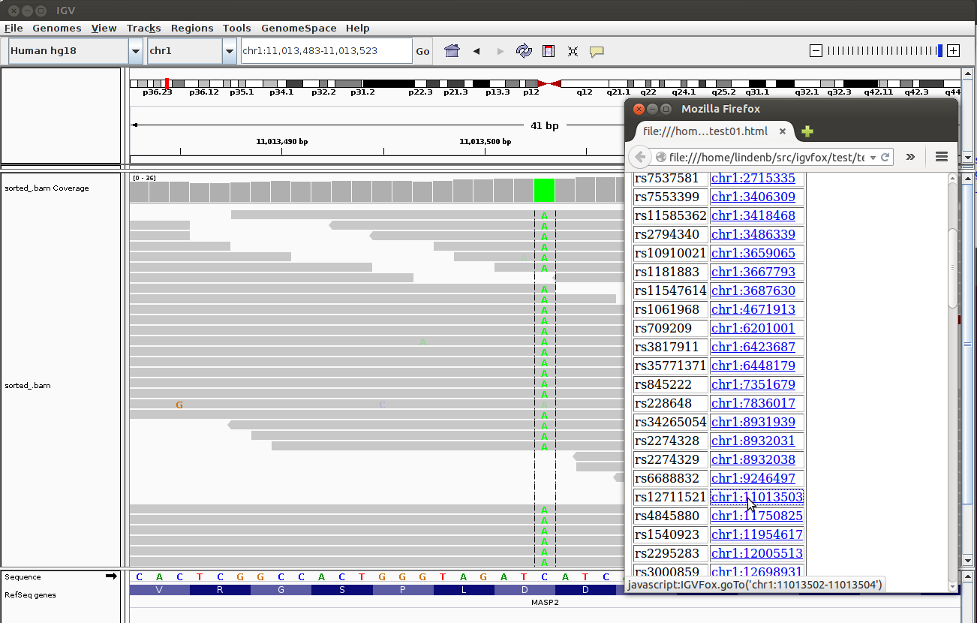
IGVFox: Integrative Genomics Viewer control through mozilla Firefox

I've just pushed IGVFox 0.1 an add-on for Firefox, controlling IGV, the Integrative Genomics Viewer.
This add-on allows the users to set the genomic position of IGV by just clicking a hyperlink in a HTML page. The source code is available on github at https://github.com/lindenb/igvfox and a first release is available as a *.xpi file at https://github.com/lindenb/igvfox/releases.


That's it,

Pierre

30 September 2014

Using the Ensembl Regulatory Build to annotate some VCF files

via UCSC Genome Browser project announcements: "Data from the Ensembl Regulatory Build are now available in the UCSC Genome Browser as a public track hub for both hg19 and hg38. This track hub contains promoters and their flanking regions, enhancers, and many other regulatory features predicted across a number of cell lines using annotated segmentation states".
For example looking at chr21:33037019-33037021 returns the following screen:

Those new annotations are deployed by the Sanger Institute as a UCSC track hub. By the way, those file can be directly handled using the UCSC standalone tools:
$ bigWigSummary -type=mean -udcDir=.  \
  "http://ngs.sanger.ac.uk/production/ensembl/regulation//hg19/segmentation_summaries/Segway_17/1.bw" \
  chr1 1  110301 1

1.23587
I wrote a java tool for the annotation of VCFs with those files. This tool uses the BigWig library for java ( https://code.google.com/p/bigwig/ ) and is available at: https://github.com/lindenb/jvarkit/wiki/VcfEnsemblReg.
Here is an example with the following VCF:
##fileformat=VCFv4.1
(...)
#CHROM POS ID REF ALT QUAL FILTER INFO FORMAT Sample
chr21 33037029 . C T 6.20 . . GT:PL:DP:GQ 1/1:35,3,0:1:4
VcfEnsemblReg is invoked:
$  java -jar dist/vcfensemblreg.jar in.vcf > out.vcf
Here is the content of out.vcf:
##fileformat=VCFv4.1
##INFO=<ID=AP2ALPHA,Number=1,Type=Float,Description="Overlap summary of AP2ALPHA ChipSeq binding peaks across available datasets http://ngs.sanger.ac.uk/production/ensembl/regulation//hg19/tfbs/AP2ALPHA.bw">
##INFO=<ID=AP2GAMMA,Number=1,Type=Float,Description="Overlap summary of AP2GAMMA ChipSeq binding peaks across available datasets http://ngs.sanger.ac.uk/production/ensembl/regulation//hg19/tfbs/AP2GAMMA.bw">
##INFO=<ID=ATF3,Number=1,Type=Float,Description="Overlap summary of ATF3 ChipSeq binding peaks across available datasets http://ngs.sanger.ac.uk/production/ensembl/regulation//hg19/tfbs/ATF3.bw">
##INFO=<ID=BAF155,Number=1,Type=Float,Description="Overlap summary of BAF155 ChipSeq binding peaks across available datasets http://ngs.sanger.ac.uk/production/ensembl/regulation//hg19/tfbs/BAF155.bw">
##INFO=<ID=BAF170,Number=1,Type=Float,Description="Overlap summary of BAF170 ChipSeq binding peaks across available datasets http://ngs.sanger.ac.uk/production/ensembl/regulation//hg19/tfbs/BAF170.bw">
(...)
#CHROM POS ID REF ALT QUAL FILTER INFO FORMAT Sample
chr21 33037029 . C T 6.20 . BuildOverview=ctcf_45704|CTCFBindingSite;Segway_17_1=3.0;Segway_17_14=7.0;Segway_17_24=3.0;Segway_17_6=1.0;Segway_17_7=2.0;Segway_17_8=1.0;Segway_17_A549_projected=ctcf_45704|InactiveRegions;Segway_17_A549_segments=14_gene_79558|TranscriptionAssociated;Segway_17_DND41_projected=ctcf_45704|InactiveRegions;Segway_17_DND41_segments=1_distal_17115|DistalEnhancer;Segway_17_GM12878_projected=ctcf_45704|InactiveRegions;Segway_17_GM12878_segments=1_distal_29075|DistalEnhancer;Segway_17_H1HESC_projected=ctcf_45704|ActiveCTCFBindingSite;Segway_17_H1HESC_segments=8_ctcf_27831|DistalCTF;Segway_17_HELAS3_projected=ctcf_45704|InactiveRegions;Segway_17_HELAS3_segments=6_distal_76536|DistalEnhancer;Segway_17_HEPG2_projected=ctcf_45704|InactiveRegions;Segway_17_HEPG2_segments=1_distal_21535|DistalEnhancer;Segway_17_HMEC_projected=ctcf_45704|InactiveRegions;Segway_17_HMEC_segments=14_gene_44998|TranscriptionAssociated;Segway_17_HSMMT_projected=ctcf_45704|InactiveRegions;Segway_17_HSMMT_segments=24_gene_70780|TranscriptionAssociated;Segway_17_HSMM_projected=ctcf_45704|InactiveRegions;Segway_17_HSMM_segments=24_gene_80902|TranscriptionAssociated;Segway_17_HUVEC_projected=ctcf_45704|InactiveRegions;Segway_17_K562_projected=ctcf_45704|InactiveRegions;Segway_17_K562_segments=14_gene_68692|TranscriptionAssociated;Segway_17_MONO_projected=ctcf_45704|InactiveRegions;Segway_17_MONO_segments=14_gene_35200|TranscriptionAssociated;Segway_17_NHA_projected=ctcf_45704|InactiveRegions;Segway_17_NHDFAD_projected=ctcf_45704|InactiveRegions;Segway_17_NHDFAD_segments=14_gene_57366|TranscriptionAssociated;Segway_17_NHEK_projected=ctcf_45704|InactiveRegions;Segway_17_NHEK_segments=24_gene_95458|TranscriptionAssociated;Segway_17_NHLF_projected=ctcf_45704|InactiveRegions;Segway_17_NHLF_segments=14_gene_59524|TranscriptionAssociated;Segway_17_OSTEO_projected=ctcf_45704|InactiveRegions;Segway_17_OSTEO_segments=14_gene_61575|TranscriptionAssociated GT:PL:DP:GQ 1/1:35,3,0:1:4
Here are the new fields in the INFO column:
Segway_17_1 3.0
Segway_17_14 7.0
Segway_17_24 3.0
Segway_17_6 1.0
Segway_17_7 2.0
Segway_17_8 1.0
Segway_17_A549_projected ctcf_45704|InactiveRegions
Segway_17_A549_segments 14_gene_79558|TranscriptionAssociated
Segway_17_DND41_projected ctcf_45704|InactiveRegions
Segway_17_DND41_segments 1_distal_17115|DistalEnhancer
Segway_17_GM12878_projected ctcf_45704|InactiveRegions
Segway_17_GM12878_segments 1_distal_29075|DistalEnhancer
Segway_17_H1HESC_projected ctcf_45704|ActiveCTCFBindingSite
Segway_17_H1HESC_segments 8_ctcf_27831|DistalCTF
Segway_17_HELAS3_projected ctcf_45704|InactiveRegions
Segway_17_HELAS3_segments 6_distal_76536|DistalEnhancer
Segway_17_HEPG2_projected ctcf_45704|InactiveRegions
Segway_17_HEPG2_segments 1_distal_21535|DistalEnhancer
Segway_17_HMEC_projected ctcf_45704|InactiveRegions
Segway_17_HMEC_segments 14_gene_44998|TranscriptionAssociated
Segway_17_HSMMT_projected ctcf_45704|InactiveRegions
Segway_17_HSMMT_segments 24_gene_70780|TranscriptionAssociated
Segway_17_HSMM_projected ctcf_45704|InactiveRegions
Segway_17_HSMM_segments 24_gene_80902|TranscriptionAssociated
Segway_17_HUVEC_projected ctcf_45704|InactiveRegions
Segway_17_K562_projected ctcf_45704|InactiveRegions
Segway_17_K562_segments 14_gene_68692|TranscriptionAssociated
Segway_17_MONO_projected ctcf_45704|InactiveRegions
Segway_17_MONO_segments 14_gene_35200|TranscriptionAssociated
Segway_17_NHA_projected ctcf_45704|InactiveRegions
Segway_17_NHDFAD_projected ctcf_45704|InactiveRegions
Segway_17_NHDFAD_segments 14_gene_57366|TranscriptionAssociated
Segway_17_NHEK_projected ctcf_45704|InactiveRegions
Segway_17_NHEK_segments 24_gene_95458|TranscriptionAssociated
Segway_17_NHLF_projected ctcf_45704|InactiveRegions
Segway_17_NHLF_segments 14_gene_59524|TranscriptionAssociated
Segway_17_OSTEO_projected ctcf_45704|InactiveRegions
Segway_17_OSTEO_segments 14_gene_61575|TranscriptionAssociated

OK, now I've got a VCF containing those 'Ensembl Regulatory' annotations. What can I do with this ? I've currently no idea :-)

That's it,
Pierre

08 September 2014

It's a kind of magic(5)

The following question was recently asked on biostars.org : Tool that detects data types:"More specifically I am interested for detecting between SAM, BAM, FASTA, FASTQ (if possible descriminating between these types), BED, BED12, BED15, GFF, GFF2, GFF3). The detection should be performed without just looking at the extension of the file....":
I suggested to create a new magic file for the linux file command. As an example, a BAM file starts (position=0) with the magic bytes BAM\1. A magic file definition 'bam' for BAM would be:

0 string BAM\1 BAM file v1.0
Compile the new magic file:
file -C -m bam
Now use this magic:
file -z -m bam.mgc file.bam
file.bam: BAM file v1.0 (data)

Now, I've started a github repo containing some 'magic' patterns for bioinformatics (Fastq, blast, bam, bigwig, etc... ): .
(My current problem is to prioritize some results like differentiating a 'Nucleotide' and a 'Protein' Fasta sequence ( http://unix.stackexchange.com/questions/154096/file1-and-magic5-prioritizing-a-result).)

That's it,
Pierre

03 September 2014

Parallelizing GNU #Make 4 in a #SLURM infrastructure/cluster

SLURM (https://computing.llnl.gov/linux/slurm/slurm.html) is The Simple Linux Utility for Resource Management . It's an open source, fault-tolerant, and highly scalable cluster management and job scheduling system for large and small Linux clusters.

A patch for GNU Make version 3.81 is available as part of the SLURM distribution in https://github.com/SchedMD/slurm/blob/master/contribs/make.slurm.patch This patch will use SLURM to launch tasks across a job's current resource allocation.

The patch for Make 'just' wraps the command into srun: ( "srun is the command sending a parallel job on cluster managed by SLURM. )

Index: job.c
===================================================================
--- job.c (revision 321)
+++ job.c (working copy)
@@ -1959,6 +1959,22 @@
void
child_execute_job (int stdin_fd, int stdout_fd, char **argv, char **envp)
{
+/* PARALLEL JOB LAUNCH VIA SLURM */
+ if (getenv("SLURM_JOB_ID")) {
+ int i;
+ static char *argx[128];
+ argx[0] = "srun";
+ argx[1] = "-N1";
+ argx[2] = "-n1";
+ for (i=0; ((i<124)&&(argv[i])); i++) {
+ argx[i+3] = argv[i];
+ }
+ if (i<124) {
+ argx[i+3] = NULL;
+ argv = argx;
+ }
+ }
+/* END OF SLURM PATCH */
if (stdin_fd != 0)
(void) dup2 (stdin_fd, 0);
if (stdout_fd != 1)

GNU-Make version 4 was recently released. This new version comes with a number of improvements like GNU Guile integration, Loadable objects (see http://plindenbaum.blogspot.fr/2014/08/a-gnu-make-plug-in-for-illumina-fastqs.html ). It also allows to specify the default shell to be invoked (see http://plindenbaum.blogspot.fr/2014/01/parallelizing-rstats-using-make.html )

http://www.gnu.org/software/make/manual/make.html : The program used as the shell is taken from the variable SHELL. If this variable is not set in your makefile, the program /bin/sh is used as the shell. The argument(s) passed to the shell are taken from the variable .SHELLFLAGS. The default value of .SHELLFLAGS is -c normally, or -ec in POSIX-conforming mode.

So, if you want to parallelize GNU-Make with SLURM you can wrap the shell into srun using SHELL and .SHELLFLAGS. Here is an example, creating and concatenating 100 files containing the hostname:

ifdef SLURM_JOB_ID
SHELL=srun
.SHELLFLAGS= -N1 -n1  bash -c 
endif
NUMBERS=$(shell seq 1 100 )
TARGETS=  $(addsuffix .test,${NUMBERS} )


.PHONY:  all clean

define TEST

$(addsuffix .test,$(1)) : 
        echo -n  $(1) " " > $$@ && hostname >> $$@
        @sleep 5

endef


all: ${TARGETS}
        cat $^

$(foreach N,$(NUMBERS), $(eval $(call TEST,$(N) ) ) )

clean:
        rm -f ${TARGETS}

now invoke Make with SLURM and the option -j ( Allow -j N jobs at once ):

$ make -j 10
echo -n  1  " " > 1.test && hostname >> 1.test
echo -n  2  " " > 2.test && hostname >> 2.test
echo -n  3  " " > 3.test && hostname >> 3.test
echo -n  4  " " > 4.test && hostname >> 4.test
echo -n  5  " " > 5.test && hostname >> 5.test
echo -n  6  " " > 6.test && hostname >> 6.test
echo -n  7  " " > 7.test && hostname >> 7.test
(...)
echo -n  100  " " > 100.test && hostname >> 100.test
cat 1.test 2.test 3.test 4.test 5.test 6.test 7.test 8.test (...)
1  node004
2  node003
3  node001
4  node002
5  node002
6  node001
7  node002
8  node001
9  node001
10  node002
(...)
92  node004
93  node001
94  node001
95  node001
96  node001
97  node002
98  node001
99  node001
100  node001
That's it,
Pierre