03 February 2010

Using a FASTA file as a source of RDF statements for SPARQL.


In this post, I'll show how a Fasta file can be used as a source of RDF statements for the Jena API.
The DNA sequences in the Fasta file will be used by Jena without any prior transformation: the file will be used as a Graph by Jena by implementing com.hp.hpl.jena.graph.Graph.

Here, my example uses a Fasta file but it could have been any kind of input: a SQL database, a XML file, a GFF file, etc...

How it works


com.hp.hpl.jena.graph.Graph is the interface to be satisfied by implementations maintaining collections of RDF triples. The core interface is small (add, delete, find, contains) and is augmented by additional classes to handle more complicated matters such as reification, query handling, bulk update, event management, and transaction handling. My implementation for this interface extends com.hp.hpl.jena.graph.impl.GraphBase, will read a Fasta file and create set of RDF triple for each sequence. All we need is (love and ) implementing the abstract function ExtendedIterator<Triple> graphBaseFind(TripleMatch matcher)
public class FastaModel
extends GraphBase
{
protected ExtendedIterator<Triple> graphBaseFind(TripleMatch matcher)
{
//the function to be implemented....
}
}

The FastaSequence


A simple container for a name and a sequence.
/** a simple fasta sequence */
private static class FastaSequence
{
StringBuilder name=new StringBuilder();
StringBuilder sequence=new StringBuilder();
}

Reading the next Fasta Sequence

... Not Rocket Science...
/** the file reader */
private PushbackReader reader;
(...)
reader=new PushbackReader(new FileReader(fastaFile));
(...)
private FastaSequence readNext() throws IOException
{
if(this.reader==null) return null;
int c;
FastaSequence seq=null;
while((c=this.reader.read())!=-1)
{
if(c=='>')
{
if(seq!=null)
{
this.reader.unread(c);
return seq;
}
seq=new FastaSequence();
while((c=this.reader.read())!=-1)
{
if(c=='\n') break;
seq.name.append((char)c);
}
}
else if(seq!=null && Character.isLetter(c))
{
seq.sequence.append((char)c);
}
}
this.close();//close the FileReader
return seq;
}

Implementing the Iterator of Triples


My FastaIterator extends jena.util.iterator.NiceIterator<Triple>, a class extening the ExtendedIterator returned by the Graph function ExtendedIterator<Triple> graphBaseFind(TripleMatch matcher). The class contains three fields:
  • a FileReader
  • com.hp.hpl.jena.graph.Triple that is used as a filter
  • a stack/queue of RDF Triples
. The constructor for 'FastaIterator' opens the stream:
FastaIterator(TripleMatch matcher) throws IOException
{
this.filter=matcher.asTriple();
try
{
this.reader=new PushbackReader(new FileReader(FastaModel.this.fastaFile));
}
catch (IOException e)
{
throw new JenaException(e);
}
}
The method 'close' just close the input stream
@Override
public void close()
{
try
{
if(this.reader!=null) reader.close();
}
catch (IOException e)
{
throw new JenaException(e);
}
finally
{
this.reader=null;
super.close();
}
The method 'next()' check if there is something in the RDF queue, if true a RDF triple is removed and returned:
@Override
public Triple next()
{
if(this.triples_queue.isEmpty()) hasNext();
if(this.triples_queue.isEmpty()) throw new IllegalStateException();
return this.triples_queue.pop();
}
The method 'hasNext()' returns true if the queue of RDF triple is not empty. Otherwise, it gets the next Fasta Sequence
from the input stream and transforms it into a set of RDF triple that are added to the RDF queue if they match this.filter.That is to say, the following fasta sequence...:


>gi|227935373|gb|FJ425127.1| Rotavirus G8 isolate 6862/2000/ARN NSP3 gene, partial cds
GGCCACTTCAACATTAGAATTAATGGGTATTCAATATGATTACAATGAAGTATTTACCAGAGTTAAAAGT
AAATTTGATTATGTGATGGATGACTCTGGTGTTAAAAACAATCTTTTGGGTAAAGCTATAACTATTGATC
AGGCATTAAATGGAAAGTTTGGCTCAGCTATTAGAAATAGAAATTGGATGACTGATTCTAAAACGGTTGC
TAAATTAGATGAAGACGTGAATAAACTTAGAATGACATTATCTTCTAAAGGAATCGACCAAAAGATGAGA
GTACTTAATGCTTGTTTAGTGTA

... will generate those four RDF statements:
<http://www.ncbi.nlm.nih.gov/nuccore/227935373> <urn:lindenb:ontology:length> "303"^^<http://www.w3.org/2001/XMLSchema#int>
<http://www.ncbi.nlm.nih.gov/nuccore/227935373> <urn:lindenb:ontology:sequence> "GGCCACTTCAACATTAGAATTAATGGGTATTCAATATGATTACAATGAAGTATTTACCAGAGTTAAAAGTAAATTTGATTATGTGATGGATGACTCTGGTGTTAAAAACAATCTTTTGGGTAAAGCTATAACTATTGATCAGGCATTAAATGGAAAGTTTGGCTCAGCTATTAGAAATAGAAATTGGATGACTGATTCTAAAACGGTTGCTAAATTAGATGAAGACGTGAATAAACTTAGAATGACATTATCTTCTAAAGGAATCGACCAAAAGATGAGAGTACTTAATGCTTGTTTAGTGTA"
<http://www.ncbi.nlm.nih.gov/nuccore/227935373> <http://purl.org/dc/elements/1.1/title> "gi|227935373|gb|FJ425127.1| Rotavirus G8 isolate 6862/2000/ARN NSP3 gene, partial cds"
<http://www.ncbi.nlm.nih.gov/nuccore/227935373> <http://www.w3.org/1999/02/22-rdf-syntax-ns#type> <urn:lindenb:ontology:Sequence>
Here is the code for the 'hasNext' function:
@Override
public boolean hasNext()
{
if(!triples_queue.isEmpty()) return true;
if(this.reader==null) return false;
try
{
/* loop until the queue is not empty or the stream is closed */
while(this.triples_queue.isEmpty())
{
//try to get a new fasta sequence
FastaSequence seq=readNext();
if(seq==null) return false;

String name=seq.name.toString();
//check it is a genbank file with a gi
if(!name.startsWith("gi|"))
{
continue;
}
int i=name.indexOf('|',3);
if(i==-1) continue;
//create the subject
Node subject =Node.createURI("http://www.ncbi.nlm.nih.gov/nuccore/"+name.substring(3,i));

//make a triple for the rdf:type
Triple triple=new Triple(
subject,
RDF.type.asNode(),
Node.createURI("urn:lindenb:ontology:Sequence")
);
//append this triple to the queue if it is accepted by this.filter
if(this.filter.asTriple().matches(triple))
{
this.triples_queue.add(triple);
}

//make a triple for the dc:title
triple=new Triple(
subject,
DC.title.asNode(),
Node.createLiteral(name)
);

//append this triple to the queue if it is accepted by this.filter
if(this.filter.asTriple().matches(triple))
{
this.triples_queue.add(triple);
}

//make a triple for the DNA sequence
triple=new Triple(
subject,
Node.createURI("urn:lindenb:ontology:sequence"),
Node.createLiteral(seq.sequence.toString())
);

//append this triple to the queue if it is accepted by this.filter
if(this.filter.asTriple().matches(triple))
{
this.triples_queue.add(triple);
}

//make a triple for the size of this sequence
triple=new Triple(
subject,
Node.createURI("urn:lindenb:ontology:length"),
Node.createLiteral(String.valueOf(seq.sequence.length()),null,XSDDatatype.XSDint)
);

//append this triple to the queue if it is accepted by this.filter
if(this.filter.asTriple().matches(triple))
{
this.triples_queue.add(triple);
}

}
}
catch (IOException e)
{
close();
throw new JenaException(e);
}
return !triples_queue.isEmpty();
}

Using the graph

.
Creating a new Jena RDF Model
Model m=ModelFactory.createModelForGraph(
new FastaModel(
new File("rotavirus.fa")
));

Looping over the RDF statements
After creating this new Model, it can be used as a regular Jena RDF Model. e.g:
StmtIterator i=m.listStatements();
while(i.hasNext())
{
System.err.println(i.next());
}
Result
[http://www.ncbi.nlm.nih.gov/nuccore/227935373, urn:lindenb:ontology:length, "303"^^http://www.w3.org/2001/XMLSchema#int]
[http://www.ncbi.nlm.nih.gov/nuccore/227935373, urn:lindenb:ontology:sequence, "GGCCACTTCAACATTAGAATTAATGGGTATTCAATATGATTACAATGAAGTATTTACCAGAGTTAAAAGTAAATTTGATTATGTGATGGATGACTCTGGTGTTAAAAACAATCTTTTGGGTAAAGCTATAACTATTGATCAGGCATTAAATGGAAAGTTTGGCTCAGCTATTAGAAATAGAAATTGGATGACTGATTCTAAAACGGTTGCTAAATTAGATGAAGACGTGAATAAACTTAGAATGACATTATCTTCTAAAGGAATCGACCAAAAGATGAGAGTACTTAATGCTTGTTTAGTGTA"]
[http://www.ncbi.nlm.nih.gov/nuccore/227935373, http://purl.org/dc/elements/1.1/title, "gi|227935373|gb|FJ425127.1| Rotavirus G8 isolate 6862/2000/ARN NSP3 gene, partial cds"]
[http://www.ncbi.nlm.nih.gov/nuccore/227935373, http://www.w3.org/1999/02/22-rdf-syntax-ns#type, urn:lindenb:ontology:Sequence]
[http://www.ncbi.nlm.nih.gov/nuccore/227935371, urn:lindenb:ontology:length, "303"^^http://www.w3.org/2001/XMLSchema#int]
[http://www.ncbi.nlm.nih.gov/nuccore/227935371, urn:lindenb:ontology:sequence, "GGCCACTTCAACATTAGAATTAATGGGTATTCAATATGATTACAATGAAGTATTTACCAGAGTTAAAAGTAAATTTGATTATGTGATGGATGACTCTGGTGTTAAAAACAATCTTTTGGGTAAAGCTATAACTATTGATCAGGCATTAAATGGAAAGTTTGGCTCAGCTATTAGAAATAGAAATTGGATGACTGATTCTAAAACGGTTGCTAAATTAGATGAAGACGTGAATAAACTTAGAATGACATTATCTTCTAAAGGAATCGACCAAAAGATGAGAGTACTTAATGCTTGTTTAGTGTA"]
[http://www.ncbi.nlm.nih.gov/nuccore/227935371, http://purl.org/dc/elements/1.1/title, "gi|227935371|gb|FJ425126.1| Rotavirus G8 isolate 6854/2002/ARN NSP3 gene, partial cds"]
[http://www.ncbi.nlm.nih.gov/nuccore/227935371, http://www.w3.org/1999/02/22-rdf-syntax-ns#type, urn:lindenb:ontology:Sequence]
[http://www.ncbi.nlm.nih.gov/nuccore/227935369, urn:lindenb:ontology:length, "303"^^http://www.w3.org/2001/XMLSchema#int]
[http://www.ncbi.nlm.nih.gov/nuccore/227935369, urn:lindenb:ontology:sequence, "GGCCACTTCAACATTAGAATTAATGGGTATTCAATATGATTACAATGAAGTATTTACCAGAGTTAAAAGTAAATTTGATTATGTGATGGATGACTCTGGTGTTAAAAACAATCTTCTGGGTAAAGCTATAACTATTGATCAGGCATTAAATGGAAAGTTTGGCTCAGCTATTAGAAATAGAAATTGGATGACTGATTCTAAAACGGTTGCTAAATTAGATGAAGACGTGAATAAACTTAGAATGACATTATCTTCTAAAGGAATCGACCAAAAGATGAGAGTACTTAATGCTTGTTTAGTGTA"]
[http://www.ncbi.nlm.nih.gov/nuccore/227935369, http://purl.org/dc/elements/1.1/title, "gi|227935369|gb|FJ425125.1| Rotavirus G8 isolate 6810/2004/ARN NSP3 gene, partial cds"]
(...)

This model can also be used as a source of RDF by ARQ , the SPARQL engine for Jena (!). Here we create a new SPARQL engine and list the sequences having a length lower than the others
Query query=QueryFactory.create(
"SELECT ?Seq1 ?Len1 ?Seq2 ?Len2" +
"{" +
"?Seq1 a <urn:lindenb:ontology:Sequence> . " +
"?Seq1 <urn:lindenb:ontology:length> ?Len1 . " +
"?Seq2 a <urn:lindenb:ontology:Sequence> . " +
"?Seq2 <urn:lindenb:ontology:length> ?Len2 . " +
"FILTER (?Seq1!=?Seq2 && ?Len1 < ?Len2) "+

"}"
);
QueryExecution execution = QueryExecutionFactory.create(query, m);
ResultSet row=execution.execSelect();
while(row.hasNext())
{
QuerySolution solution=row.next();

for(Iterator<String> si=solution.varNames();si.hasNext();)
{
String name=si.next();
System.out.println(name+" : "+solution.get(name));
}
System.out.println();
}
Result:
Seq1 : http://www.ncbi.nlm.nih.gov/nuccore/227935373
Len1 : 303^^http://www.w3.org/2001/XMLSchema#int
Seq2 : http://www.ncbi.nlm.nih.gov/nuccore/227935361
Len2 : 304^^http://www.w3.org/2001/XMLSchema#int

Seq1 : http://www.ncbi.nlm.nih.gov/nuccore/227935373
Len1 : 303^^http://www.w3.org/2001/XMLSchema#int
Seq2 : http://www.ncbi.nlm.nih.gov/nuccore/227935359
Len2 : 304^^http://www.w3.org/2001/XMLSchema#int

Seq1 : http://www.ncbi.nlm.nih.gov/nuccore/227935373
Len1 : 303^^http://www.w3.org/2001/XMLSchema#int
Seq2 : http://www.ncbi.nlm.nih.gov/nuccore/215489730
Len2 : 305^^http://www.w3.org/2001/XMLSchema#int

Seq1 : http://www.ncbi.nlm.nih.gov/nuccore/227935371
Len1 : 303^^http://www.w3.org/2001/XMLSchema#int
Seq2 : http://www.ncbi.nlm.nih.gov/nuccore/227935361
Len2 : 304^^http://www.w3.org/2001/XMLSchema#int

Seq1 : http://www.ncbi.nlm.nih.gov/nuccore/227935371
Len1 : 303^^http://www.w3.org/2001/XMLSchema#int
Seq2 : http://www.ncbi.nlm.nih.gov/nuccore/227935359
Len2 : 304^^http://www.w3.org/2001/XMLSchema#int

Seq1 : http://www.ncbi.nlm.nih.gov/nuccore/227935371
Len1 : 303^^http://www.w3.org/2001/XMLSchema#int
Seq2 : http://www.ncbi.nlm.nih.gov/nuccore/215489730
Len2 : 305^^http://www.w3.org/2001/XMLSchema#int

Seq1 : http://www.ncbi.nlm.nih.gov/nuccore/227935369
Len1 : 303^^http://www.w3.org/2001/XMLSchema#int
Seq2 : http://www.ncbi.nlm.nih.gov/nuccore/227935361
Len2 : 304^^http://www.w3.org/2001/XMLSchema#int
(...)
Hey, I thinks it's coool ! :-)
BTW I wonder how, knowing the FILTER of the SPARQL query, searching the Graph can be optimized, for example if we know that the sequences have been sorted in the fasta file according to their lengths.... Any idea ?

Compiling


export JENAPATH=${JENALIB}/icu4j-3.4.4.jar:${JENALIB}/iri-0.7.jar:${JENALIB}/jena-2.6.2.jar:${JENALIB}/jena-2.6.2-tests.jar:${JENALIB}/junit-4.5.jar:${JENALIB}/log4j-1.2.13.jar:${JENALIB}/lucene-core-2.3.1.jar:${JENALIB}/slf4j-api-1.5.6.jar:${JENALIB}/slf4j-log4j12-1.5.6.jar:${JENALIB}/stax-api-1.0.1.jar:${JENALIB}/wstx-asl-3.2.9.jar:${JENALIB}/xercesImpl-2.7.1.jar:${JENALIB}/icu4j-3.4.4.jar:${JENALIB}/iri-0.7.jar:${JENALIB}/jena-2.6.2.jar:${JENALIB}/jena-2.6.2-tests.jar:${JENALIB}/junit-4.5.jar:${JENALIB}/log4j-1.2.13.jar:${JENALIB}/lucene-core-2.3.1.jar:${JENALIB}/slf4j-api-1.5.6.jar:${JENALIB}/slf4j-log4j12-1.5.6.jar:${JENALIB}/stax-api-1.0.1.jar:${JENALIB}/wstx-asl-3.2.9.jar:${JENALIB}/xercesImpl-2.7.1.jar:${JENALIB}/arq-2.8.1.jar
javac -cp ${JENAPATH}:. -d bin -sourcepath src src/test/FastaModel.java

Running


java -cp ${JENAPATH}:bin test.FastaModel

All, in one, here is the code


That's it !
Pierre

01 February 2010

Searching for Genotypes with SPARQL.

This week-end, I've noticed that the NCBI has an interface called Genotype Query Form used to query some genotypes the generating the following kind of XML output:
<GenoExchange xmlns:xsi="http://www.w3.org/2001/XMLSchema-instance" xmlns="http://www.ncbi.nlm
.nih.gov/SNP/geno" xsi:schemaLocation="http://www.ncbi.nlm.nih.gov/SNP/geno ftp://ftp.ncbi.nlm.nih.gov/snp/specs/genoex_1_4.xsd" dbSNPBuildNo="129">
<Population popId="1409" handle="CSHL-HAPMAP" locPopId="HapMap-CEU">
<popClass self="NOT SPECIFIED" />
</Population>
<Individual indId="170" taxId="9606" sex="F" indGroup="European">
<SourceInfo source="Coriell" sourceType="repository" ncbiPedId="80" pedId="1340" indId="NA07000" maId="0" paId="0" srcIndGroup="Western and Nothern European" />
<SubmitInfo popId="1409" submittedIndId="NA07000" subIndGroup="Western and Northern European" />
</Individual>
<Individual indId="621" taxId="9606" sex="F" indGroup="European">

(...)
<SnpLoc genomicAssembly="36:reference" chrom="1" start="1286927" locType="2" rsOrientToCh
rom="rev" contigAllele="C" />
<SsInfo ssId="3906671" locSnpId="AL139287.6_22772" ssOrientToRs="fwd">
<ByPop popId="1409" sampleSize="120">
<AlleleFreq allele="A" freq="0.117" />
<AlleleFreq allele="G" freq="0.883" />
<GTypeFreq gtype="A/G" freq="0.233" />
<GTypeFreq gtype="G/G" freq="0.767" />
(...)
<GTypeByInd indId="636" gtype="G/G" />
<GTypeByInd indId="456" gtype="G/G" />
<GTypeByInd indId="536" gtype="G/G" />
</ByPop>
</SsInfo>
<GTypeFreq gtype="A/A" freq="0.380952380952381" />
<GTypeFreq gtype="A/G" freq="0.352380952380952" />
<GTypeFreq gtype="G/G" freq="0.266666666666667" />
</SnpInfo>
<SnpInfo rsId="2765021" observed="A/G">
(...)
I wanted to see how one could query this kind of data with SPARQL... well, I'm sure that RDF is one of the most inefficient way to store this kind of data but I wanted to see what could be extracted from such RDFStore from a semantic query. First, I wrote a XSLT stylesheet transforming <GenoExchange/> to <rdf:RDF/>. The stylsheet is available at http://code.google.com/p/lindenb/source/browse/trunk/src/xsl/genoexch2rdf.xsl.
.

Transform the data

About 639 HAPMAP snps on the chromosome 1 were extracted using the HTML form and saved as XML to the file 'SNPgenotype-100201-1244-3905.xml'(size 4Mo). The xml was converted to RDF with the xsltproc engine:
xsltproc --stringparam "with-sequence" yes --novalid genoexch2rdf.xsl SNPgenotype-100201-1244-3905.xml > input.rdf
The size of 'input.rdf' (including the flanking sequences of the SNPs) was 20Mo.

Result


<?xml version="1.0"?>
<rdf:RDF xmlns:rdf="http://www.w3.org/1999/02/22-rdf-syntax-ns#" xmlns:xsi="http://www.w3.org/2001/XMLSchema-instance" xmlns:g="http://www.ncbi.nlm.nih.gov/SNP/geno" xmlns:snp="http://www.ncbi.nlm.nih.gov/SNP/docsum" xmlns="http://ontology.lindenb.org/genotypes/">
<Population rdf:about="http://www.ncbi.nlm.nih.gov/projects/SNP/snp_viewTable.cgi?type=pop&amp;pop_id=1409">
<handle>CSHL-HAPMAP</handle>
<locPopId>HapMap-CEU</locPopId>
</Population>
<Individual rdf:about="http://www.ncbi.nlm.nih.gov/projects/SNP/snp_ind.cgi?ind_id=170">
<hasPop rdf:resource="http://www.ncbi.nlm.nih.gov/projects/SNP/snp_viewTable.cgi?type=pop&amp;pop_id=1409"/>
<sex>F</sex>
<name>NA07000</name>
</Individual>
<Individual rdf:about="http://www.ncbi.nlm.nih.gov/projects/SNP/snp_ind.cgi?ind_id=621">
<hasPop rdf:resource="http://www.ncbi.nlm.nih.gov/projects/SNP/snp_viewTable.cgi?type=pop&amp;pop_id=1409"/>
<sex>F</sex>
<name>NA12875</name>
</Individual>
<Individual rdf:about="http://www.ncbi.nlm.nih.gov/projects/SNP/snp_ind.cgi?ind_id=538">
<hasPop rdf:resource="http://www.ncbi.nlm.nih.gov/projects/SNP/snp_viewTable.cgi?type=pop&amp;pop_id=1409"/>
<sex>F</sex>
<name>NA12753</name>
(...)
<SNP rdf:about="http://www.ncbi.nlm.nih.gov/projects/SNP/snp_ref.cgi?rs=307347">
<het rdf:datatype="http://www.w3.org/2001/XMLSchema#float">0.1</het>
<name>rs307347</name>
<seq5>GGGGATGGCTGCTCCTGGGCCTCAGAAAGATGCAGTCCCATAGACTTCCAGCACGCCCCTCCCCTCCTCGGGCCTTAATTTTGTCCACTGAGAAGATGGTCTCTGAGGCTCTGGGGTTTCCTTCTTGGTCACCAGATATTCTGCGGGCCTTGCCTTCCTGCCCAGATTCGAGCCAGTGGCAAACAGAAGCTGCCAGGAGC</seq5>
<observed>C/T</observed>
<seq3>TCTCAGAGCTGTGGCTGGTGGCTCGGTAACAACAGGAAGGGCAGTGGCTGTGCAGGAGGCAGGCAGCTTGCCAGCCCAGGAAGGTGACCCAGGACACCTCCAGGCCTTTCCCAGGGCAGCCCAACGGCCCAAGGTCAGGGCCGGGCGCGAGGGCGGCCTGAGCACAGAGCACGGGGGCTGACAGCAGGCTGGGGGGCCAG</seq3>
</SNP>
<MapLoc>
<hasSNP rdf:resource="http://www.ncbi.nlm.nih.gov/projects/SNP/snp_ref.cgi?rs=307347"/>
<strand>+</strand>
<chrom>1</chrom>
<start rdf:datatype="http://www.w3.org/2001/XMLSchema#integer">1320381</start>
<assembly rdf:resource="urn:assembly:Celera:36_3"/>
<type>exact</type>
</MapLoc>
(...)
<Genotype>
<hasIndi rdf:resource="http://www.ncbi.nlm.nih.gov/projects/SNP/snp_ind.cgi?ind_id=465"/>
<hasSNP rdf:resource="http://www.ncbi.nlm.nih.gov/projects/SNP/snp_ref.cgi?rs=940550"/>
<allele1>T</allele1>
<allele2>T</allele2>
</Genotype>
<Genotype>
<hasIndi rdf:resource="http://www.ncbi.nlm.nih.gov/projects/SNP/snp_ind.cgi?ind_id=253"/>
<hasSNP rdf:resource="http://www.ncbi.nlm.nih.gov/projects/SNP/snp_ref.cgi?rs=940550"/>
<allele1>T</allele1>
<allele2>T</allele2>
</Genotype>
</rdf:RDF>

Invoking ARQ

export ARQROOT=ARQ-2.5.0
ARQ-2.5.0/bin/arq --data ~/input.rdf --query ~/query01.rq

Dump All


Query

PREFIX rdf: <http://www.w3.org/1999/02/22-rdf-syntax-ns#>
PREFIX g: <http://ontology.lindenb.org/genotypes/>
SELECT ?s ?p ?o {?s ?p ?o.}

Result

| _:b0 | g:allele2 | "C" |
| _:b0 | g:allele1 | "C" |
| _:b0 | g:hasSNP | <http://www.ncbi.nlm.nih.gov/projects/SNP/snp_ref.cgi?rs=17160669> |
| _:b0 | g:hasIndi | <http://www.ncbi.nlm.nih.gov/projects/SNP/snp_ind.cgi?ind_id=636> |
| _:b0 | rdf:type | g:Genotype |
| _:b1 | g:allele2 | "T" |
| _:b1 | g:allele1 | "C" |
| _:b1 | g:hasSNP | <http://www.ncbi.nlm.nih.gov/projects/SNP/snp_ref.cgi?rs=17160669> |
| _:b1 | g:hasIndi | <http://www.ncbi.nlm.nih.gov/projects/SNP/snp_ind.cgi?ind_id=361> |
| _:b1 | rdf:type | g:Genotype |
| <http://www.ncbi.nlm.nih.gov/projects/SNP/snp_ind.cgi?ind_id=174> | g:name | "NA07048" |
| <http://www.ncbi.nlm.nih.gov/projects/SNP/snp_ind.cgi?ind_id=174> | g:sex | "M" |
| <http://www.ncbi.nlm.nih.gov/projects/SNP/snp_ind.cgi?ind_id=174> | g:hasPop | <http://www.ncbi.nlm.nih.gov/projects/SNP/snp_viewTable.cgi?type=pop&pop_id=1409> |
| <http://www.ncbi.nlm.nih.gov/projects/SNP/snp_ind.cgi?ind_id=174> | rdf:type | g:Individual |
| <http://www.ncbi.nlm.nih.gov/projects/SNP/snp_ind.cgi?ind_id=566> | g:name | "NA12802" |
| <http://www.ncbi.nlm.nih.gov/projects/SNP/snp_ind.cgi?ind_id=566> | g:sex | "F" |
| <http://www.ncbi.nlm.nih.gov/projects/SNP/snp_ind.cgi?ind_id=566> | g:hasPop | <http://www.ncbi.nlm.nih.gov/projects/SNP/snp_viewTable.cgi?type=pop&pop_id=1409> |
| <http://www.ncbi.nlm.nih.gov/projects/SNP/snp_ind.cgi?ind_id=566> | rdf:type | g:Individual |
| _:b2 | g:allele2 | "A" |
| _:b2 | g:allele1 | "A" |
| _:b2 | g:hasSNP | <http://www.ncbi.nlm.nih.gov/projects/SNP/snp_ref.cgi?rs=2765021> |
| _:b2 | g:hasIndi | <http://www.ncbi.nlm.nih.gov/projects/SNP/snp_ind.cgi?ind_id=429> |
| _:b2 | rdf:type | g:Genotype |
| _:b3 | g:allele2 | "C" |
| _:b3 | g:allele1 | "C" |
| _:b3 | g:hasSNP | <http://www.ncbi.nlm.nih.gov/projects/SNP/snp_ref.cgi?rs=17160669> |
| _:b3 | g:hasIndi | <http://www.ncbi.nlm.nih.gov/projects/SNP/snp_ind.cgi?ind_id=546> |
| _:b3 | rdf:type | g:Genotype |
| _:b4 | g:allele2 | "T" |
| _:b4 | g:allele1 | "C" |
| _:b4 | g:hasSNP | <http://www.ncbi.nlm.nih.gov/projects/SNP/snp_ref.cgi?rs=17160669> |
| _:b4 | g:hasIndi | <http://www.ncbi.nlm.nih.gov/projects/SNP/snp_ind.cgi?ind_id=159> |
| _:b4 | rdf:type | g:Genotype |
| <http://www.ncbi.nlm.nih.gov/projects/SNP/snp_ind.cgi?ind_id=621> | g:name | "NA12875" |
| <http://www.ncbi.nlm.nih.gov/projects/SNP/snp_ind.cgi?ind_id=621> | g:sex | "F" |
(...)


Select the populations


Query

PREFIX rdf: <http://www.w3.org/1999/02/22-rdf-syntax-ns#>
PREFIX g: <http://ontology.lindenb.org/genotypes/>
SELECT ?pop
{
?s a g:Population .
?s g:handle ?pop .
}

Result

-----------------
| pop |
=================
| "CSHL-HAPMAP" |
-----------------


List six individuals for each population


Query

PREFIX rdf: <http://www.w3.org/1999/02/22-rdf-syntax-ns#>
PREFIX g: <http://ontology.lindenb.org/genotypes/>
SELECT ?pop ?indi_name ?good
{
?s a g:Population .
?s g:handle ?pop .
?s2 a g:Individual .
?s2 g:hasPop ?s .
?s2 g:sex ?good .
?s2 g:name ?indi_name
}
limit 6

Result

------------------------------------
| pop | indi_name | good |
====================================
| "CSHL-HAPMAP" | "NA10854" | "F" |
| "CSHL-HAPMAP" | "NA12264" | "M" |
| "CSHL-HAPMAP" | "NA11993" | "F" |
| "CSHL-HAPMAP" | "NA10830" | "M" |
| "CSHL-HAPMAP" | "NA12762" | "M" |
| "CSHL-HAPMAP" | "NA12155" | "M" |
------------------------------------


List the SNPs having a flanking sequence containing 'CACACA'


Query

PREFIX rdf: <http://www.w3.org/1999/02/22-rdf-syntax-ns#>
PREFIX g: <http://ontology.lindenb.org/genotypes/>
PREFIX fn: <http://www.w3.org/2005/xpath-functions#>

SELECT ?name ?seq5 ?observed ?seq3
WHERE
{
?s a g:SNP .
?s g:name ?name .
?s g:seq5 ?seq5 .
?s g:seq3 ?seq3 .
?s g:observed ?observed .

FILTER (
fn:contains(fn:upper-case(?seq5), "CACACA") ||
fn:contains(fn:upper-case(?seq3), "CACACA")
)
}

Result

-------------------------------------------------------------------------------------------------------------------------------------------------------------------------------------------------------------------------------------------------------------------------------------------------------------------------------------------------------------------------------------------------------------------------------------------------------------------------------------------------------------------------------------------------------------------------------------------------------------------------------------------------------------
| name | seq5 | observed | seq3 |
=============================================================================================================================================================================================================================================================================================================================================================================================================================================================================================================================================================================================================================================================
| "rs17160669" | "GCCACCGCGCCTGGCCCACAAGCATAACTTTTATAAAAATAATTTACTTTTACAATTAAGCTTAGGAATCACACAGACTCAGGGCTGGCTCATGGCTTCC" | "C/T" | "GGCAAGTTAAACTCTGTACTTAGGCTCGGCGCGTATGAAATGGCTAATTCTAATCAGTGGTGCAATGAAGTAACTCCTCTAAAGAACTTATCGGGCCGGG" |
| "rs2765023" | "ACTTGTAAATTTAGTCAGCATACATAACTAACCAAAACTTCAATATATCTTGAGACCCCCTTGGGGGGCTGTCTCCATAAAAGTGACTTTCCCAGGAGAGTGACTGGATGTGATTGGCCAACACCGTCTTAGCCCGCAGGGGTTCCTGGCGCGGAAGCCTCACGTCCCTCCCCACAGCGAGTTTTCAGAATCCAAAGGCCGTAGGAGAAAGAAGGCTGGCGGTGTTTCCTCTTAGAGGGGAGAAACTCAGCCTGGGTAGGAGACCCAGCCCCACGCAGGGAAAACTGTGCTAACGCTTCC" | "A/G" | "ATGTGCGTGGCAGGTGCGGCGGCGGCGAATACGGTTTGTCCTCGAGCCTAACCCTGTCTGTGTTGGTGTCAGCAGTGGCCCCCCTACCACACACACAGGGTCCCTGGCGTCCCAAGACCACTCCTGGCAGCCCCGCCACTGGCTGCGCCTGGAAGCCGCGTCCTCAGGCCTCGCCTGGCATTTGCTGTCACAGAGGTTGCTTCCTTGGGTCCGTCCGTCCTCGCCCCTCCAGCCTGGGCGCCCCCCCACCCCTGTCTCATTCCCTCCACCACATGCAGCACAGTCCAGGAGGCTGGGGTC" |
-------------------------------------------------------------------------------------------------------------------------------------------------------------------------------------------------------------------------------------------------------------------------------------------------------------------------------------------------------------------------------------------------------------------------------------------------------------------------------------------------------------------------------------------------------------------------------------------------------------------------------------------------------------


Get 12 Heterozygous Genotypes


Query

PREFIX rdf: <http://www.w3.org/1999/02/22-rdf-syntax-ns#>
PREFIX g: <http://ontology.lindenb.org/genotypes/>
PREFIX fn: <http://www.w3.org/2005/xpath-functions#>

SELECT ?indi ?snp ?a1 ?a2
WHERE
{
?s a g:Genotype .
?s g:allele1 ?a1 .
?s g:allele2 ?a2 .
?s g:hasIndi ?s2 .
?s2 g:name ?indi .
?s g:hasSNP ?s3 .
?s3 g:name ?snp .
FILTER ( ?a1 != ?a2 )
}
LIMIT 10

Result

----------------------------------------
| indi | snp | a1 | a2 |
========================================
| "NA12056" | "rs17160669" | "C" | "T" |
| "NA12716" | "rs17160669" | "C" | "T" |
| "NA12761" | "rs17160669" | "C" | "T" |
| "NA10839" | "rs2765023" | "A" | "G" |
| "NA12813" | "rs2765023" | "A" | "G" |
| "NA12760" | "rs2765023" | "A" | "G" |
| "NA12865" | "rs17160669" | "C" | "T" |
| "NA07056" | "rs17160669" | "C" | "T" |
| "NA12146" | "rs2765023" | "A" | "G" |
| "NA10860" | "rs2765023" | "A" | "G" |
| "NA10839" | "rs17160669" | "C" | "T" |
| "NA12812" | "rs17160669" | "C" | "T" |
----------------------------------------


List 12 SNPs on chr1 between 100000 and 500000 on the reference assembly, order by chrom/position


Query

PREFIX rdf: <http://www.w3.org/1999/02/22-rdf-syntax-ns#>
PREFIX g: <http://ontology.lindenb.org/genotypes/>
PREFIX fn: <http://www.w3.org/2005/xpath-functions#>

SELECT ?snp ?chrom ?orient ?start
WHERE
{
?s a g:SNP .
?s g:name ?snp .
?s2 a g:MapLoc .
?s2 g:hasSNP ?s .
?s2 g:chrom ?chrom .
?s2 g:chrom "1" .
?s2 g:strand ?orient .
?s2 g:start ?start .
?s2 g:assembly <urn:assembly:reference:36_3> .
FILTER ( ?start > 100000 && ?start< 500000)
}
ORDER BY ?chrom ?start
LIMIT 12

Result

------------------------------------------
| snp | chrom | orient | start |
==========================================
| "rs17009015" | "1" | "-" | 121810 |
| "rs11490937" | "1" | "+" | 222076 |
| "rs12041624" | "1" | "+" | 232164 |
| "rs11514575" | "1" | "-" | 235726 |
| "rs4731490" | "1" | "+" | 311783 |
| "rs4006867" | "1" | "+" | 325493 |
| "rs7462951" | "1" | "-" | 360984 |
| "rs4030300" | "1" | "+" | 392471 |
| "rs4030303" | "1" | "+" | 392552 |
| "rs9661032" | "1" | "-" | 396549 |
| "rs3872250" | "1" | "-" | 400742 |
| "rs3907361" | "1" | "-" | 412985 |
------------------------------------------


List the positions of 10 SNPs on the reference assembly and chr1, print the heterozygosity if it exists and is greater than 0.1


Query

PREFIX rdf: <http://www.w3.org/1999/02/22-rdf-syntax-ns#>
PREFIX g: <http://ontology.lindenb.org/genotypes/>

SELECT ?snp ?chrom ?orient ?start ?het
WHERE
{
?s a g:SNP .
?s g:name ?snp .
?s2 a g:MapLoc .
?s2 g:hasSNP ?s .
?s2 g:chrom ?chrom .
?s2 g:chrom "1" .
?s2 g:strand ?orient .
?s2 g:start ?start .
?s2 g:assembly <urn:assembly:reference:36_3> .
OPTIONAL { ?s g:het ?het . FILTER ( ?het > 0.1 ) }
}
LIMIT 10

Result

------------------------------------------------------------------------------------------------
| snp | chrom | orient | start | het |
================================================================================================
| "rs7417504" | "1" | "+" | 555799 | |
| "rs10018120" | "1" | "-" | 241387750 | "0.48"^^<http://www.w3.org/2001/XMLSchema#float> |
| "rs12043546" | "1" | "+" | 224043895 | |
| "rs4023296" | "1" | "-" | 141776514 | |
| "rs1320571" | "1" | "+" | 1110293 | "0.31"^^<http://www.w3.org/2001/XMLSchema#float> |
| "rs1359759" | "1" | "+" | 115826181 | "0.49"^^<http://www.w3.org/2001/XMLSchema#float> |
| "rs7553429" | "1" | "+" | 1080419 | "0.19"^^<http://www.w3.org/2001/XMLSchema#float> |
| "rs4245756" | "1" | "+" | 789325 | |
| "rs3766177" | "1" | "-" | 1471210 | "0.5"^^<http://www.w3.org/2001/XMLSchema#float> |
| "rs9442372" | "1" | "+" | 1008566 | "0.46"^^<http://www.w3.org/2001/XMLSchema#float> |
------------------------------------------------------------------------------------------------


Print 10 differences between the Reference Assembly and the Celera Assembly


Query

PREFIX rdf: <http://www.w3.org/1999/02/22-rdf-syntax-ns#>
PREFIX g: <http://ontology.lindenb.org/genotypes/>

SELECT ?snp ?chrom1 ?orient1 ?start1 ?chrom2 ?orient2 ?start2
WHERE
{
?s a g:SNP .
?s g:name ?snp .

?s2 a g:MapLoc .
?s2 g:hasSNP ?s .
?s2 g:chrom ?chrom1 .
?s2 g:strand ?orient1 .
?s2 g:start ?start1 .
?s2 g:assembly <urn:assembly:Celera:36_3> .

?s3 a g:MapLoc .
?s3 g:hasSNP ?s .
?s3 g:chrom ?chrom2 .
?s3 g:strand ?orient2 .
?s3 g:start ?start2 .
?s3 g:assembly <urn:assembly:reference:36_3> . .

}
LIMIT 10

Result

-----------------------------------------------------------------------------
| snp | chrom1 | orient1 | start1 | chrom2 | orient2 | start2 |
=============================================================================
| "rs7553640" | "1" | "-" | 833104 | "1" | "+" | 1751873 |
| "rs3951936" | "9" | "-" | 41330304 | "4" | "+" | 49186295 |
| "rs3951936" | "9" | "-" | 41330304 | "1" | "-" | 142233119 |
| "rs3951936" | "9" | "-" | 41330304 | "1" | "+" | 142038296 |
| "rs3951936" | "9" | "-" | 41330304 | "1" | "-" | 141781399 |
| "rs3951936" | "9" | "-" | 41330304 | "1" | "+" | 141641811 |
| "rs41319344" | "Y" | "+" | 10690990 | "Y" | "-" | 25853159 |
| "rs41319344" | "Y" | "+" | 10690990 | "Y" | "+" | 24928047 |
| "rs41319344" | "Y" | "+" | 10690990 | "1" | "-" | 241194834 |
| "rs10907183" | "1" | "-" | 1511375 | "1" | "+" | 1060980 |
-----------------------------------------------------------------------------


Create a new RDF graph of 10 SNPs having a neighbour at a distance less than 500pb


Query

PREFIX rdf: <http://www.w3.org/1999/02/22-rdf-syntax-ns#>
PREFIX g: <http://ontology.lindenb.org/genotypes/>
PREFIX fn: <http://www.w3.org/2005/xpath-functions#>

CONSTRUCT { ?snp1 g:hasNeighbour ?snp2 . }
WHERE
{
?snp1 a g:SNP .
?snp2 a g:SNP .

?s1 a g:MapLoc .
?s1 g:hasSNP ?snp1 .
?s1 g:chrom ?chrom1 .
?s1 g:strand ?orient1 .
?s1 g:start ?start1 .
?s1 g:assembly <urn:assembly:reference:36_3> .

?s2 a g:MapLoc .
?s2 g:hasSNP ?snp2 .
?s2 g:chrom ?chrom2 .
?s2 g:strand ?orient2 .
?s2 g:start ?start2 .
?s2 g:assembly <urn:assembly:reference:36_3> .

FILTER( (fn:abs(?start1 - ?start2) < 500) && ?chrom1=?chrom2 && ?snp1!=?snp2)

}
LIMIT 10

Result

@prefix : <http://ontology.lindenb.org/genotypes/> .
@prefix g: <http://ontology.lindenb.org/genotypes/> .
@prefix rdf: <http://www.w3.org/1999/02/22-rdf-syntax-ns#> .
@prefix fn: <http://www.w3.org/2005/xpath-functions#> .

<http://www.ncbi.nlm.nih.gov/projects/SNP/snp_ref.cgi?rs=7545812>
:hasNeighbour <http://www.ncbi.nlm.nih.gov/projects/SNP/snp_ref.cgi?rs=9970455> .

<http://www.ncbi.nlm.nih.gov/projects/SNP/snp_ref.cgi?rs=1043506>
:hasNeighbour <http://www.ncbi.nlm.nih.gov/projects/SNP/snp_ref.cgi?rs=12126411> .

<http://www.ncbi.nlm.nih.gov/projects/SNP/snp_ref.cgi?rs=6603793>
:hasNeighbour <http://www.ncbi.nlm.nih.gov/projects/SNP/snp_ref.cgi?rs=7548693> ;
:hasNeighbour <http://www.ncbi.nlm.nih.gov/projects/SNP/snp_ref.cgi?rs=7553066> .

<http://www.ncbi.nlm.nih.gov/projects/SNP/snp_ref.cgi?rs=10907178>
:hasNeighbour <http://www.ncbi.nlm.nih.gov/projects/SNP/snp_ref.cgi?rs=10907177> ;
:hasNeighbour <http://www.ncbi.nlm.nih.gov/projects/SNP/snp_ref.cgi?rs=11260588> ;
:hasNeighbour <http://www.ncbi.nlm.nih.gov/projects/SNP/snp_ref.cgi?rs=11260587> ;
:hasNeighbour <http://www.ncbi.nlm.nih.gov/projects/SNP/snp_ref.cgi?rs=6701114> ;
:hasNeighbour <http://www.ncbi.nlm.nih.gov/projects/SNP/snp_ref.cgi?rs=3737728> ;
:hasNeighbour <http://www.ncbi.nlm.nih.gov/projects/SNP/snp_ref.cgi?rs=9442398> .


That's it !
Pierre

28 January 2010

Elementary school for Bioinformatics: Suffix Arrays

I was recently asked to map the flanking ends of a large set of SNPs on the human genome. As a perfect match algorithm was sufficient I've implemented a suffix array algorithm to map each flanking sequence. Via Wikipedia:A suffix array is an array of integers giving the starting positions of suffixes of a string in lexicographical order. It can be used as an index to quickly locate every occurrence of a substring within the string. Finding every occurrence of the substring is equivalent to finding every suffix that begins with the substring. Thanks to the lexicographical ordering, these suffixes will be grouped together in the suffix array, and can be found efficiently with a binary search.

Say, the sequence of your genome is "gggtaaagctataactattgatcaggcgtt".
The array of integers giving the starting positions of the suffixes is:

[00]    gggtaaagctataactattgatcaggcgtt
[01] ggtaaagctataactattgatcaggcgtt
[02] gtaaagctataactattgatcaggcgtt
[03] taaagctataactattgatcaggcgtt
[04] aaagctataactattgatcaggcgtt
[05] aagctataactattgatcaggcgtt
[06] agctataactattgatcaggcgtt
[07] gctataactattgatcaggcgtt
[08] ctataactattgatcaggcgtt
[09] tataactattgatcaggcgtt
[10] ataactattgatcaggcgtt
[11] taactattgatcaggcgtt
[12] aactattgatcaggcgtt
[13] actattgatcaggcgtt
[14] ctattgatcaggcgtt
[15] tattgatcaggcgtt
[16] attgatcaggcgtt
[17] ttgatcaggcgtt
[18] tgatcaggcgtt
[19] gatcaggcgtt
[20] atcaggcgtt
[21] tcaggcgtt
[22] caggcgtt
[23] aggcgtt
[24] ggcgtt
[25] gcgtt
[26] cgtt
[27] gtt
[28] tt
[29] t
This array is sorted using the lexicographical order of the prefixes:
[04]    aaagctataactattgatcaggcgtt
[12] aactattgatcaggcgtt
[05] aagctataactattgatcaggcgtt
[13] actattgatcaggcgtt
[06] agctataactattgatcaggcgtt
[23] aggcgtt
[10] ataactattgatcaggcgtt
[20] atcaggcgtt
[16] attgatcaggcgtt
[22] caggcgtt
[26] cgtt
[08] ctataactattgatcaggcgtt
[14] ctattgatcaggcgtt
[19] gatcaggcgtt
[25] gcgtt
[07] gctataactattgatcaggcgtt
[24] ggcgtt
[00] gggtaaagctataactattgatcaggcgtt
[01] ggtaaagctataactattgatcaggcgtt
[02] gtaaagctataactattgatcaggcgtt
[27] gtt
[29] t
[03] taaagctataactattgatcaggcgtt
[11] taactattgatcaggcgtt
[09] tataactattgatcaggcgtt
[15] tattgatcaggcgtt
[21] tcaggcgtt
[18] tgatcaggcgtt
[28] tt
[17] ttgatcaggcgtt
Now, using a Binary Search we can quickly find where is the sequence "aagctataacta" in the genome:
[04]    aaagctataactattgatcaggcgtt
[12] aactattgatcaggcgtt
[05] aagctataactattgatcaggcgtt
HIT! aagctataacta
[13] actattgatcaggcgtt
[06] agctataactattgatcaggcgtt
(...)
I've implemented this basic algorithm in Java for my needs (finding the pairs of hits, etc...). The source code is available here:. The program was able to map 17E6 * 2 sequences on the human genome in about half a day and, as each sequence can be searched regardless of the others, I now plan to make the code multithreaded.

Implementation (Samples)


Building the index


//write genomic sequence in this dynamic byte array
ByteArrayOutputStream baos=new ByteArrayOutputStream(150000000);
//open the genomiic sequence
FileInputStream fin=new FileInputStream(chromFile);

//ignore the fasta header
int c=fin.read();
if(c!='>') throw new IOException("not starting with '>' "+chromFile);
///skip fasta header
while((c=fin.read())!=-1)
{
if(c=='\n') break;
}
//read the fasta sequence
byte array[]=new byte[1000000];
int nRead;
while((nRead=fin.read(array))!=-1)
{
int j=0;
//remove blanks
for(int i=0;i< nRead;++i)
{
if( Character.isWhitespace(array[i])||
Character.isDigit(array[i])) continue;
array[j]=(byte)Character.toUpperCase(array[i]);
if(array[j]=='>') throw new IOException("expected only one sequence in "+chromFile);
j++;
}
baos.write(array,0,j);
}
fin.close();
//get the genomic sequence as an array of bytes
this.chrom_sequence=baos.toByteArray();
baos=null;
LOG.info("OK in byte array. length= "+chrom_sequence.length);

//build the array of pointers
this.pointers=new int[chrom_sequence.length];
for(int i=0;i+this.flanking<= this.pointers.length;++i)
{
this.pointers[i]=i;
}

(...)
//sort the suffix array
quicksort(0,this.pointers.length-1);
(...)

Binary Search


private int lower_bound(
int first, int last,
byte shortSeq[]
)
{
int len = last - first;
while (len > 0)
{
int half = len / 2;
int middle = first + half;
if (compare(middle,shortSeq)<0)
{
first = middle + 1;
len -= half + 1;
}
else
{
len = half;
}
}
return first;
}
(...)
byte shortSeq[]=...;
int i=lower_bound(0,this.pointers.length,shortSeq);
if(i>= this.pointers.length ) return;
while(i< this.pointers.length &&
compare(i, shortSeq)==0)
{
System.out.println(
shortName+"\t"+
chromName+"\t"+
strand+"\t"+
this.pointers[i]+"\t"+
(this.pointers[i]+shortSeq.length)
);
i++;
}

That's it
Pierre

26 January 2010

QuoteEditor

It's 00H25 here, and while one of my programs is aligning some SNPs on the human genome, I'm going to describe the tiny tool I wrote this Week-end. QuoteEditor is a java editor used to store some famous quotes in a RDF/XML file. The java 'jar' and the documentation are available at :

.

Usage


java -jar lindenb/build/quotes.jar [-f <rdf-file> ]
the optional parameter '-f' is the name of the XML/RDF file where the quotes will be added. If this file does not exists, it will be created by QuoteEditor (default is ~/quotes.rdf )

The Interface


  • Author: must be a URL or a name that must be resolved in wikipedia. For example 'Victor Hugo' will be resolved as http://en.wikipedia.org/wiki/Victor_Hugo
  • Source: a free text. The source of the quote
  • Date: a free text: A date for this quote
  • Keywords: one or more keywords ( or URL ) , space delimited. Each keyword must be resolved as a Category in wikipedia. For example Scientists will be resolved as http://en.wikipedia.org/wiki/Category:Scientists
  • Quote Source: a free text. Where this quote was found
  • lang: the language for this quote


each time a new quote is saved it will be added at the end of the rdf-file.

Result


Here is an example of RDF/XML file generated by QuoteEditor:
<?xml version="1.0" encoding="UTF-8"?>
<rdf:RDF xmlns:rdf="http://www.w3.org/1999/02/22-rdf-syntax-ns#" xmlns:dc="http://purl.org/dc/elements/1.1/" xmlns:q="urn:ontology:quotes:">
<q:Quote>
<q:quote xml:lang="fr">L'œil était dans la tombe et regardait Caïn.</q:quote>
<q:author rdf:resource="http://en.wikipedia.org/wiki/Victor Hugo"/>
<q:source>La Conscience, from La Légende des siècles (1859),</q:source>
<q:date>1859</q:date>
<q:origin>http://en.wikiquote.org/wiki/Victor_Hugo</q:origin>
<q:subject rdf:resource="http://en.wikipedia.org/wiki/Category:Murders"/>
<q:subject rdf:resource="http://en.wikipedia.org/wiki/Remorse"/>
<q:subject rdf:resource="http://en.wikipedia.org/wiki/Category:Emotions"/>
</q:Quote>
<q:Quote>
<q:quote xml:lang="fr">Des mouches pour des enfants espiègles, voilà ce que nous sommes pour les Dieux ;
Ils nous tuent pour se divertir.</q:quote>
<q:author rdf:resource="http://en.wikipedia.org/wiki/William Shakespeare"/>
<q:source>Le Roi Lear (1605), William Shakespeare</q:source>
<q:date>1605</q:date>
<q:origin>http://fr.wikiquote.org/wiki/William_Shakespeare</q:origin>
<q:subject rdf:resource="http://en.wikipedia.org/wiki/Category:God"/>
<q:subject rdf:resource="http://en.wikipedia.org/wiki/Category:Crimes"/>
<q:subject rdf:resource="http://en.wikipedia.org/wiki/Category:Flies"/>
<q:subject rdf:resource="http://en.wikipedia.org/wiki/Category:Recreation"/>
</q:Quote>
(...)
</rdf:RDF>


That's it
Pierre

PS: Hum, my program mapping the SNPs is still running... 200Mo generated so far...

10 January 2010

What is the CSS style of that HTML element ?: CSSPopup, an extension for firefox

Trying to find the CSS style of a HTML element is a common task for me and I often look in the <style/> of the pages to try to find what can be "this inspiring CSS". So, I've created CSSPopup, a small extension for firefox. This extension appends a new button in the contextual menu that will print all the CSS selectors of the element that was clicked. For example when I clicked on "Welcome to NCBI" at http://www.ncbi.nlm.nih.gov/, the result was:

h1 {
font-size:32px;
font-weight:bold;
line-height:36px;
margin-bottom:21.4333px;
margin-top:21.4333px;
padding-left:16px;
-moz-column-gap:32px;
}

div {
}

div {
}

div {
}

div {
margin-bottom:0px;
margin-left:0px;
margin-right:0px;
margin-top:0px;
}

body {
margin-bottom:8px;
margin-left:8px;
margin-right:8px;
margin-top:8px;
}

html {
background-attachment:scroll;
background-color:transparent;
background-image:none;
background-position:0% 0%;
background-repeat:repeat;
border-collapse:separate;
border-spacing:0px 0px;
bottom:auto;
caption-side:top;
clear:none;
clip:auto;
color:rgb(0, 0, 0);
content:none;
counter-increment:none;
counter-reset:none;
cursor:auto;
direction:ltr;
display:block;
empty-cells:show;
float:none;
font-family:serif;
font-size:16px;
font-size-adjust:none;
font-style:normal;
font-variant:normal;
font-weight:400;
height:auto;
ime-mode:auto;
left:auto;
letter-spacing:normal;
line-height:19px;
list-style-image:none;
list-style-position:outside;
list-style-type:disc;
margin-bottom:0px;
margin-left:0px;
margin-right:0px;
margin-top:0px;
marker-offset:auto;
max-height:none;
max-width:none;
min-height:0px;
min-width:0px;
opacity:1;
outline-color:rgb(0, 0, 0);
outline-offset:0px;
outline-style:none;
outline-width:0px;
overflow:visible;
overflow-x:visible;
overflow-y:visible;
padding-bottom:0px;
padding-left:0px;
padding-right:0px;
padding-top:0px;
page-break-after:auto;
page-break-before:auto;
pointer-events:visiblepainted;
position:static;
quotes:"“" "”" "‘" "’";
right:auto;
table-layout:auto;
text-align:start;
text-decoration:none;
text-indent:0px;
text-rendering:auto;
text-shadow:none;
text-transform:none;
top:auto;
unicode-bidi:normal;
vertical-align:baseline;
visibility:visible;
white-space:normal;
width:auto;
word-spacing:normal;
word-wrap:normal;
z-index:auto;
-moz-appearance:none;
-moz-background-clip:border;
-moz-background-inline-policy:continuous;
-moz-background-origin:padding;
-moz-binding:none;
-moz-border-bottom-colors:none;
-moz-border-left-colors:none;
-moz-border-right-colors:none;
-moz-border-top-colors:none;
-moz-border-image:none;
-moz-border-radius-bottomleft:0px;
-moz-border-radius-bottomright:0px;
-moz-border-radius-topleft:0px;
-moz-border-radius-topright:0px;
-moz-box-align:stretch;
-moz-box-direction:normal;
-moz-box-flex:0;
-moz-box-ordinal-group:1;
-moz-box-orient:horizontal;
-moz-box-pack:start;
-moz-box-shadow:none;
-moz-box-sizing:content-box;
-moz-column-count:auto;
-moz-column-gap:16px;
-moz-column-width:auto;
-moz-column-rule-width:0px;
-moz-column-rule-style:none;
-moz-column-rule-color:rgb(0, 0, 0);
-moz-float-edge:content-box;
-moz-force-broken-image-icon:0;
-moz-image-region:auto;
-moz-outline-color:rgb(0, 0, 0);
-moz-outline-offset:0px;
-moz-outline-radius-bottomleft:0px;
-moz-outline-radius-bottomright:0px;
-moz-outline-radius-topleft:0px;
-moz-outline-radius-topright:0px;
-moz-outline-style:none;
-moz-outline-width:0px;
-moz-stack-sizing:stretch-to-fit;
-moz-transform:none;
-moz-transform-origin:50% 50%;
-moz-user-focus:none;
-moz-user-input:auto;
-moz-user-modify:read-only;
-moz-user-select:auto;
-moz-appearance:none;
-moz-user-select:auto;
}
The extension can be downloaded at http://code.google.com/p/lindenb/downloads/list and the source code is available at http://code.google.com/p/lindenb/source/browse/trunk/proj/tinyxul/csspopup/.

That's it,
Pierre

06 January 2010

Transforming Pubmed to Simile/Exhibit with XSLT

Cameron Neylon recently asked on friendfeed:

"Advice request: What is the best approach to exposing a publications list online. Any good tools for generating html/xml/rdfa?".

In the comments, it was suggested to use Simile/Exhibit. This gave me the idea to write a XSLT stylesheet to transform a pubmed xml result to an Exhibit file. This XSLT stylesheet is available at:


Usage

Save your pubmed result as XML in a file named pubmed_result.xml and invoke your favorite xslt processor:
xsltproc pubmed2exhibit.xsl ~/pubmed_result.xml > file.html
.
That's all ! You now have an interactive bibliography in a html file !
Note: the JSON data are embedded in the html file thanks to this hack.

Result

I've tested the stylesheet with the following query. The Exhibit displays and filters (by year/journal/author) the articles:


as well as a timeline:


That's it !

Pierre

05 January 2010

My Python notebook: displaying the state of the Genome Projects

This post if about my first Python program. I'm still a newbie so please, don't flame ! :-)

The NCBI hosts a XML file describing the state of the Genome Projects at ftp://ftp.ncbi.nih.gov/genomes/genomeprj/gp.xml. The very first lines of the file look like this:

<?xml version="1.0" encoding="UTF-8"?>
<!DOCTYPE gp:DocumentSet SYSTEM "gp4v.dtd">
<gp:DocumentSet xmlns:SOAP-ENV="http://schemas.xmlsoap.org/soap/envelope/" xmlns:SOAP-ENC="http://s
chemas.xmlsoap.org/soap/encoding/" xmlns:xsi="http://www.w3.org/2001/XMLSchema-instance" xmlns:xsd="http://www.w3.org/2001/XMLSchema" xmlns:gp="gp">
<gp:Document>
<gp:ProjectID>1</gp:ProjectID>
<gp:IsPrivate>false</gp:IsPrivate>
<gp:eType>eGenome</gp:eType>
<gp:eMethod>eWGS</gp:eMethod>
<gp:eTechnologies>eUnspecified</gp:eTechnologies>
<gp:OriginDB>NCBI</gp:OriginDB>
<gp:CreateDate>03/05/2003 15:03:16</gp:CreateDate>
<gp:ModificationDate>07/18/2006 16:09:02</gp:ModificationDate>
<gp:ProjectName/>
<gp:OrganismName>Acidobacterium capsulatum ATCC 51196</gp:OrganismName>
<gp:StrainName>ATCC 51196</gp:StrainName>
<gp:TaxID>240015</gp:TaxID>
<gp:LocusTagPrefix/>
<gp:DNASource/>
<gp:SequencingDepth/>
<gp:ProjectURL>http://www.tigr.org/tdb/mdb/mdbinprogress.html</gp:ProjectURL>
<gp:DataURL/>
<gp:OrganismDescription/>
<gp:EstimatedGenomeSize>4.15</gp:EstimatedGenomeSize>
(...)
<gp:ChromosomeDefinitions/>
<gp:SubmittedSequences/>
<gp:LegacyPrefixes/>
</gp:Document>
<gp:Document>
<gp:ProjectID>3</gp:ProjectID>
<gp:IsPrivate>false</gp:IsPrivate>
<gp:eType>eGenome</gp:eType>
(...)
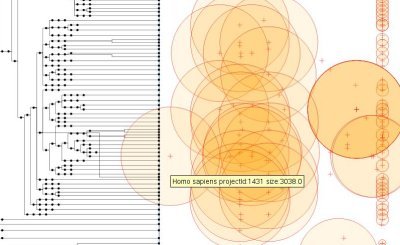
The program I wrote reads this XML file and generates the following visualization:
The left part is the tree of the NCBI taxonomy. In front of each taxon, the circles on the right are the Genome Projects. The size of a circle is the log10 of the estimated size of the genome (if available). The position on the x-axis of those circles is the date given by the tag "<p:CreateDate>".
There are two main classes: A Taxon is a node in the NCBI taxonomy, it contains a link to his children and to his parent:
class Taxon:
def __init__(self):
self.id=-1
self.name=None
self.parent=None
self.children=set()
. A Project is an item in the XML file. It contains a link to a Taxon:
class Project:
def __init__(self):
self.id=-1
self.taxon=None
self.genomeSize=None
self.date=None
The XML file is processed with a SAX handler. Each time a new project is found, the corresponding taxon is downloaded :
class GPHandler(handler.ContentHandler):
LIMIT=1E7
SLEEP=0
def __init__(self,owner):
self.owner=owner
self.content=None
self.project=None

(...)

def startElementNS(self,name,qname,attrs):
if name[1]=="Document":
self.project=Project()
elif name[1] in ["ProjectID","TaxID","CreateDate","EstimatedGenomeSize"] :
self.content=""

def endElementNS(self,name,qname):
if name[1]=="Document":
if len(self.owner.id2project)<GPHandler.LIMIT:
self.owner.id2project[self.project.id]= self.project
self.project=None
elif name[1]=="TaxID":
if len(self.owner.id2project)<GPHandler.LIMIT:
self.project.taxon=self.owner.findTaxonById(int(self.content))
time.sleep(GPHandler.SLEEP) #don't be evil with NCBI
elif name[1]=="ProjectID":
self.project.id=int(self.content)
sys.stderr.write("Project id:"+self.content+" n="+str(len(self.owner.id2project))+"\n")
elif name[1]=="EstimatedGenomeSize" and len(self.content)>0:
self.project.genomeSize=float(self.content)
elif name[1]=="CreateDate":
self.project.date=self.sql2date(self.content)
self.content=None
def characters(self,content):
if self.content!=None:
self.content+=content
The XML description of each taxons is downloaded and parsed using the NCBI EFetch service. A XML for a taxon looks like this:
<TaxaSet>
<Taxon>
<TaxId>240015</TaxId>
<ScientificName>Acidobacterium capsulatum ATCC 51196</ScientificName>
<OtherNames>
<EquivalentName>Acidobacterium capsulatum strain ATCC 51196</EquivalentName>
<EquivalentName>Acidobacterium capsulatum str. ATCC 51196</EquivalentName>
</OtherNames>
<ParentTaxId>33075</ParentTaxId>
<Rank>no rank</Rank>
<Division>Bacteria</Division>
<GeneticCode>
<GCId>11</GCId>
<GCName>Bacterial, Archaeal and Plant Plastid</GCName>
</GeneticCode>
<MitoGeneticCode>
<MGCId>0</MGCId>
<MGCName>Unspecified</MGCName>
</MitoGeneticCode>
<Lineage>cellular organisms; Bacteria; Fibrobacteres/Acidobacteria group; Acidobacteria; Acidobacteria (class); Acidobacteriales; Acidobacteriaceae; Acidobacterium; Acidobacterium capsulatum</Lineage>
<LineageEx>
<Taxon>
<TaxId>131567</TaxId>
<ScientificName>cellular organisms</ScientificName>
<Rank>no rank</Rank>
</Taxon>
<Taxon>
<TaxId>2</TaxId>
<ScientificName>Bacteria</ScientificName>
<Rank>superkingdom</Rank>
</Taxon>
<Taxon>
<TaxId>131550</TaxId>
<ScientificName>Fibrobacteres/Acidobacteria group</ScientificName>
<Rank>superphylum</Rank>
</Taxon>
<Taxon>
<TaxId>57723</TaxId>
<ScientificName>Acidobacteria</ScientificName>
<Rank>phylum</Rank>
</Taxon>
<Taxon>
<TaxId>204432</TaxId>
<ScientificName>Acidobacteria (class)</ScientificName>
<Rank>class</Rank>
</Taxon>
<Taxon>
<TaxId>204433</TaxId>
<ScientificName>Acidobacteriales</ScientificName>
<Rank>order</Rank>
</Taxon>
<Taxon>
<TaxId>204434</TaxId>
<ScientificName>Acidobacteriaceae</ScientificName>
<Rank>family</Rank>
</Taxon>
<Taxon>
<TaxId>33973</TaxId>
<ScientificName>Acidobacterium</ScientificName>
<Rank>genus</Rank>
</Taxon>
<Taxon>
<TaxId>33075</TaxId>
<ScientificName>Acidobacterium capsulatum</ScientificName>
<Rank>species</Rank>
</Taxon>
</LineageEx>
<CreateDate>2003/07/25</CreateDate>
<UpdateDate>2005/01/19</UpdateDate>
<PubDate>2005/01/29</PubDate>
</Taxon>
</TaxaSet>
This time I used a DOM implementation for python to analyse the file:
def findTaxonById(self,taxId):
if taxId in self.id2taxon:
return self.id2taxon[taxId]

url="http://eutils.ncbi.nlm.nih.gov/entrez/eutils/efetch.fcgi?db=taxonomy&retmode=xml&id="+str(taxId)
new_taxon=Taxon()
new_taxon.id=taxId
new_taxon.parent

dom = xml.dom.minidom.parse(urllib.urlopen(url))
top= dom.documentElement
e1= self.first(top,"Taxon")
new_taxon.name = self.textContent(self.first(e1,"ScientificName"))

lineage=[]
lineage.append(self.taxonRoot)
for e2 in self.elements(self.first(e1,"LineageEx"),"Taxon"):
t2=Taxon()
t2.id= int(self.textContent(self.first(e2,"TaxId")))
t2.name= self.textContent(self.first(e2,"ScientificName"))
if t2.id in self.id2taxon:
t2= self.id2taxon[t2.id]
else:
self.id2taxon[t2.id]=t2
lineage.append(t2)
lineage.append(new_taxon)

i=1
while i < len(lineage):
lineage[i-1].children.add(lineage[i])
lineage[i].parent=lineage[i-1]
i+=1

self.id2taxon[new_taxon.id]=new_taxon
return new_taxon
At the end, the figure is generated using SVG:

Source code

#Author Pierre Lindenbaum
#Mail: plindenbaum@yahoo.fr
#WWW: http://plindenbaum.blogspot.com
#usage:
# wget -O gp.xml "ftp://ftp.ncbi.nih.gov/genomes/genomeprj/gp.xml"
# python gp.py gp.xml
from xml.sax import make_parser, handler,saxutils
import sys,time,math,pickle,os.path
import xml.dom.minidom
import urllib


class SVG:
NS="http://www.w3.org/2000/svg"
class XLINK:
NS="http://www.w3.org/1999/xlink"


class Main:
DB_FILE="gp.db"
def __init__(self):
self.id2project=dict()
self.id2taxon=dict()
self.min_size=1.0E13
self.max_size=0.0
self.min_date=1.0E13
self.max_date=0.0
self.taxonRoot=Taxon()
self.taxonRoot.id=0
self.taxonRoot.name="Tree of Life"
self.id2taxon[self.taxonRoot.id]=self.taxonRoot

def escape(self,s):
x=""
for c in s:
if c=='<':
x+="&lt;"
elif c=='>':
x+="&gt;"
elif c=='&':
x+="&amp;"
elif c=='\'':
x+="&apos;"
elif c=='\'':
x+="&quot;"
else:
x+=c
return x

def first(self,root,name):
for c1 in root.childNodes:
if c1.nodeType!= xml.dom.minidom.Node.ELEMENT_NODE or \
c1.nodeName!=name:
continue
return c1
return None
def elements(self,root,name):
a=[]
for c1 in root.childNodes:
if c1.nodeType!= xml.dom.minidom.Node.ELEMENT_NODE or \
c1.nodeName!=name:
continue
a.append(c1)
return a

def textContent(self,root):
content=""
for c1 in root.childNodes:
if c1.nodeType== xml.dom.minidom.Node.TEXT_NODE:
content+= c1.nodeValue
else:
content+=self.textContent(c1)
return content

def findTaxonById(self,taxId):
if taxId in self.id2taxon:
return self.id2taxon[taxId]

url="http://eutils.ncbi.nlm.nih.gov/entrez/eutils/efetch.fcgi?db=taxonomy&retmode=xml&id="+str(taxId)
sys.stderr.write(url+"\n")

new_taxon=Taxon()
new_taxon.id=taxId
new_taxon.parent

dom = xml.dom.minidom.parse(urllib.urlopen(url))
top= dom.documentElement
e1= self.first(top,"Taxon")
new_taxon.name = self.textContent(self.first(e1,"ScientificName"))

lineage=[]
lineage.append(self.taxonRoot)
for e2 in self.elements(self.first(e1,"LineageEx"),"Taxon"):
t2=Taxon()
t2.id= int(self.textContent(self.first(e2,"TaxId")))
t2.name= self.textContent(self.first(e2,"ScientificName"))
if t2.id in self.id2taxon:
t2= self.id2taxon[t2.id]
else:
self.id2taxon[t2.id]=t2
lineage.append(t2)
lineage.append(new_taxon)

i=1
while i < len(lineage):
lineage[i-1].children.add(lineage[i])
lineage[i].parent=lineage[i-1]
i+=1

self.id2taxon[new_taxon.id]=new_taxon
return new_taxon

def svg(self):
width= 1000
height=10000
for p in self.id2project.values():
if p.genomeSize!=None:
self.min_size = min(self.min_size, p.genomeSize)
self.max_size = max(self.max_size, p.genomeSize)
self.min_date = min(self.min_date, p.date)
self.max_date = max(self.max_date, p.date)
shift= (self.max_date-self.min_date)*0.05
self.min_date-=shift
self.max_date+=shift
sys.stderr.write(" size:"+str(self.min_size)+"/"+str(self.max_size))
sys.stderr.write(" date:"+str(self.min_date)+"/"+str(self.max_date))
print "<?xml version='1.0' encoding='UTF-8'?>"
print "<svg xmlns='"+SVG.NS+"' xmlns:xlink='"+XLINK.NS+"' "+\
"width='"+str(width+1)+"' "+\
"height='"+str(height+1)+"' "+\
"style='stroke:black;fill:none;stroke-width:0.5px;' "+\
"><title>Genome Projects</title>"
print "<rect x='0' y='0' width='"+str(width/2.0)+"' height='"+str(height)+"' style='stroke:green;'/>"
print "<rect x='"+str(1+width/2.0)+"' y='0' width='"+str(width/2.0)+"' height='"+str(height)+"' style='stroke:blue;'/>"
self.recurs(self.taxonRoot,0,0,width/2,height,(width/2.0)/self.taxonRoot.depth())
print "</svg>"
def recurs(self,taxon,x,y,width,height,h_size):
total=0.0
midy=y+height/2.0
print "<circle cx='"+str(x)+"' cy='"+str(midy)+"' r='"+str(2)+"' title='"+self.escape(taxon.name)+"' style='fill:black;'/>"

for p in self.id2project.values():
if p.taxon!=taxon:
continue
cx= width+ ((p.date - self.min_date)/(self.max_date - self.min_date))*width
cy= midy
print "<a target='ncbi' title='"+self.escape(taxon.name)+" projectId:"+str(p.id)+" size:"+str(p.genomeSize)+"' xlink:href='http://www.ncbi.nlm.nih.gov/sites/entrez?Db=genomeprj&amp;cmd=ShowDetailView&amp;TermToSearch="+str(p.id)+"'>"
print "<g style='stroke:red;' >"
if p.genomeSize!=None:
radius=max(2.0,((math.log10(p.genomeSize) - math.log10(self.min_size))/(math.log10(self.max_size) - math.log10(self.min_size)))*100.0)
print "<circle cx='"+str(cx)+"' cy='"+str(cy)+"' r='"+str(radius)+"' style='fill:orange;fill-opacity:0.1;'/>"
print "<line x1='"+str(cx-5)+"' y1='"+str(cy)+"' x2='"+str(cx+5)+"' y2='"+str(cy)+"'/>"
print "<line x1='"+str(cx)+"' y1='"+str(cy-5)+"' x2='"+str(cx)+"' y2='"+str(cy+5)+"'/>"
print "</g></a>"

for c in taxon.children:
total+= c.weight()
for c in taxon.children:
h2=height* (c.weight()/total)
y2=y+h2/2.0
w2=h_size
if len(c.children)==0:
w2=width-x
print "<polyline points='"+\
str(x)+","+str(midy)+" "+\
str(x+w2/2.0)+","+str(midy)+" "+\
str(x+w2/2.0)+","+str(y2)+" "+\
str(x+w2)+","+str(y2)+" "+\
"' title='"+self.escape(c.name)+"'/>"
self.recurs(c,x+w2,y,width,h2,w2)
y+=h2


class Taxon:
def __init__(self):
self.id=-1
self.name=None
self.parent=None
self.children=set()
def __hash__(self):
return self.id.__hash__()
def __eq__(self,other):
if other==None:
return False
return self.id==other.id
def weight(self):
w=1
for t in self.children:
w+= t.weight()
return w
def depth(self):
##sys.stderr.write(self.name+"\n")
d=0.0
for t in self.children:
d= max(t.depth(),d)
return 1.0+d

class Project:
def __init__(self):
self.id=-1
self.taxon=None
self.genomeSize=None
self.date=None

class GPHandler(handler.ContentHandler):
LIMIT=1E7
SLEEP=0
def __init__(self,owner):
self.owner=owner
self.content=None
self.project=None
def sql2date(self,s):
s=s[:s.index(' ')]
cal =time.mktime( time.strptime(s,"%m/%d/%Y") )
return cal
def startElementNS(self,name,qname,attrs):
if name[1]=="Document":
self.project=Project()
elif name[1] in ["ProjectID","TaxID","CreateDate","EstimatedGenomeSize"] :
self.content=""
def endElementNS(self,name,qname):
if name[1]=="Document":
if len(self.owner.id2project)<GPHandler.LIMIT:
self.owner.id2project[self.project.id]= self.project
self.project=None
elif name[1]=="TaxID":
if len(self.owner.id2project)<GPHandler.LIMIT:
self.project.taxon=self.owner.findTaxonById(int(self.content))
time.sleep(GPHandler.SLEEP) #don't be evil with NCBI
elif name[1]=="ProjectID":
self.project.id=int(self.content)
sys.stderr.write("Project id:"+self.content+" n="+str(len(self.owner.id2project))+"\n")
elif name[1]=="EstimatedGenomeSize" and len(self.content)>0:
self.project.genomeSize=float(self.content)
elif name[1]=="CreateDate":
self.project.date=self.sql2date(self.content)
self.content=None
def characters(self,content):
if self.content!=None:
self.content+=content


main=Main();
sys.stderr.write(main.escape("<>!")+"\n")
parser = make_parser()
# we want XML namespaces
parser.setFeature(handler.feature_namespaces,True)
# tell parser to disable validation
parser.setFeature(handler.feature_validation,False)
parser.setFeature(handler.feature_external_ges, False)
parser.setContentHandler(GPHandler(main))
parser.parse(sys.argv[1])

main.svg()


That's it,

Pierre