Presentation : File formats for Next Generation Sequencing
Here is my presentation for the course "File formats for Next Generation Sequencing", I gave monday at the University of Nantes.
Here is my presentation for the course "File formats for Next Generation Sequencing", I gave monday at the University of Nantes.
Here is my presentation for the course "Advanced NCBI", I gave yesterday at the University of Nantes.
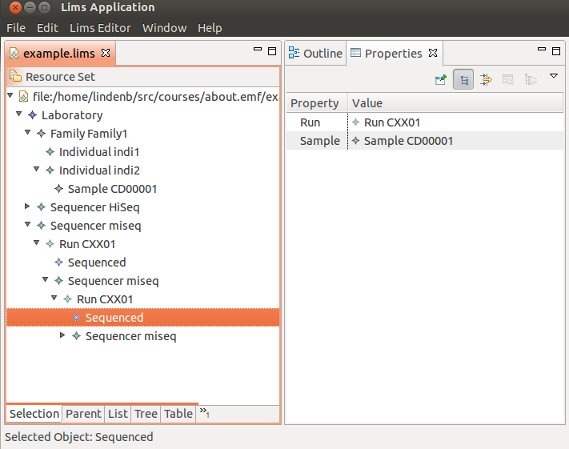
I played with the Eclipse Modeling Framework (EMF) and created a simple interface to manage a list of sequenced samples.
In order to create a class to translate the chromosome names from one naming convention to another. I've compared the MD5 sums of the human genome versions g1k/v37 and ucsc/hg19. Here is the java program to create the MD5s:
The MD5 sums were extracted as follow:
Here are the common chromosomes, joined on the hash-sum:
And here are the unpairable data:
I knew the problem for chrY ( http://www.biostars.org/p/58143/) but not for chr3.. What is the problem for this chromosome ?
Edit: Here are the number of bases for UCSC/chr3:
{T=58760485, G=38670110, A=58713343, C=38653197, N=3225295}and for g1kv37:{T=58760485, G=38670110, A=58713343, R=2, C=38653197, M=1, N=3225292}http://www.knime.org/ is "a user-friendly graphical workbench for the entire analysis process: data access, data transformation, initial investigation, powerful predictive analytics, visualisation and reporting". In this post, I'll show how to invoke an external java program, and more precisely a tool from the picard library from with knime. The workflow: load a list of BAM filenames, invoke SortSam and display the names of the sorted files.
Construct the following workflow:

Edit the FileReader node and load a list of paths to the BAMs

Edit the properties of the java node, in the "Additional Libraries" tab, load the jar of SortSam.jar

Edit the java snippet node, create a new column SORTED_BAM for the output.

and copy the following code:
// Your custom imports:
import net.sf.picard.sam.SortSam;
import java.io.File;
----------------------------------------------------------
// Enter your code here:


File input=new File(c_BAM);

//build the output filename
out_SORTED = input.getName();
if(!(out_SORTED.endsWith(".sam") || out_SORTED.endsWith(".bam")))
{
 throw new Abort("not a SAM/BAM :"+c_BAM);
}
int dot=out_SORTED.lastIndexOf('.');
out_SORTED=new File(input.getParentFile(),out_SORTED.substring(0, dot)+"_sorted.bam").getPath();

//create a new instance of SortSam
SortSam cmd=new SortSam();

//invoke the instance
int ret=cmd.instanceMain(new String[]{
 "I="+input.getPath(),
 "O="+out_SORTED,
 "SO=coordinate",
 "VALIDATION_STRINGENCY=LENIENT",
 "CREATE_INDEX=true",
 "MAX_RECORDS_IN_RAM=500000"
 });

if(ret!=0)
{
 throw new Abort("SortSam failed with: "+c_BAM+" "+out_SORTED);
}
Execute KNIME, picard runs the job, and get the names of the sorted BAMs:

Let's annotate a VCF file with the data from the NCBI biosystem.
First the 'NCBI biosystem' data are mapped to a BED file using the following script. It joins "ncbi;biosystem2gene", "ncbi:biosystem-label" and "biomart-ensembl:gene"
It produces a tabix-inded BED mapping the data of 'NCBI biosystem':
$ gunzip -c ncbibiosystem.bed.gz | head
1 69091 70008 79501 106356 30 Signaling_by_GPCR
1 69091 70008 79501 106383 50 Olfactory_Signaling_Pathway
1 69091 70008 79501 119548 40 GPCR_downstream_signaling
1 69091 70008 79501 477114 30 Signal_Transduction
1 69091 70008 79501 498 40 Olfactory_transduction
1 69091 70008 79501 83087 60 Olfactory_transduction
1 367640 368634 26683 106356 30 Signaling_by_GPCR
1 367640 368634 26683 106383 50 Olfactory_Signaling_Pathway
1 367640 368634 26683 119548 40 GPCR_downstream_signaling
1 367640 368634 26683 477114 30 Signal_Transduction
java -jar dist/vcfbed.jar \
   TABIXFILE=~/ncbibiosystem.bed.gz \
   TAG=NCBIBIOSYS \
   FMT='($4|$5|$6|$7)'|\
grep -E '(^#CHR|NCBI)'
##INFO=<ID=NCBIBIOSYS,Number=.,Type=String,Description="metadata added from /home/lindenb/ncbibiosystem.bed.gz . Format was ($4|$5|$6|$7)">

#CHROM POS ID REF ALT QUAL FILTER INFO FORMAT 1094PC0005 1094PC0009 1094PC0012 1094PC0013
1 69270 . A G 2694.18 . AC=40;AF=1.000;AN=40;DP=83;Dels=0.00;EFF=SYNONYMOUS_CODING(LOW|SILENT|tcA/tcG|S60|305|OR4F5|protein_coding|CODING|ENST00000335137|exon_1_69091_70008);FS=0.000;HRun=0;HaplotypeScore=0.0000;InbreedingCoeff=-0.0598;MQ=31.06;MQ0=0;NCBIBIOSYS=(79501|119548|40|GPCR_downstream_signaling),(79501|106356|30|Signaling_by_GPCR),(79501|498|40|Olfactory_transduction),(79501|83087|60|Olfactory_transduction),(79501|477114|30|Signal_Transduction),(79501|106383|50|Olfactory_Signaling_Pathway);QD=32.86 GT:AD:DP:GQ:PL ./. ./. 1/1:0,3:3:9.03:106,9,0 1/1:0,6:6:18.05:203,18,0
1 69511 . A G 77777.27 . AC=49;AF=0.875;AN=56;BaseQRankSum=0.150;DP=2816;DS;Dels=0.00;EFF=NON_SYNONYMOUS_CODING(MODERATE|MISSENSE|Aca/Gca|T141A|305|OR4F5|protein_coding|CODING|ENST00000335137|exon_1_69091_70008);FS=21.286;HRun=0;HaplotypeScore=3.8956;InbreedingCoeff=0.0604;MQ=32.32;MQ0=0;MQRankSum=1.653;NCBIBIOSYS=(79501|119548|40|GPCR_downstream_signaling),(79501|106356|30|Signaling_by_GPCR),(79501|498|40|Olfactory_transduction),(79501|83087|60|Olfactory_transduction),(79501|477114|30|Signal_Transduction),(79501|106383|50|Olfactory_Signaling_Pathway);QD=27.68;ReadPosRankSum=2.261 GT:AD:DP:GQ:PL ./. ./. 0/1:2,4:6:15.70:16,0,40 0/1:2,2:4:21.59:22,0,40
The UCSC has recently created the Genome Browser Track Hubs: " Track hubs are web-accessible directories of genomic data that can be viewed on the UCSC Genome Browser. ". I've created a Hub for the Rotavirus Genome hosted on github at:https://github.com/lindenb/genomehub.
My data were primarily described as a XML file. It contains a description of the genome, of the tracks, the path to the fasta sequence etc... The FASTA sequence was provided by Dr Didier Poncet (CNRS/Gig). As far as I understand, it is not currently possible to specify that a track describes a protein.
<?xml version="1.0" encoding="UTF-8"?>
<genomeHub >
  <name>Rotavirus</name>
  <shortLabel>Rotavirus</shortLabel>
  <longLabel>Rotavirus</longLabel>
  (...)
  <accessions id="set1">
   <acn>GU144588</acn>
 <acn source="uniprot">Q0H8C5</acn>
 <acn source="uniprot">Q45UF6</acn>
 (..)
  <genome id="rf11">
    <description>Rotavirus RF11</description>
    <organism>Rotavirus</organism>
    <defaultPos>RF01:1-10</defaultPos>
    <scientificName>Rotavirus</scientificName>
    <organism>Rotavirus</organism>
    <orderKey>10970</orderKey>
    <fasta>rotavirus/rf/rf.fa</fasta>
     (...)
 <group id="active_site"><accessions ref="set1"/><include>active site</include></group>
 <group id="calcium-binding_region"><accessions ref="set1"/><include>calcium-binding region</include></group>
 <group id="chain"><accessions ref="set1"/><include>chain</include></group>
   (...)
This XML file is then processed with the following xsl stylsheet: https://github.com/lindenb/genomehub/blob/master/data/genomehub.xml : it generates a Makefile that will translate the fasta sequence to 2bit, create the bed files by aligning some annotated files to the reference with blast and convert them to bigbed../data/genomehub.xml ./data/genomehub2make.xsl ./data/sequence2fasta.xsl ./data/hub.txt ./data/genomes.txt ./data/rotavirus ./data/rotavirus/rf ./data/rotavirus/rf/signal_peptide.bed ./data/rotavirus/rf/CDS.bed ./data/rotavirus/rf/turn.bb ./data/rotavirus/rf/chrom.sizes ./data/rotavirus/rf/site.bed ./data/rotavirus/rf/coiled-coil_region.bed ./data/rotavirus/rf/mutagenesis_site.bb ./data/rotavirus/rf/UTR.bed ./data/rotavirus/rf/reference.fa~ ./data/rotavirus/rf/misc_feature.bed ./data/rotavirus/rf/CDS.bb ./data/rotavirus/rf/helix.bed ./data/rotavirus/rf/strand.bb ./data/rotavirus/rf/sequence_conflict.bb ./data/rotavirus/rf/modified_residue.bb ./data/rotavirus/rf/coiled-coil_region.bb ./data/rotavirus/rf/topological_domain.bb ./data/rotavirus/rf/active_site.bed ./data/rotavirus/rf/sequence_variant.bb ./data/rotavirus/rf/transmembrane_region.bb ./data/rotavirus/rf/zinc_finger_region.bed ./data/rotavirus/rf/region_of_interest.bb ./data/rotavirus/rf/glycosylation_site.bb ./data/rotavirus/rf/domain.bb ./data/rotavirus/rf/region_of_interest.bed ./data/rotavirus/rf/misc_feature.bb ./data/rotavirus/rf/topological_domain.bed ./data/rotavirus/rf/sequence_conflict.bed ./data/rotavirus/rf/UTR.bb ./data/rotavirus/rf/compositionally_biased_region.bed ./data/rotavirus/rf/chain.bed ./data/rotavirus/rf/glycosylation_site.bed ./data/rotavirus/rf/trackDb.txt ./data/rotavirus/rf/modified_residue.bed ./data/rotavirus/rf/disulfide_bond.bed ./data/rotavirus/rf/strand.bed ./data/rotavirus/rf/helix.bb ./data/rotavirus/rf/compositionally_biased_region.bb ./data/rotavirus/rf/transmembrane_region.bed ./data/rotavirus/rf/rf.fa ./data/rotavirus/rf/rf.2bit ./data/rotavirus/rf/splice_variant.bed ./data/rotavirus/rf/short_sequence_motif.bed ./data/rotavirus/rf/rf.fa.nsq ./data/rotavirus/rf/ALL.bed.blast.xml~ ./data/rotavirus/rf/gene.bed ./data/rotavirus/rf/sequence_variant.bed ./data/rotavirus/rf/disulfide_bond.bb ./data/rotavirus/rf/signal_peptide.bb ./data/rotavirus/rf/rf.fa.nin ./data/rotavirus/rf/short_sequence_motif.bb ./data/rotavirus/rf/turn.bed ./data/rotavirus/rf/domain.bed ./data/rotavirus/rf/mutagenesis_site.bed ./data/rotavirus/rf/zinc_finger_region.bb ./data/rotavirus/rf/chain.bb ./data/rotavirus/rf/rf.fa.nhr ./data/rotavirus/rf/splice_variant.bb ./data/rotavirus/rf/active_site.bb ./data/rotavirus/rf/site.bb ./data/rotavirus/rf/description.html ./README.md

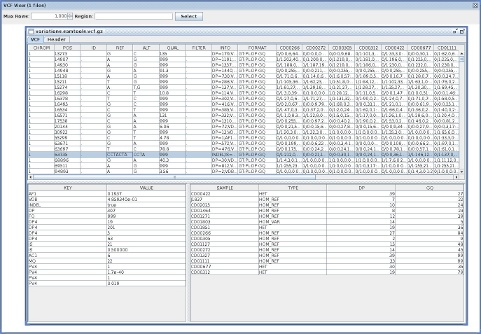
A quick note about three java-based tools for VCF files I wrote today.
$ java -jar dist/vcfgo.jar I="https://raw.github.com/arq5x/gemini/master/test/tes.snpeff.vcf" |\
    grep -v -E '^##' | head -n 3

#CHROM  POS ID  REF ALT QUAL    FILTER  INFO    FORMAT  1094PC0005  1094PC0009  1094PC0012  1094PC0013
chr1    30860   .   G   C   33.46   .   AC=2;AF=0.053;AN=38;BaseQRankSum=2.327;DP=49;Dels=0.00;EFF=DOWNSTREAM(MODIFIER||||85|FAM138A|protein_coding|CODING|ENST00000417324|),DOWNSTREAM(MODIFIER|||||FAM138A|processed_transcript|CODING|ENST00000461467|),DOWNSTREAM(MODIFIER|||||MIR1302-10|miRNA|NON_CODING|ENST00000408384|),INTRON(MODIFIER|||||MIR1302-10|antisense|NON_CODING|ENST00000469289|),INTRON(MODIFIER|||||MIR1302-10|antisense|NON_CODING|ENST00000473358|),UPSTREAM(MODIFIER|||||WASH7P|unprocessed_pseudogene|NON_CODING|ENST00000423562|),UPSTREAM(MODIFIER|||||WASH7P|unprocessed_pseudogene|NON_CODING|ENST00000430492|),UPSTREAM(MODIFIER|||||WASH7P|unprocessed_pseudogene|NON_CODING|ENST00000438504|),UPSTREAM(MODIFIER|||||WASH7P|unprocessed_pseudogene|NON_CODING|ENST00000488147|),UPSTREAM(MODIFIER|||||WASH7P|unprocessed_pseudogene|NON_CODING|ENST00000538476|);FS=3.128;HRun=0;HaplotypeScore=0.6718;InbreedingCoeff=0.1005;MQ=36.55;MQ0=0;MQRankSum=0.217;QD=16.73;ReadPosRankSum=2.017 GT:AD:DP:GQ:PL  0/0:7,0:7:15.04:0,15,177    0/0:2,0:2:3.01:0,3,39   0/0:6,0:6:12.02:0,12,143    0/0:4,0:4:9.03:0,9,119
chr1    69270   .   A   G   2694.18 .   AC=40;AF=1.000;AN=40;DP=83;Dels=0.00;EFF=SYNONYMOUS_CODING(LOW|SILENT|tcA/tcG|S60|305|OR4F5|protein_coding|CODING|ENST00000335137|exon_1_69091_70008);FS=0.000;GOA=OR4F5|GO:0004984&GO:0005886&GO:0004930&GO:0016021;HRun=0;HaplotypeScore=0.0000;InbreedingCoeff=-0.0598;MQ=31.06;MQ0=0;QD=32.86   GT:AD:DP:GQ:PL  ./. ./. 1/1:0,3:3:9.03:106,9,0  1/1:0,6:6:18.05:203,18,0
$  java -jar dist/vcffiltergo.jar I="https://raw.github.com/arq5x/gemini/master/test/test1.snpeff.vcf"  \
    CHILD_OF=GO:0005886 FILTER=MEMBRANE  |\
    grep -v "^##"   | head -n 3

#CHROM  POS ID  REF ALT QUAL    FILTER  INFO    FORMAT  1094PC0005  1094PC0009  1094PC0012  1094PC0013
chr1    30860   .   G   C   33.46   PASS    AC=2;AF=0.053;AN=38;BaseQRankSum=2.327;DP=49;Dels=0.00;EFF=DOWNSTREAM(MODIFIER||||85|FAM138A|protein_coding|CODING|ENST00000417324|),DOWNSTREAM(MODIFIER|||||FAM138A|processed_transcript|CODING|ENST00000461467|),DOWNSTREAM(MODIFIER|||||MIR1302-10|miRNA|NON_CODING|ENST00000408384|),INTRON(MODIFIER|||||MIR1302-10|antisense|NON_CODING|ENST00000469289|),INTRON(MODIFIER|||||MIR1302-10|antisense|NON_CODING|ENST00000473358|),UPSTREAM(MODIFIER|||||WASH7P|unprocessed_pseudogene|NON_CODING|ENST00000423562|),UPSTREAM(MODIFIER|||||WASH7P|unprocessed_pseudogene|NON_CODING|ENST00000430492|),UPSTREAM(MODIFIER|||||WASH7P|unprocessed_pseudogene|NON_CODING|ENST00000438504|),UPSTREAM(MODIFIER|||||WASH7P|unprocessed_pseudogene|NON_CODING|ENST00000488147|),UPSTREAM(MODIFIER|||||WASH7P|unprocessed_pseudogene|NON_CODING|ENST00000538476|);FS=3.128;HRun=0;HaplotypeScore=0.6718;InbreedingCoeff=0.1005;MQ=36.55;MQ0=0;MQRankSum=0.217;QD=16.73;ReadPosRankSum=2.017 GT:AD:DP:GQ:PL  0/0:7,0:7:15.04:0,15,177    0/0:2,0:2:3.01:0,3,39   0/0:6,0:6:12.02:0,12,143    0/0:4,0:4:9.03:0,9,119
chr1    69270   .   A   G   2694.18 MEMBRANE    AC=40;AF=1.000;AN=40;DP=83;Dels=0.00;EFF=SYNONYMOUS_CODING(LOW|SILENT|tcA/tcG|S60|305|OR4F5|protein_coding|CODING|ENST00000335137|exon_1_69091_70008);FS=0.000;HRun=0;HaplotypeScore=0.0000;InbreedingCoeff=-0.0598;MQ=31.06;MQ0=0;QD=32.86 GT:AD:DP:GQ:PL  ./. ./. 1/1:0,3:3:9.03:106,9,0  1/1:0,6:6:18.05:203,18,0
This post is the answer to my own question on biostar "BLASTN / TBLASTN : mapping the features of the query to the hit.". I wrote a java program to map the annotations of a sequence to the Hit of a Blast result. The tool is available on github at https://github.com/lindenb/jvarkit.
For example, say you want to map the features of the Uniprot record for Rotavirus NSP3 (http://www.uniprot.org/uniprot/P04514) on Genbank http://www.ncbi.nlm.nih.gov/nuccore/AY065842.1 (RNA).
Download P04514 as XML
TblastN P04514(protein) vs AY065842 (RNA) and save the BLAST result as XML:
<BlastOutput_program>tblastn</BlastOutput_program>
  <BlastOutput_version>TBLASTN 2.2.28+</BlastOutput_version>
(...)
<Hit>
  <Hit_num>1</Hit_num>
  <Hit_id>gi|18139606|gb|AY065842.1|</Hit_id>
  <Hit_def>AY065842</Hit_def>
  <Hit_accession>AY065842</Hit_accession>
  <Hit_len>1078</Hit_len>
  <Hit_hsps>
    <Hsp>
      <Hsp_num>1</Hsp_num>
      <Hsp_bit-score>546.584</Hsp_bit-score>
      <Hsp_score>1407</Hsp_score>
      <Hsp_evalue>0</Hsp_evalue>
      <Hsp_query-from>1</Hsp_query-from>
      <Hsp_query-to>313</Hsp_query-to>
      <Hsp_hit-from>26</Hsp_hit-from>
      <Hsp_hit-to>964</Hsp_hit-to>
      <Hsp_query-frame>0</Hsp_query-frame>
      <Hsp_hit-frame>2</Hsp_hit-frame>
      <Hsp_identity>260</Hsp_identity>
      <Hsp_positive>260</Hsp_positive>
      <Hsp_gaps>0</Hsp_gaps>
      <Hsp_align-len>313</Hsp_align-len>
      <Hsp_qseq>MLKMESTQQMASSIINTSFEAAVVAATSTLELMGIQYDYNEIYTRVKSKFDYVMDDSGVKNNLLGKAATIDQALNGKFGSVMRNKNWMTDSRTVAKLDEDVNKLRMMLSSKGIDQKMRVLNACFSVKRIPGKSSSVIKCTRLMKDKIERGAVEVDDSFVEEKMEVDTVDWKSRYDQLERRFESLKQRVNEKYTTWVQKAKKVNENMYSLQNVISQQQNQIADLQNYCSKLEADLQNKVGSLVSSVEWYLKSMELPDEVKTDIEQQLNSIDTISPINAIDDLEILIRNLIHDYDRTFLMFKGLLRQCNYEYAYE</Hsp_qseq>
      <Hsp_hseq>MLKMESTQQMASSIINSSFEAAVVAATSTLELMGIQYDYNEVYTRVKSKFDLVMDDSGVKNNLIGKAITIDQALNGKFSSAIRNRNWMTDSRTVAKLDEDVNKLRIMLSSKGIDQKMRVLNACFSVKRIPGKSSSIVKCTRLMKDKLERGEVEVDDSFVEEKMEVDTIDWKSRYEQLEKRFESLKHRVNEKYNHWVLKARKVNENMNSLQNVISQQQAHINELQMYNNKLERDLQSKIGSVVSSIEWYLRSMELSDDVKSDIEQQLNSIDQLNPVNAIDDFESILRNLISDYDRLFIMFKGLLQQCNYTYTYE</Hsp_hseq>
      <Hsp_midline>MLKMESTQQMASSIIN SFEAAVVAATSTLELMGIQYDYNE YTRVKSKFD VMDDSGVKNNL GKA TIDQALNGKF S  RN NWMTDSRTVAKLDEDVNKLR MLSSKGIDQKMRVLNACFSVKRIPGKSSS  KCTRLMKDK ERG VEVDDSFVEEKMEVDT DWKSRY QLE RFESLK RVNEKY  WV KA KVNENM SLQNVISQQQ  I  LQ Y  KLE DLQ K GS VSS EWYL SMEL D VK DIEQQLNSID   P NAIDD E   RNLI DYDR F MFKGLL QCNY Y YE</Hsp_midline>
    </Hsp>
   (..)
Now generate a BED file to map the features of P04514 on AY065842: $ java -jar dist/blastmapannots.jar I=P04514.xml B=blast.xml AY065842 25 961 Non-structural_protein_3 943 + 25961 255,255,255 1 936 25 AY065842 34 469 RNA-binding 970 + 34 469 255,255,255 1 435 34 AY065842 472 640 Dimerization 947 + 472 640 255,255,255 1 168 472 AY065842 532 724 Interaction_with_ZC3H7B 917 + 532 724 255,255,255 1 192 532 AY065842 646 961 Interaction_with_EIF4G1 905 + 646 961 255,255,255 1 315 646 AY065842 520 733 coiled-coil_region 916 + 520 733 255,255,255 1 213 520
Here is a screenshot of Thunderbird with the RSS feeds for "NCBI/pubmed: Exome Sequencing".
I'm pretty sure that all that (semantic) information is lost.

